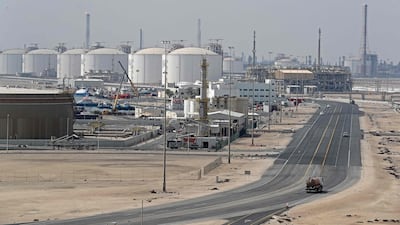

Reopening the Strait of Hormuz will not return Qatari and UAE liquefied natural gas exports to normal, with damaged facilities and soaring insurance costs set to keep supplies constrained for months or years, gas executives said on Monday.
About 17 per cent of Qatar’s LNG capacity is offline after Iranian strikes damaged two of its 14 export trains, removing 12.8 million tonnes a year from the market. QatarEnergy has said repairs will take three to five years, meaning even a safe reopening of Hormuz would restore access to only part of Qatar’s prewar supply.
“First of all, you have reopening, and then you have restoration. Those are still two very different things,” Cederic Cremers, Shell’s president of integrated gas, told the Gastech conference in Bangkok. “Even if we would see a normalisation or reopening of the Strait of Hormuz, I don’t think you would immediately go back to the type of flows that we saw before the war started.”
Structural damage
The other constraint is shipping, as the Strait of Hormuz is the only outlet for Qatari and Emirati LNG to international markets, with no alternative pipeline or seaborne routes. About a fifth of global LNG trade transited the strait in 2024, almost all of it from Qatar and the UAE, according to the International Energy Forum.
LNG tankers have also been slow to return to the Gulf as war-risk insurance costs remain high and security concerns persist. Even with safe passage, restoring regular marine flows will take time, Mr Cremers said.
Shell’s Pearl gas-to-liquids plant in Qatar, whose two trains were hit by a missile early in the seven-month conflict, is expected to be back online towards the end of the first quarter of 2027. “It’s not just restoration of production capacity itself,” Mr Cremers said. “It is also restoration of the actual marine flows, which will not be overnight either.”
Some 36 million tonnes of Qatari and Emirati supply has been absent from the market year-to-date compared with 2025, Mr Cremers said. Roughly 20 million tonnes of the shortfall were offset by new volumes from the US and Canada, while the rest came from demand destruction and storage draws.
Limited cushioning
The global LNG market entered the February disruption with a thinner supply cushion than in previous years. In 2025, for the first time in nearly a decade, spare liquefaction capacity was insufficient to replace all the LNG moving through the Strait of Hormuz, leaving a replacement gap of about 10 million tonnes, according to a report published on Monday by the IEF and Japan's Jogmec.
The market has since absorbed about three-quarters of the volumes lost since early March, chiefly through higher US production and cargoes redirected to Asia. But the IEF cautions that nominal spare liquefaction capacity does not necessarily translate into deliverable LNG, with feedgas availability and shipping limiting how much supply can actually reach buyers.
The disruption has left Europe particularly exposed before winter. Gas storage across the continent is at historically low levels, while Asian buyers are competing for replacement cargoes. India sourced about 75 per cent of its LNG through Hormuz in 2024, while the share was 87 per cent for Pakistan and 71 per cent for Bangladesh.
Elevated gas prices
Guido Brusco, Eni’s chief operating officer for global natural resources, pushed back on the longer timelines.
“You can read many reports on three months, four months, five months. Generally, in our experience, our industry reacts much faster than what reports say.”
Mr Brusco declined to forecast prices, calling gas “one of the most studied commodities and the least predictable”.
Asian prices are up about 150 per cent year-to-date, European prices are up about 100 per cent. Asian buyers spent $7.8 billion on spot cargoes in the first nine months, against $3 billion a year earlier.
Peter Clarke, ExxonMobil’s senior vice president for LNG, said Qatar would re-enter the market “rapidly” once the strait opened, drawing on undamaged trains and expansions already well advanced.
“Qatar has been one of the most reliable suppliers in the world. It is a cornerstone of energy security.”
Falling prices would restore affordability, he said, while latent Asian regasification capacity would absorb volumes as economics improve. Where affordable gas is unavailable, countries are switching to higher-emission fuels.
Prolonged shortfall
Qatar is already preparing for a prolonged shortfall. QatarEnergy is seeking multiyear US LNG contracts to 2031 after previously relying on US spot cargoes to help meet commitments to Asian customers. The move suggests Doha expects damaged capacity to remain a constraint well beyond any reopening of Hormuz.
A new supply wave is hitting the markets nonetheless. Exxon’s Golden Pass delivered its first cargoes in March-April and will add 18 million tonnes; Mozambique – a further 18 million tonnes – is due for a final investment decision before year-end, with six million tonnes more from Papua New Guinea. Mr Clarke expects US LNG to make up about 30 per cent of global supply by 2030. Shell is growing its LNG sales by 4 per cent to 5 per cent a year from a base above 70 million tonnes, while Adnoc is targeting 47 million tonnes by 2035.
Long-term contracts
The IEF projects global trade of about 590 million tonnes by 2031, with the US adding 56.7 million tonnes and Qatar 34.5 million tonnes as Doha lifts capacity to 142 million tonnes a year by 2030, from 77 million.
The disruption is also changing how LNG buyers contract for supply, with long-term agreements and diversification gaining importance as companies seek protection against future disruptions.
“A long-term contract with diversified suppliers gives you that comfort that if one is not able to deliver, in three days’ time the other one will,” said Rashid Al Mazrouei, Adnoc’s chief marketing and origination officer for LNG. Single-project sourcing “has gone”, he said. Buyers left exposed to the spot market “can’t afford it”, Mr Cremers said.

