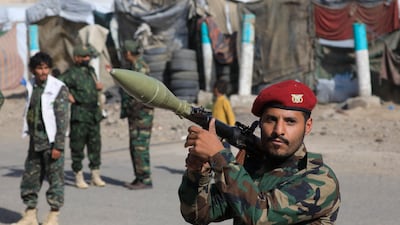

Houthi fighters were forced to redeploy in territory they had newly seized on Yemen's west coast after suffering “heavy losses” from strikes by pro-government forces, a Yemeni security source told The National.
The Iran-backed Houthi rebels admitted they had been targeted by dozens of air strikes on Saturday and Sunday in Al Bayda, Al Jawf, Hajjah, Lahij, Saada and Taiz.
Saudi Arabia leads a coalition that intervened in Yemen after the Houthi takeover of the capital Sanaa in 2014. Saudi Arabia has not confirmed carrying out attacks on Houthi positions but has been repeatedly targeted by the group in recent weeks, most notably in Khamis Mushait, which is home to the King Khalid airbase and the East-West pipeline, with a full pumping capacity of seven million barrels of oil per day.

“The Houthis are attempting to minimise their visible human presence to avoid being targeted by air strikes, as the area is an open coastal desert,” the security source said. At the same time, the redeployment inside territory they seized only days ago restricts the rebels' access to the strategic Bab Al Mandeb.
“With high confidence, Houthi forces are no longer able to exercise effective control over the Bab Al Mandeb and have withdrawn most of their forces from the area,” Mohammed Al Basha, founder of the US-based risk advisory firm Basha Report, wrote on X. “Government forces have not yet fully secured the territory but sustained close air support has effectively denied the area to Houthi forces.”
The attacks on Houthi positions south of the rebel-controlled port of Hodeidah, near Bab Al Mandeb, took place within a “kill box” – a defined military target area – revealed by government forces on Saturday. A video released by Yemen's military purportedly shows strikes being carried out in Dhubab and Mokha, both of which were taken over by the Houthis late last week.
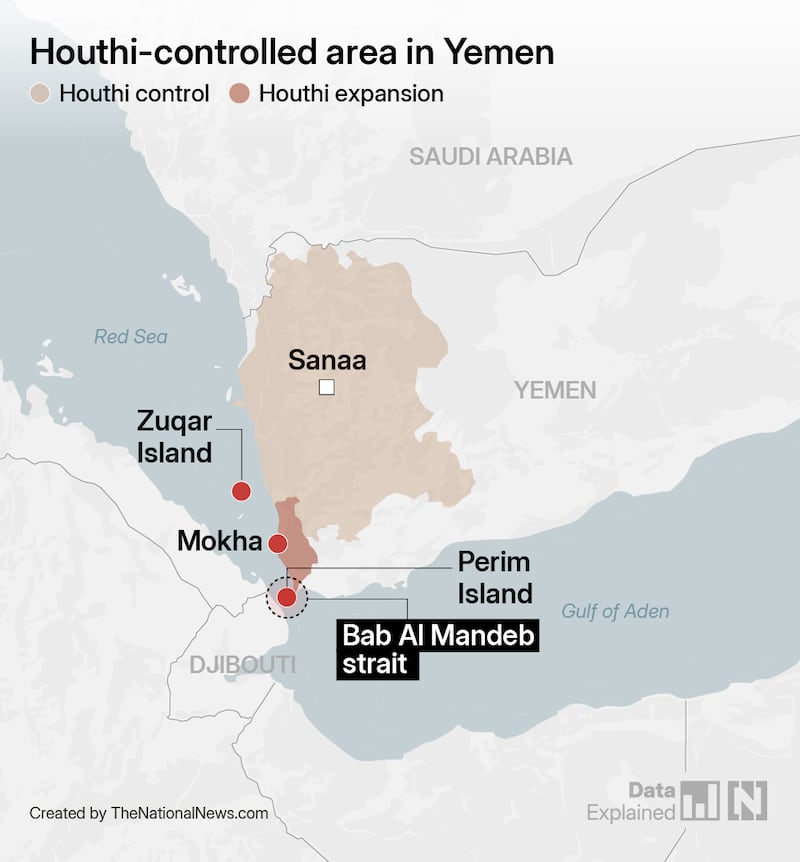
Col Majed Al Nuzaili, spokesman for the armed forces, told civilians to avoid the Taiz-Mokha road and the coastal route running south from Mokha to Dhubab because of the military operations. The announcement came after the Houthis had seized Yemen's entire western coastline, giving the rebels unprecedented control over the Yemeni side of the Bab Al Mandeb.
Figures from the UN's International Organisation for Migration (IOM) show that displacement in Yemen has surpassed 85,000 since escalations began, with more than 2,000 people crossing into Djibouti to escape the fighting. In Taiz in the south-west, where the fighting continues, 9,280 households, or around 56,000 people, have been displaced.
“Inside Yemen, families continue to flee multiple times, some for the second or third time in 12 years of conflict, with almost nothing left,” the organisation said. “Roads are increasingly inaccessible due to continuing fighting and communications in affected areas remain disrupted, making it harder to reach people and assess needs.”
The surge in fighting comes during the biggest declared wave of US-Iran tit-for-tat attacks on Gulf shipping since the war began in late February. The Houthis' gaining control of the waterway on the opposite side of the Arabian Peninsula from the Strait of Hormuz could give Iran a critical advantage in the war, reducing supplies travelling through a second major transit corridor and sending oil prices surging.
As part of their west coast operations, the Houthis also took over Perim and Zuqar islands, which are vital for maritime security. Fighting around the western coast put the islands at the centre of the rebel offensive and the wider US-Iran war.
Perim, with an area of 13 square kilometres, lies in the Bab Al Mandeb, between Yemen’s mainland and Djibouti, dividing the waterway into two channels. Its position gives whoever controls it an exceptional advantage in monitoring vessels entering or leaving the Red Sea and those on the route towards the Suez Canal moving between Asia, the Gulf and Europe.

