
Lebanese historian Makram Rabah recalls his grandfather's Venezuelan home with its portrait of “The Liberator” Simon Bolivar on the wall as the symbol of the country of “goodness and generosity”.
For Lebanese in Venezuela − the majority of whom opposed President Nicolas Maduro's regime and its allies − these are uncertain times.
The fate of Hezbollah's extensive and well-documented networks in the country rests with the regime’s intelligence services. After US forces captured Mr Maduro last weekend, President Donald Trump declared that Caracas would co-operate with Washington in a strategic alignment that rejects a quarter-century of anti-American socialism.
Holy Spirit University of Kaslik
Hezbollah's presence in Venezuela now looms as a test of Washington’s determination to stamp out drug trafficking and terrorism in the country.
The Iranian-backed Lebanese militia, which was weakened by the 2024 war with Israel, has been able to fund itself through drug smuggling and shadow fleet operations, some of which are based in Venezuela.
Until now, they were protected by Venezuela's Bolivarian National Intelligence Service (Sebin), with who they worked “hand in glove”, according to Gregg Roman, director of the US-based think tank Middle East Forum.
It is still unclear whether Venezuela’s regime, which follows an extreme form of socialism put forward by former president Hugo Chavez, will be under sufficient US pressure to end these activities.
Vice President Delcy Rodriguez, who has taken over as acting president following Mr Maduro’s capture, has US President Donald Trump’s approval. She has served as the head of Sebin since 2018.
“Just because Maduro was taken out, doesn’t mean the Iranian infrastructure will suddenly go away,” Mr Roman told The National.
Scared to speak out
Fear still reigns among many Venezuelans who oppose the Chavista regime − including among a community of more than 750,000 Venezuelans of Lebanese origin.
According to Mr Rabah, a professor at the American University of Beirut, the wider population is biding its time. Many of those living in the country were scared to publicly speak out about recent events and what could happen next − either to the community or Venezuela itself.
Even a text message critical of the regime could get them arrested, he said. “Maduro’s people are stopping people on the street to check their phones,” Mr Rabah told The National.
The country has a religiously diverse community with Lebanese and Syrian ancestry, who have made important contributions to politics, academia and the arts.
But many fled to Miami and Lebanon during Mr Maduro’s autocratic tenure and the collapse of the economy.
About 300,000 Venezuelans live in Lebanon, mostly those who have direct local heritage. The vast majority of Lebanese Venezuelans opposed the Chavista regime and are hopeful they will now see the end of it.

“They are a very well-established community [in Venezuela], very active in economic circles, very entrepreneurial,” said Eduardo Aboultaif, assistant professor of politics at the Holy Spirit University of Kaslik, in Jounieh, north of Beirut, who is himself from Venezuela.
“They lost their wealth, their time. The years under the Chavez regime were painful, they see this as a good opportunity,” he said.
Even before the high-profile and spectacular snatch operation in Caracas on Saturday, there were signs that the Iranian-backed networks could be on the edge as the US increased pressure on the Maduro regime.
Former vice president Tareck El Aissami − who has Syrian Druze origins − was placed under sanctions by the US in 2017 for trafficking drugs. He was jailed by Mr Maduro last year on corruption charges, after a fall out.

Colombian police, who are monitoring the border in anticipation of a migration crisis, are watching for Hezbollah operatives fleeing the country, police sources told the Colombian newspaper El Espectador.
The US seized the Russian-flagged oil tanker Marinera on Wednesday, which was headed towards Russia from Venezuela. The US imposed sanctions on the vessel last year − when it was known as Bella 1 − for carrying “sanctioned cargo” on behalf of a Hezbollah-owned offshore company.
Ali Zaki Haj Jalil, a suspect in the 1994 bombing of Alas Chiricanas Flight 901 − which exploded shortly after taking off from an airport in Panama − was arrested on Margarita Island by Venezuelan authorities in November last year. This was a joint operation with Interpol and international intelligence agencies.
'Rejectionist front'
Hezbollah’s links to Venezuela are financial as well as ideological – aligning themselves as part of a “rejectionist front” against the US and the West, Mr Rabah said.
Mr Chavez expressed admiration of Arab nationalist dictators such as Saddam Hussein, Hafez Al Assad and Muammar Qaddafi. These leaders also supported sympathetic diaspora groups in Latin America during the Cold War.
But when these Arab regimes fell, Iran filled the vacuum. Hezbollah’s late leader Hassan Nasrallah and Mr Maduro publicly praised and expressed solidarity towards each other’s causes.

A new wave of Lebanese emigrants who supported the Chavez regime and Hezbollah began settling in Venezuela from the early 2000s, according to Mr Aboultaif. They established themselves at a much faster pace than their predecessors, owing to their connections to the new government.
The Venezuelan government stands accused of issuing diplomatic passports and citizenship to members of the Lebanese armed group.
Former Lebanese MP Wehbe Katisha claimed that up to 10,000 passports may have been issued to loyalists, according to the news website The Beiruter. He added that Syrian military officers from the deposed Assad regime could have also used these passports to flee Syria after being ousted in 2024.
Hezbollah used these passports and the visa-free access they afforded to enter Europe, but these advantages have dwindled as Venezuela became a pariah state, Mr Rabah said.

'Doubled down'
Hezbollah's illicit networks in Latin America, which were targeted by the US Drug Enforcement Agency’s Cassandra Project between 2011 and 2016, are a vital lifeline for the group.
It has since “doubled down” on its overseas activities, according to Dr Matthew Levitt, a counter-terrorism expert at the Washington Institute think tank.
While the group continued to rely on funding from Tehran and the cash-based economy in Lebanon, it had been “expanding efforts to make money from places around the world” where it had a presence, Mr Levitt told The National.
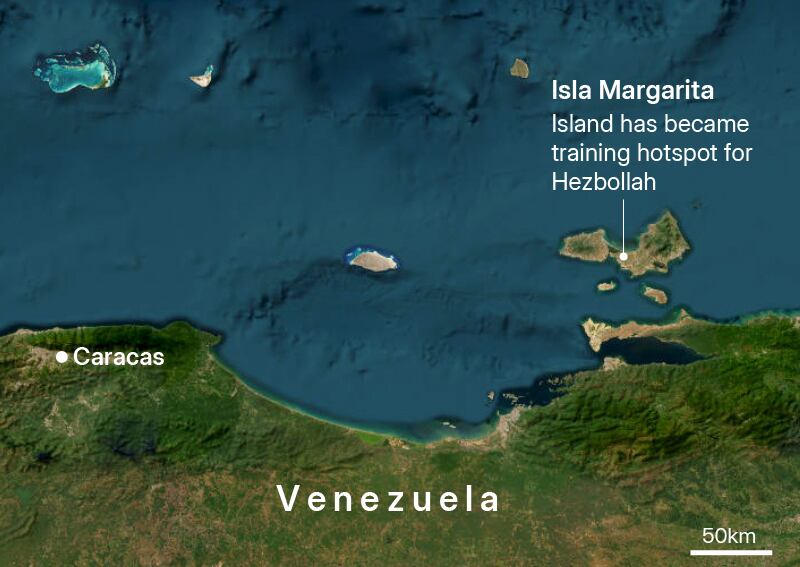
A particular area of concern for US officials has been Margarita Island, off Venezuela's north-eastern coast, which has long been associated with organised crime and narcotics money-laundering.
Intelligence and open-source reports have described the island as a hub for trafficking and paramilitary training activities linked to Hezbollah and allied clans, such as the Nasr Al Din family. It has been implicated in enabling Iranian penetration and paramilitary logistics in the region.
With Hezbollah's capacity to carry strikes on Israel now severely reduced, there are fears the group could conduct terrorist attacks overseas – as it has been accused of doing in the past including in Latin America.
“The concern was that they might want to do something abroad that focuses people on their international network,” Mr Levitt said.

