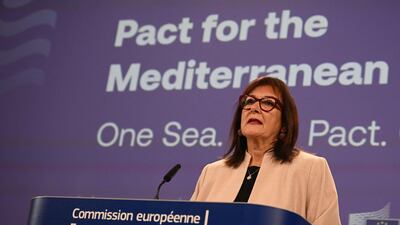

A strategic partnership agreement between the EU and UAE can help translate the newly adopted Pact for the Mediterranean into action, a senior European official has told The National.
Once signed, the legally binding SPA will advance the pact’s objectives, EU Commissioner for the Mediterranean Dubravka Suica said.
Launched in November, the Pact for the Mediterranean is a strategic framework to deepen co-operation with the EU's southern neighbours through people-to-people ties, economic integration, security, migration and other shared priorities.
The 10 countries in the pact are Algeria, Egypt, Israel, Jordan, Lebanon, Libya, Morocco, Palestine, Syria and Tunisia. Gulf nations, including the UAE, are integrated as engaged partners.
Ms Suica described the pact as “a framework for co-operation between the European Union, the Middle East and North Africa, and the Gulf”.
While the Gulf is “not Mediterranean, they are neighbours of our neighbours”, she told The National. This allows for “triangular co-operation, between the three of us, to promote stability and prosperity in our shared neighbourhood”.
Having led consultations on the pact that started in early 2025, Ms Suica emphasised that it was “not just another” initiative, but rather a “living document”, meaning that new initiatives, actions and projects can be added over time.
An action plan for the framework is expected in March 2026, giving partner nations room to “contribute with projects, designs, ideas and whatever people from the southern neighbourhood and the Gulf want to see on the ground”, she said.
'Reaching out'
The European Commissioner is on a mission to initiate strategic partnership agreements with all six member states of the Gulf Co-operation Council (GCC) as part of an ambitious agenda put forward by leaders at the 2024 EU-GCC Summit in Brussels.
Negotiations for an SPA between the UAE and the EU were launched in Abu Dhabi on Thursday. The agreement aims to strengthen collaboration towards regional peace and stability, and to safeguard multilateralism and international law.
It will also accelerate work to explore new opportunities in areas such as connectivity, research and innovation, energy, green and digital transition, and artificial intelligence, according to a joint statement.
Negotiations for an SPA between Qatar and the EU were launched on December 6. Ms Suica also travelled to Riyadh on December 8 to explore new areas of co-operation in Saudi Arabia's strategic relationship with the EU.
Her efforts are part of the bloc's campaign to expand ties in the region and deepen partnerships.
“Europe is reaching out,” Ms Suica told The National. “We are reaching out now because we really want to have partnerships worldwide. Multilateralism is at stake nowadays, and we really need new partners or old partners to deepen partnerships,” she said.
'Need for peace'
The EU's push for partners comes at a critical time for the region, marked by overlapping conflicts.
“There won't be prosperity for the Gulf, for Europe and for North Africa if we don't have peace in the Middle East,” said Ms Suica. “So a solution for peace is very important.”
A fragile ceasefire came into effect in Gaza on October 10 after two years of war that has had wider regional repercussions.
“This is the reason why we welcome the peace agreement by [US] President [Donald] Trump,” said Ms Suica. “The ceasefire is holding. But we are looking forward to the second phase of this agreement … which is very important.”
The initial phase of Mr Trump’s 20-point plan for Gaza included a truce and the exchange of Israeli hostages for Palestinian detainees. Phase two focuses on the postwar government of Gaza and reconstruction in the Palestinian enclave.
“We need a governance body, we need a peace board, and we need those who will invest their money,” said Ms Suica. “This is why the Gulf is very important in this pact. We need them for reconstruction. And we think the UAE will have an interest to invest both in Gaza and in Syria.”
Support for Syria
With new leadership and a strained economy, Syria is attempting to recover and rebuild after five decades of the Assad family's rule and nearly 14 years of civil war.
To support Syria's rehabilitation, the EU has lifted almost all of its economic sanctions on the war-torn country. But the bloc remains “cautious” of the current leadership, she told The National.
Rebels from Hayat Tahrir Al Sham, a former Al Qaeda affiliate, led the assault that toppled the Assad regime on December 8, 2024. The group's leader, Ahmad Al Shara, was declared the head of Syria's transitional government.
“Let's be open and clear: we are very cautious, knowing their background, but at the same time, there is no alternative. We are putting our trust in them,” Ms Suica said.
“We think they are going in a good direction, but the only issue is that they have to be inclusive with minorities. They haven't managed to include all the minorities, and this is something which we ask from them.”
The EU Commissioner met Mr Al Shara in June during a visit to Damascus, where she announced a €175 million ($205.2 million) support package for Syria. But the country needs more than just money, she told The National.
“They need knowledge, expertise and technical assistance. They don't have any knowledge of how to build institutions,” she said. Syria also needs support for reconstruction, she added.
“I hope that the UAE will also have an interest in investing there. If the situation allows, of course, we are trying to create conditions for everybody to come there because it's a big and important country.”
High ambitions
The UAE has long been hailed as a key strategic partner of the EU.
The strategic partnership agreement “extends beyond its tremendous economic ambition. It reflects a shared responsibility to contribute to global stability and humanitarian relief”, said UAE Minister of State and Envoy of the Minister of Foreign Affairs to the EU, Lana Nusseibeh.
Ms Suica said there were no major differences on either side that could slow negotiations for an SPA.
“The ambition is high on both sides,” she said. While there is no fixed timeline on the negotiations, she would like to have the agreement “as soon as possible”.

