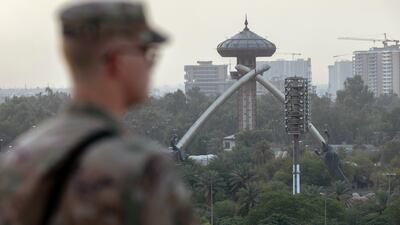
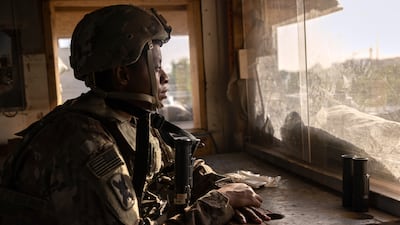
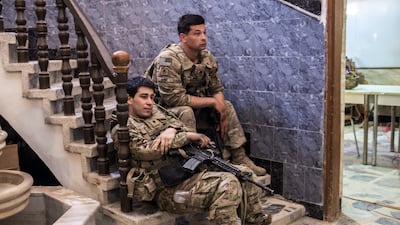
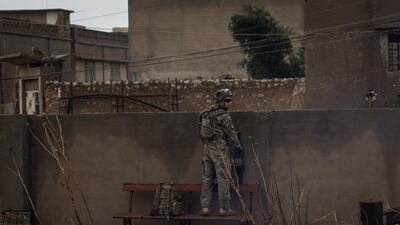
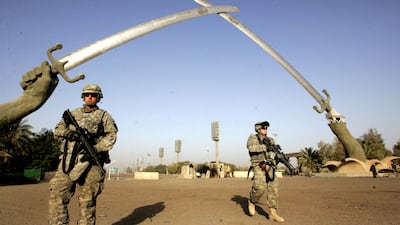
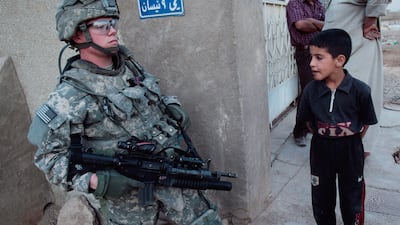
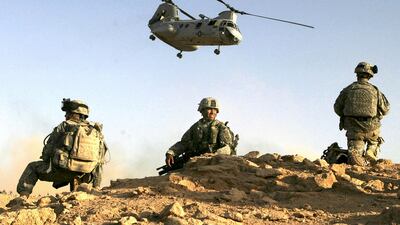
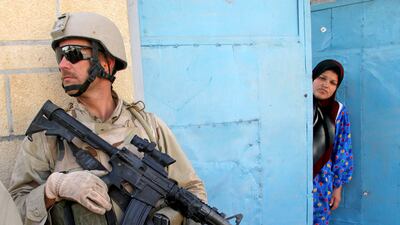
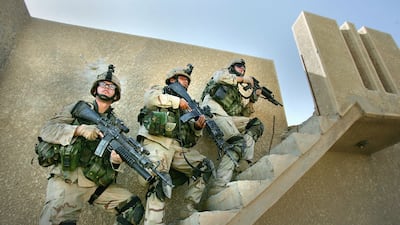
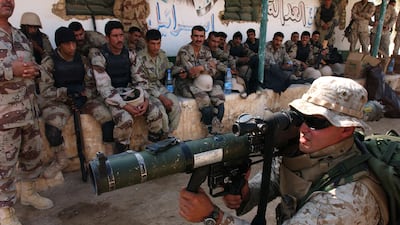
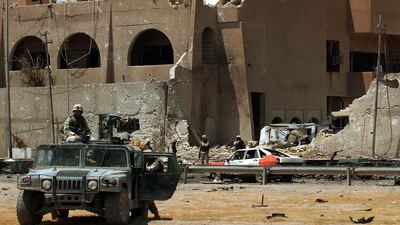
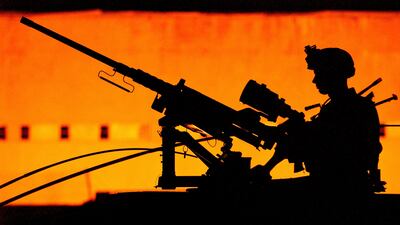
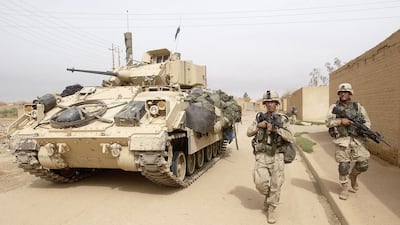
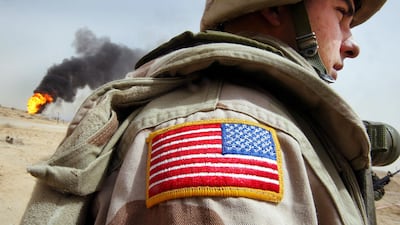
Coalition soldiers at the K1 Airbase near Kirkuk in northern Iraq. AFP

US to pull troops from parts of Iraq but some will remain for years to come


  • English
  • Arabic

The US on Friday announced an agreement with Iraq that will result in the withdrawal of American troops from parts of Iraq, where they have been stationed for a decade to help fight ISIS, but some forces will remain in the country for years to come.

The plan consists of two main phases, US officials said. The first stage will bring an end to military operations conducted by Combined Joint Task Force Inherent Resolve, an international coalition that was founded to fight ISIS after the group seized large parts of Iraq and Syria in 2014.

This will result in “ending the presence of coalition forces in certain locations in Iraq, as mutually determined” with Baghdad by September 2025, a senior Biden administration official told reporters.

The second part of the agreement means US forces remain in Iraq until at least September 2026, but they will only be striking ISIS in neighbouring Syria, the official said. This time frame could be extended, “subject to conditions on the ground and obviously consultations among future political leaders of Iraq, the United States and coalition members”.

“To be clear, the United States is not withdrawing from Iraq,” the official said.

Even though ISIS remain a threat in Iraq and Syria, Prime Minister Mohammed Shia Al Sudani has been under sustained political pressure to end the US troop presence, which is seen by critics as antagonistic to Iran-backed groups in the region. Both sides were set to announce the deal in August but it was postponed after an attack on US troops at Ain Al Asad airbase in western Iraq.

Friday's announcement offered no details on how many US troops will stay in Iraq, and for how long. Currently, about 2,500 are based in Iraq, where they work with Iraqi and Kurdish partners against ISIS cells. Iraq is also a launch pad for US-led anti-ISIS operations in Syria, where the group continues to operate but no longer controls territory.

The US official said ISIS still poses a “real threat” but is diminished in Iraq and across the region.

“While ISIS is down, they are not out,” the official said. “Together, the US, Iraq and the coalition remain committed to defeat the core ISIS threat. We plan to continue focusing on that important task. As we head into the future, we will continue to work with the Iraqi Security Forces, including the Kurdish Peshmerga forces, to build up their capabilities and ensure an Iraqi-led enduring defeat of ISIS.”

In a joint statement, Iraq and the US stressed “the need to continue all efforts to ensure that the threat from this terrorist organisation does not return in any way”.

ISIS fighters carry out sporadic attacks, mainly in rural areas. This month, US troops took part in an operation alongside Iraqi forces in the west of the country in which they rooted out an ISIS hideout, killing 14 extremists, among them four major figures in the group.

Washington and Baghdad are striving to change public perception of the US presence in Iraq and have continually referred to the new “bilateral security relationship”.

A senior US defence official said the Iraqi government “has expressed continued willingness and interest to solidify and expand that partnership, including on counter-terrorism co-operation”.

“The details of that will take time to emerge, but it will be building on what already exists with the advise-and-assist mission of US forces to help the Iraqi Security Forces conduct counter ISIS missions,” the official said.

Dr Abbas Kadhim, director of the Iraq Initiative at the Atlantic Council, said Friday’s announcement served as a stopgap for the Iraqi government and the outgoing Biden administration to signal progress on withdrawing US forces without actually setting any drawdown numbers.

“There are lots of pressures on both governments, the Iraqi government and the US government, to accomplish this withdrawal, and especially now, given the chaotic situation in Palestine and Lebanon,” Dr Kadhim told The National. “So this is a great way to kick the can down the road.”

He also said the Iraqi government will open itself up to criticism if US forces withdraw from some parts of the country but not other places like Kurdistan.

“Symbolically, at least, it doesn't look good. The message it sends is that Kurdistan is safe for US forces and the rest of Iraq isn't. There is room for exploitation domestically,” he said.

Republican Congressman French Hill, who has led Washington policy on Syria and the Captagon drug trade, said now is “not the time to be withdrawing our forces”.

“Leaving the region now puts our allies, the Kurds, and the Syrian people at risk, as well as risks the re-emergence of ISIS without our support of the Kurds,” he told The National.

He urged Congress to “carefully assess” the preliminary exit plan to ensure it best ensures “long term US and Iraqi interests”.

US troops have been stationed in Iraq since 2003, when an international coalition invaded Iraq to topple Saddam Hussein’s regime, claiming he was developing and stockpiling weapons of mass destruction. No such weaponry was found and the invasion plunged Iraq into decades of civil war, chaos and political instability.

The horrors of the battle of Mosul, March 4, 2017. Reuters

In 2008, Iraq and the US signed the Strategic Framework Agreement that led to the withdrawal of most US forces by the end of 2011, leaving behind a small number of troops to protect its embassy and to train and assist Iraqi forces. At its peak presence in 2007, the US military numbered about 170,000 soldiers. About 2,500 US troops remain stationed in Iraq as part of the coalition.

However, foreign troops returned in 2014, when ISIS seized about a third of the country in a vast takeover in Iraq and Syria, which the US-trained Iraqi security forces were not able to stop. The extremist group was defeated in 2017 and driven out of the main cities it captured such as Mosul and Tikrit.

Thereafter, the US gradually reduced the number of its troops in Iraq from about 5,000 to 2,500. Hundreds of soldiers from Europe are also part of the coalition. Washington also has about 900 troops in neighbouring Syria on a mission it says aims to advise and assist local forces to prevent a resurgence of the group.

Greater paramilitary powers?

Any reduction in US intelligence, air support or training capabilities could undermine efforts to contain any ISIS sleeper cells, raising concerns of a potential resurgence of the terrorist group.

It could force Iraq to rely more on its own security apparatus, which has been bolstered by the presence of the Popular Mobilisation Forces (PMF). Although the PMF officially integrated into Iraq’s state security forces in 2016, many of its militias maintain their allegiance to Iran, which has led to concerns over their role in Iraq’s political and security future.

Since declaring the end of the fight against ISIS in late 2017, these groups have grown in power and influence and have been calling for the full withdrawal of the US from Iraq. Their political clout has been also strengthened since October 2022, when Mohammed Shia Al Sudani became Prime Minister.

These calls intensified after the US assassinated Maj Gen Qassem Suleimani, commander of the Quds Force of Iran’s Islamic Revolutionary Guard Corps, and prominent Iraqi militia leader Abu Mahdi Al Muhandis in an air strike in Baghdad in 2020. Two days after the assassination, Shiites in Iraq's Parliament passed a resolution calling on the government to expel foreign troops. Sunnis and Kurds did not support the move.

The outbreak of the Israeli war in Gaza war ended a year-long calm between the Iraqi militias and the US forces that followed the establishment of Mr Al Sudani’s government. The groups started launching a wave of attacks on US interests after Israel began bombing Gaza relentlessly, demanding an immediate ceasefire in the Palestinian territory run by their ally Hamas.

In January, Baghdad, under domestic pressure, initiated talks with Washington to end the coalition's mission. The Iraqi government said it was willing to enter bilateral security agreements with member states. An unannounced truce that involved Tehran and the Iraqi government in February halted the militias' attacks against US forces in the Middle East. However, as the war in Gaza continued, attacks resumed and the truce with Washington collapsed after a few months.

Calls to end to the truce were renewed after at least four members of the PMF's 47th Brigade were killed in a US strike on a base in Babil province, south of Baghdad, at the end of July.

“The resistance factions in Iraq ended this truce and therefore all options are available to the resistance forces to target all US bases inside Iraq,” Haider Al Lami, a member of the political council of Al Nujaba Movement in Iraq, told The National at the time.

Around the same time, an Iraqi delegation led by Defence Minister Thabet Al Abbasi visited Washington to put the final touches to the withdrawal deal. Baghdad and Washington agreed in late July on a two-year plan to end the mission of the US-led coalition in Iraq. Both sides were set to announce the deal in August but this was postponed after the Ain Al Asad airbase attack.

Ellie Sennett contributed to this report in Washington

Iraqis hold placards and flags as they gather to mark the anniversary of the killing of senior Iranian military commander Qassem Suleimani in Baghdad. Reuters
RESULTS

Bantamweight title:
Vinicius de Oliveira (BRA) bt Xavier Alaoui (MAR)
(KO round 2)
Catchweight 68kg:
Sean Soriano (USA) bt Noad Lahat (ISR)
(TKO round 1)
Middleweight:
Denis Tiuliulin (RUS) bt Juscelino Ferreira (BRA)
(TKO round 1)
Lightweight:
Anas Siraj Mounir (MAR) bt Joachim Tollefsen (DEN)
(Unanimous decision)
Catchweight 68kg:
Austin Arnett (USA) bt Daniel Vega (MEX)
(TKO round 3)
Lightweight:
Carrington Banks (USA) bt Marcio Andrade (BRA)
(Unanimous decision)
Catchweight 58kg:
Corinne Laframboise (CAN) bt Malin Hermansson (SWE)
(Submission round 2)
Bantamweight:
Jalal Al Daaja (CAN) bt Juares Dea (CMR)
(Split decision)
Middleweight:
Mohamad Osseili (LEB) bt Ivan Slynko (UKR)
(TKO round 1)
Featherweight:
Tarun Grigoryan (ARM) bt Islam Makhamadjanov (UZB)
(Unanimous decision)
Catchweight 54kg:
Mariagiovanna Vai (ITA) bt Daniella Shutov (ISR)
(Submission round 1)
Middleweight:
Joan Arastey (ESP) bt Omran Chaaban (LEB)
(Unanimous decision)
Welterweight:
Bruno Carvalho (POR) bt Souhil Tahiri (ALG)
(TKO)

Specs

Engine: 3.0L twin-turbo V6
Gearbox: 10-speed automatic
Power: 405hp at 5,500rpm
Torque: 562Nm at 3,000rpm
Fuel economy, combined: 11.2L/100km
Price: From Dh292,845 (Reserve); from Dh320,145 (Presidential)
On sale: Now

F1 The Movie

Starring: Brad Pitt, Damson Idris, Kerry Condon, Javier Bardem

Director: Joseph Kosinski

Rating: 4/5

MATCH INFO

FA Cup final

Chelsea 1
Hazard (22' pen)

Manchester United 0

Man of the match: Eden Hazard (Chelsea)

Bareilly Ki Barfi
Directed by: Ashwiny Iyer Tiwari
Starring: Kriti Sanon, Ayushmann Khurrana, Rajkummar Rao
Three and a half stars

Shubh Mangal Saavdhan
Directed by: RS Prasanna
Starring: Ayushmann Khurrana, Bhumi Pednekar

BLACKBERRY
%3Cp%3EDirector%3A%20Matt%20Johnson%3C%2Fp%3E%0A%3Cp%3EStars%3A%20Jay%20Baruchel%2C%20Glenn%20Howerton%2C%20Matt%20Johnson%3C%2Fp%3E%0A%3Cp%3ERating%3A%204%2F5%3C%2Fp%3E%0A
THE BIO:

Sabri Razouk, 74

Athlete and fitness trainer 

Married, father of six

Favourite exercise: Bench press

Must-eat weekly meal: Steak with beans, carrots, broccoli, crust and corn

Power drink: A glass of yoghurt

Role model: Any good man

Company%20profile
%3Cp%3E%3Cstrong%3EName%3A%20%3C%2Fstrong%3EMaly%20Tech%3Cbr%3E%3Cstrong%3EStarted%3A%3C%2Fstrong%3E%202023%3Cbr%3E%3Cstrong%3EFounder%3A%3C%2Fstrong%3E%20Mo%20Ibrahim%3Cbr%3E%3Cstrong%3EBased%3A%3C%2Fstrong%3E%20Dubai%20International%20Financial%20Centre%3Cbr%3E%3Cstrong%3ESector%3A%3C%2Fstrong%3E%20FinTech%3Cbr%3E%3Cstrong%3EFunds%20raised%3A%3C%2Fstrong%3E%20%241.6%20million%3Cbr%3E%3Cstrong%3ECurrent%20number%20of%20staff%3A%3C%2Fstrong%3E%2015%3Cbr%3E%3Cstrong%3EInvestment%20stage%3A%20%3C%2Fstrong%3EPre-seed%2C%20planning%20first%20seed%20round%3Cbr%3E%3Cstrong%3EInvestors%3A%3C%2Fstrong%3E%20GCC-based%20angel%20investors%3C%2Fp%3E%0A
A timeline of the Historical Dictionary of the Arabic Language
  • 2018: Formal work begins
  • November 2021: First 17 volumes launched 
  • November 2022: Additional 19 volumes released
  • October 2023: Another 31 volumes released
  • November 2024: All 127 volumes completed
Results
%3Cp%3E%0D%3Cstrong%3EElite%20men%3C%2Fstrong%3E%0D%3Cbr%3E1.%20Amare%20Hailemichael%20Samson%20(ERI)%202%3A07%3A10%0D%3Cbr%3E2.%20Leornard%20Barsoton%20(KEN)%202%3A09%3A37%0D%3Cbr%3E3.%20Ilham%20Ozbilan%20(TUR)%202%3A10%3A16%0D%3Cbr%3E4.%20Gideon%20Chepkonga%20(KEN)%202%3A11%3A17%0D%3Cbr%3E5.%20Isaac%20Timoi%20(KEN)%202%3A11%3A34%0D%3Cbr%3E%3Cstrong%3EElite%20women%3C%2Fstrong%3E%0D%3Cbr%3E1.%20Brigid%20Kosgei%20(KEN)%202%3A19%3A15%0D%3Cbr%3E2.%20Hawi%20Feysa%20Gejia%20(ETH)%202%3A24%3A03%0D%3Cbr%3E3.%20Sintayehu%20Dessi%20(ETH)%202%3A25%3A36%0D%3Cbr%3E4.%20Aurelia%20Kiptui%20(KEN)%202%3A28%3A59%0D%3Cbr%3E5.%20Emily%20Kipchumba%20(KEN)%202%3A29%3A52%3C%2Fp%3E%0A
Profile of Bitex UAE

Date of launch: November 2018

Founder: Monark Modi

Based: Business Bay, Dubai

Sector: Financial services

Size: Eight employees

Investors: Self-funded to date with $1m of personal savings

Groom and Two Brides

Director: Elie Semaan

Starring: Abdullah Boushehri, Laila Abdallah, Lulwa Almulla

Rating: 3/5

COMPANY%20PROFILE
%3Cp%3E%3Cstrong%3EName%3A%3C%2Fstrong%3E%20Floward%0D%3Cbr%3E%3Cstrong%3EBased%3A%20%3C%2Fstrong%3ERiyadh%2C%20Saudi%20Arabia%0D%3Cbr%3E%3Cstrong%3EFounders%3A%20%3C%2Fstrong%3EAbdulaziz%20Al%20Loughani%20and%20Mohamed%20Al%20Arifi%0D%3Cbr%3E%3Cstrong%3ESector%3A%20%3C%2Fstrong%3EE-commerce%0D%3Cbr%3E%3Cstrong%3ETotal%20funding%3A%20%3C%2Fstrong%3EAbout%20%24200%20million%0D%3Cbr%3E%3Cstrong%3EInvestors%3A%20%3C%2Fstrong%3EAljazira%20Capital%2C%20Rainwater%20Partners%2C%20STV%20and%20Impact46%0D%3Cbr%3E%3Cstrong%3ENumber%20of%20employees%3A%20%3C%2Fstrong%3E1%2C200%3C%2Fp%3E%0A

Mercer, the investment consulting arm of US services company Marsh & McLennan, expects its wealth division to at least double its assets under management (AUM) in the Middle East as wealth in the region continues to grow despite economic headwinds, a company official said.

Mercer Wealth, which globally has $160 billion in AUM, plans to boost its AUM in the region to $2-$3bn in the next 2-3 years from the present $1bn, said Yasir AbuShaban, a Dubai-based principal with Mercer Wealth.

Within the next two to three years, we are looking at reaching $2 to $3 billion as a conservative estimate and we do see an opportunity to do so,” said Mr AbuShaban.

Mercer does not directly make investments, but allocates clients’ money they have discretion to, to professional asset managers. They also provide advice to clients.

“We have buying power. We can negotiate on their (client’s) behalf with asset managers to provide them lower fees than they otherwise would have to get on their own,” he added.

Mercer Wealth’s clients include sovereign wealth funds, family offices, and insurance companies among others.

From its office in Dubai, Mercer also looks after Africa, India and Turkey, where they also see opportunity for growth.

Wealth creation in Middle East and Africa (MEA) grew 8.5 per cent to $8.1 trillion last year from $7.5tn in 2015, higher than last year’s global average of 6 per cent and the second-highest growth in a region after Asia-Pacific which grew 9.9 per cent, according to consultancy Boston Consulting Group (BCG). In the region, where wealth grew just 1.9 per cent in 2015 compared with 2014, a pickup in oil prices has helped in wealth generation.

BCG is forecasting MEA wealth will rise to $12tn by 2021, growing at an annual average of 8 per cent.

Drivers of wealth generation in the region will be split evenly between new wealth creation and growth of performance of existing assets, according to BCG.

Another general trend in the region is clients’ looking for a comprehensive approach to investing, according to Mr AbuShaban.

“Institutional investors or some of the families are seeing a slowdown in the available capital they have to invest and in that sense they are looking at optimizing the way they manage their portfolios and making sure they are not investing haphazardly and different parts of their investment are working together,” said Mr AbuShaban.

Some clients also have a higher appetite for risk, given the low interest-rate environment that does not provide enough yield for some institutional investors. These clients are keen to invest in illiquid assets, such as private equity and infrastructure.

“What we have seen is a desire for higher returns in what has been a low-return environment specifically in various fixed income or bonds,” he said.

“In this environment, we have seen a de facto increase in the risk that clients are taking in things like illiquid investments, private equity investments, infrastructure and private debt, those kind of investments were higher illiquidity results in incrementally higher returns.”

The Abu Dhabi Investment Authority, one of the largest sovereign wealth funds, said in its 2016 report that has gradually increased its exposure in direct private equity and private credit transactions, mainly in Asian markets and especially in China and India. The authority’s private equity department focused on structured equities owing to “their defensive characteristics.”

Directed by Sam Mendes

Starring Dean-Charles Chapman, George MacKay, Daniel Mays

4.5/5

Notable salonnières of the Middle East through history

Al Khasan (Okaz, Saudi Arabia)

Tamadir bint Amr Al Harith, known simply as Al Khasan, was a poet from Najd famed for elegies, earning great renown for the eulogy of her brothers Mu’awiyah and Sakhr, both killed in tribal wars. Although not a salonnière, this prestigious 7th century poet fostered a culture of literary criticism and could be found standing in the souq of Okaz and reciting her poetry, publicly pronouncing her views and inviting others to join in the debate on scholarship. She later converted to Islam.


Maryana Marrash (Aleppo)

A poet and writer, Marrash helped revive the tradition of the salon and was an active part of the Nadha movement, or Arab Renaissance. Born to an established family in Aleppo in Ottoman Syria in 1848, Marrash was educated at missionary schools in Aleppo and Beirut at a time when many women did not receive an education. After touring Europe, she began to host salons where writers played chess and cards, competed in the art of poetry, and discussed literature and politics. An accomplished singer and canon player, music and dancing were a part of these evenings.


Princess Nazil Fadil (Cairo)

Princess Nazil Fadil gathered religious, literary and political elite together at her Cairo palace, although she stopped short of inviting women. The princess, a niece of Khedive Ismail, believed that Egypt’s situation could only be solved through education and she donated her own property to help fund the first modern Egyptian University in Cairo.


Mayy Ziyadah (Cairo)

Ziyadah was the first to entertain both men and women at her Cairo salon, founded in 1913. The writer, poet, public speaker and critic, her writing explored language, religious identity, language, nationalism and hierarchy. Born in Nazareth, Palestine, to a Lebanese father and Palestinian mother, her salon was open to different social classes and earned comparisons with souq of where Al Khansa herself once recited.

Our legal consultant

Name: Dr Hassan Mohsen Elhais

Position: legal consultant with Al Rowaad Advocates and Legal Consultants.

At Eternity’s Gate

Director: Julian Schnabel

Starring: Willem Dafoe, Oscar Isaacs, Mads Mikkelsen

Three stars

UAE%20ILT20
%3Cp%3E%3Cstrong%3EMarquee%20players%3A%3C%2Fstrong%3E%0D%3Cbr%3EMoeen%20Ali%2C%20Andre%20Russell%2C%20Dawid%20Malan%2C%20Wanindu%20Hasiranga%2C%20Sunil%20Narine%2C%20Evin%20Lewis%2C%20Colin%20Munro%2C%20Fabien%20Allen%2C%20Sam%20Billings%2C%20Tom%20Curran%2C%20Alex%20Hales%2C%20Dushmantha%20Chameera%2C%20Shimron%20Hetmyer%2C%20Akeal%20Hosein%2C%20Chris%20Jordan%2C%20Tom%20Banton%2C%20Sandeep%20Lamichhane%2C%20Chris%20Lynn%2C%20Rovman%20Powell%2C%20Bhanuka%20Rajapaksa%2C%20Mujeeb%20Ul%20Rahman%0D%3Cbr%3E%3Cstrong%3EInternational%20players%3A%3C%2Fstrong%3E%0D%3Cbr%3ELahiru%20Kumara%2C%20Seekugge%20Prassanna%2C%20Charith%20Asalanka%2C%20Colin%20Ingram%2C%20Paul%20Stirling%2C%20Kennar%20Lewis%2C%20Ali%20Khan%2C%20Brandon%20Glover%2C%20Ravi%20Rampaul%2C%20Raymon%20Reifer%2C%20Isuru%20Udana%2C%20Blessing%20Muzarabani%2C%20Niroshan%20Dickwella%2C%20Hazaratullah%20Zazai%2C%20Frederick%20Klassen%2C%20Sikandar%20Raja%2C%20George%20Munsey%2C%20Dan%20Lawrence%2C%20Dominic%20Drakes%2C%20Jamie%20Overton%2C%20Liam%20Dawson%2C%20David%20Wiese%2C%20Qais%20Ahmed%2C%20Richard%20Gleeson%2C%20James%20Vince%2C%20Noor%20Ahmed%2C%20Rahmanullah%20Gurbaz%2C%20Navin%20Ul%20Haq%2C%20Sherfane%20Rutherford%2C%20Saqib%20Mahmood%2C%20Ben%20Duckett%2C%20Benny%20Howell%2C%20Ruben%20Trumpelman%0D%3Cbr%3E%3C%2Fp%3E%0A
AGUERO'S PREMIER LEAGUE RECORD

Apps: 186
Goals: 127
Assists: 31
Wins: 117
Losses: 33

Updated: September 28, 2024, 1:39 PM