


Widespread terrorist attacks by Islamic extremists in Europe are a genuine prospect as a result of the mounting deaths in Gaza, security analysts have told The National.
While increased state surveillance has made it difficult to mount spectacular attacks such as the Paris Bataclan in 2015, there are increasing fears of a Christmas atrocity by a “lone wolf” operative.
After several years of relative quiet in Europe, security chiefs are now on high alert for terrorist attacks as the Israel-Gaza conflict has proved “fodder for a reignition of global Islamic extremism”, said Justin Crump, chief executive of the Sibylline intelligence company.
In the past week, European police forces have arrested a number of people, allegedly connected to Hamas, looking to smuggle weapons across the continent.
The former head of MI6 has also disclosed that British intelligence officers are deeply concerned about Gaza’s impact.
“What really alarms my former colleagues is the scale of radicalisation as a result of what's happening in the Middle East that is pretty well unparalleled, so that augurs trouble ahead,” Sir Alex Younger said last week.
Gaza impact
“Radicalisation flourishes and recruitment increases where one party is inflicting sustained and unprecedented violence against civilians in order to meet its military objective,” said Dr Benjamin Petrini, a terrorism expert at the International Institute for Strategic Studies think tank.
The growth of extremism has come in waves across the West, with the fallout from the Bosnia war in the 1990s, the US invasion of Iraq in 2003 then the sudden explosion of organised ISIS terrorists a decade ago.
The question, and the apprehension, that western intelligence agencies are now confronted with is what impact will the Israel-Gaza wars have on global Muslim populations?
Israel’s military operation has already claimed more than 20,000 Palestinian lives, according to the Hamas-run Health Ministry, and if it continues to cause such devastation it will inevitably “trigger an uptick in anti-western rhetoric and anti-western violence, radicalisation and recruitment,” said Dr Petrini, speaking from Washington.
The “awful scenes” caused by Israel’s bombing will be used by radicals to justify global attacks, added Mr Crump.
“Since October 7, it has been described to me that the threat-board is lighting up red as Gaza is energising the rallying cry,” he said. “Lots of people are going to be motivated and radicalised by seeing these images and feeling that Muslims are under attack and that they need to defend Islam.”
But so far the movement had lacked the cohesion that ISIS or Al Qaeda possessed without a global figurehead.
-
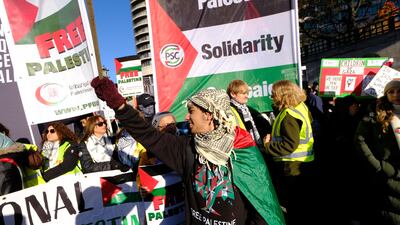
A pro-Palestine march sets off from London's Park Lane. Photo: Jess Hurd -
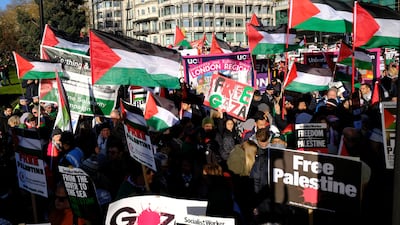
Thousands were marching to Whitehall on Saturday. Photo: Jess Hurd -
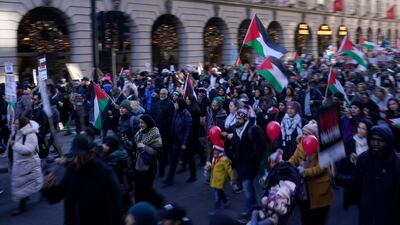
Protesters carry Palestinian flags. AP -
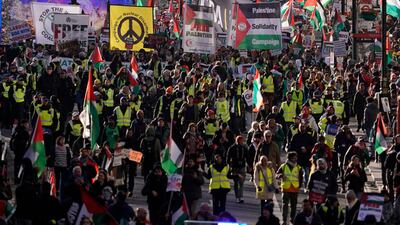
Protesters were calling for an end to the war in Gaza. AP -

Buses brought people from across the UK to London. AP -

The protests were largely peaceful, organisers said. AP -

Police officers keep an eye on protesters during a 'National March For Palestine'. AFP -
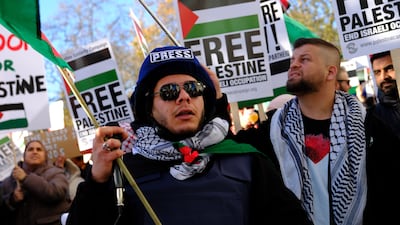
Demonstrators were also honouring the memory of reporters lost during the conflict. Photo: Jess Hurd -
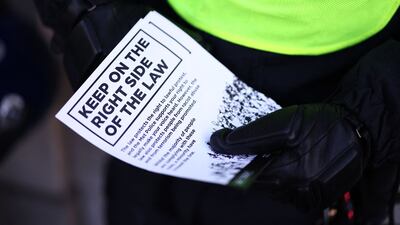
A police officer hands out leaflets reminding demonstrators to 'stay on the right side of the law'. AFP


Hamas in Europe
Hamas has been singularly fixated on the destruction of the Israeli state and defending its territory in Gaza.
Yet the arrests in Europe suggest the movement may well be looking to expand its campaign and co-operate with Hezbollah, which has a strong continental network and without border checks within EU countries, it is easier to move weapons.
“What makes this potentially very dangerous is that the authorities in Germany and other countries are very strong in saying that the arrests were based on an order received from Hamas in Lebanon, and that the people who were carrying it out were actually sworn-in members of Hamas,” said Prof Peter Neumann, a security specialist at King's College London.
The potential movement of weapons could well herald that Hamas is “preparing for a scenario where they might be used”.
Before the October 7 attacks, Europe’s security services had not taken the Hamas threat seriously but that now will change with a “much more forceful” approach, Prof Neumann added.

Fears Hamas will unleash 'ice pack' bombs
Director of the Counter Extremism Project, Dr Hans Jacob-Schindler, told The National Hamas has deep-rooted cells across Europe, which are now being activated to commit attacks in a bid to force European leaders to urge Israel to leave Gaza.
"Right now there are Christmas concerts and Christmas markets where people congregate and there are more targets than usual," he said.
"It makes the situation a lot more complicated. Everyone is working flat out to make sure nothing happens. But it is absolutely clear we are in a very tricky situation.
"Hamas is pumping propaganda into Europe saying something needs to be done. The group made a contingency plan for the situation they are in and there are definitely more Hamas terror cells across Europe than the ones that have been found.

"Now, their backs are against the wall, all rules are out of the window and they want attacks so they can use them to pressure European governments to tell Israel to stop. Hamas wants to exert pressure faster than Israel can destroy their infrastructure.”
In a raid against a Hamas cell in Germany ice packs were recovered.
The packs contain ammonium nitrate, which can be used for explosives and Dr Jacob-Schindler believes Hamas has similar weapon hoards across Europe. It is a method previously used by Hezbollah.
"The security services across Europe have been looking for Hamas’s weapons haul for a while. I’m quite sure these weapons dumps were created longer than six months ago. We have more than one arms dump," he said.
"The ice-pack method is similar to what Hezbollah did in 2015 in Cyprus. They hid five tonnes of enormous ice packs, like the ones found in Berlin.
"The packs contain ammonium nitrate, which is a highly controlled substance, and it would be flagged to security services if it was being bought but in ice packs, which are legal, it can be slowly removed and happening under the radar."
Sole perpetrator
Mounting a major attack involves more people and hence greater chance of detection.
Extremist organisations have therefore called for lone individuals to launch attacks and since October 7 there has been six terror-related incidents in Europe – the same number as in all of last year.
What worries governments most is the “lone wolf” attacks in which a radicalised person initiates a terror attack with very little or no outside assistance.
“The message we're getting is that there’s a steady trickle of smaller things,” said Mr Crump.
“No one can stop people from having a car or buying a knife, allowing them to do a run-over attack or stabbing,” which he pointed out was much easier than making suicide vests, car bombs or smuggling arms.
“There are so many people on the radar who could use simple tactics that you can't possibly keep them all under surveillance, so you have to focus on the most dangerous threats. That means lone actors can overwhelm things and get through.”
He added the longer the war in Gaza continued, “the more chance of tension escalating and therefore radicalisation”, unless the US, Britain or France intervened.
“We don't know to what extent there are plots in the making or plots that are thwarted by intelligence services,” said Dr Petrini. “But the arrests suggest they're very active and perceive that these are real risks.”
Seize the peace
The increase in Islamophobic attacks is happening alongside those targeting Israelis and Jews but as yet there was no “grand unifying message that will inspire people to act”, said Mr Crump.
His colleague Ben Halliday, the Europe security specialist at Sibylline, agreed the conflict was going to “increase the threat of Islamist terrorism” on the continent, especially around Christmas.
“Many individuals have been radicalised online and it's difficult to say whether there are cells but certainly there are networks of concerns to the authorities,” he added.
That has led to threat levels in France and the Netherlands being raised, although Britain’s remains at “substantial”, two stages below that of “severe” and “critical”.
Governments can also help prevent radicalisation by agreeing to allow mass protests by pro-Palestinians, meaning some anger is vented rather than retained.
“By allowing protests the Metropolitan Police are trying not to create a further potential cycle of violence,” said Mr Crump. “Britain is being quite clever by letting the anger out in acceptable directions and trying not to stack up anger that then makes its way out in violence.”
Ultimately, it is an enduring peace between Israel and the Palestinians that will substantially reduce the radicalisation threat.
“The Palestinian issue is the very root cause of the injustices to Muslims all over the world,” said Dr Petrini. “This conflict has triggered one of the drivers of Islamist radicalisation throughout the second half of the 20th century and all the way up to 9/11 and is now back to squarely being at the centre stage.”

