

International donors are mulling a plan to deliver cash to the Lebanese army unable to keep paying, feeding and clothing soldiers as diplomats in Beirut told The National that the situation risks national security.
Like other government institutions, the army is under severe financial stress since the start of the country’s dire economic crisis two years ago.
Even as wages have lost most of their value, soldiers are increasingly being asked to take on roles beyond the usual scope of the military, placing an additional burden on already overstretched units.
“There is a serious risk of the army disintegrating without the backing of the international community,” said one source, who - like all diplomats interviewed - asked to remain anonymous to speak more freely.
The United Nations Special Coordinator for Lebanon Joanna Wronecka said at a UN meeting on Tuesday that they were looking to adopt a mechanism for cash transfers to the army and security forces.
It's the first official recognition of the army request for direct salary support that is some key donors - including France - have been studying for weeks.
Morale in the army is at an all-time low. A junior soldier’s monthly salary is now worth little more than $100, while a brigadier general makes $400 a month.
Few soldiers can afford soaring transport costs to even reach their duty stations.
“It costs them more to get to work than to work,” said one source.
The exact amount the army needs is unclear. But, for donors, sending cash to the army is also controversial.
“It’s very delicate because it raises questions about the management of important sums of money,” said a diplomat.
“We have to ask ourselves, 'who can pay this, how, and how do we avoid corruption?' Injecting money into the Lebanese army is like sending money to the Lebanese government.”
-
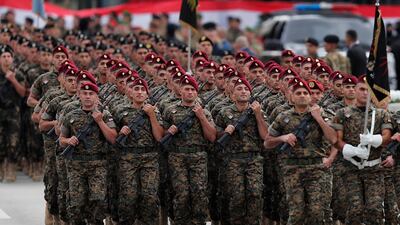
Lebanese army special forces march during a military parade to mark the 74th anniversary of Lebanon's independence from France. Hussein Malla / Reuters -
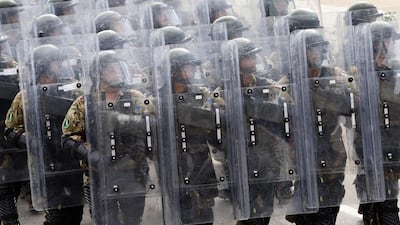
Members of the Lebanese security forces take part in a military parade in Beirut. Anwar Amro / AFP Photo -
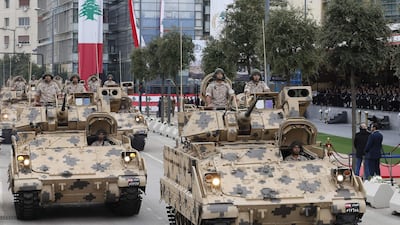
Tanks drive through Beirut. -
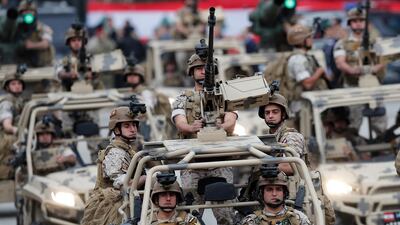
Lebanon's military parade coincided with Lebanese premier Saad Hariri's much anticipated return to Beirut. Hussein Malla / AP Photo -
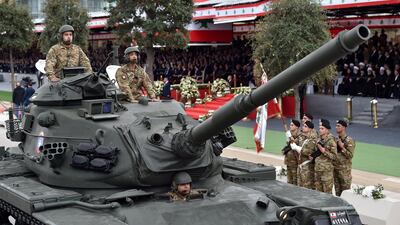
A tank battalion of the Lebanese army passes the presidential podium. Wael Hamzeh / EPA -
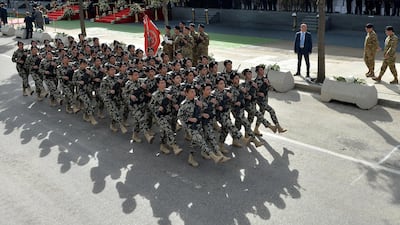
Lebanese troops march by. Wael Hamzeh / EPA -

Lebanon gained independence from France on November 22, 1943. Wael Hamzeh / EPA -
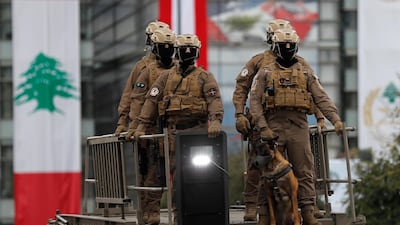
The Lebanese sniffer dog unit participate a military parade. Hussein Malla / AP Photo -
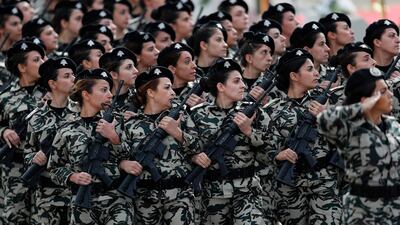
Women in the Lebanese General Security forces by. Hussein Malla / AP Photo -
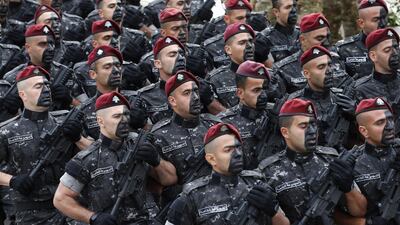
Anwar Amro / AFP Photo


The army regularly polls as Lebanon's most trusted public institution and is seen as being above the country's sectarian political infighting and working in public service.
Since mass protests started in 2019 and the situation deteriorated, most international donors have made clear assistance would go to the Lebanese people, not the state which is seen as responsible for the crisis after years of corruption and mismanagement.
With most aid to the military being donations of supplies, arms and equipment, shifting to direct cash injections will require different monitoring to ensure there's no corruption.
Some embassies also reject the idea of giving stipends for soldiers altogether, arguing it would be tantamount to admitting that Lebanon was essentially a failed state.
“For us, this is a normal state. They have a government, a budget and taxes. They should provide institutions with money,” said a European military source.
While some countries are still hesitant about cash transfers, they were prompt to respond to army chief Gen Joseph Aoun’s warning last March that his 80,000 to 85,000 soldiers were going hungry. The army scrapped meat from its meals in the summer of 2020 as inflation soared.
In recent months, countries including Jordan, Spain, Morocco and Turkey donated hundreds of tonnes of food parcels and medicines.
Germany will soon be sending 100,000 euros ($117,320) worth of medication, including over the counter drugs like ibuprofen, for military hospitals. France gave 200,000 euros ($234,650) worth of midazolam, a surgical anaesthetic.
-

A view of Lebanon's capital, Beirut, with the lights on only in some buildings. Lebanese rely on highly polluting diesel generators run by private neighbourhood operators to make up for shortfalls in electricity supply from the state utility. EPA -
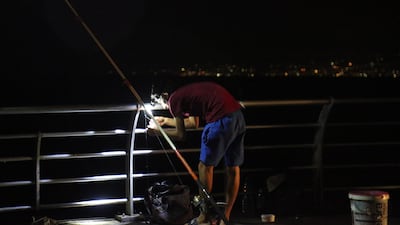
A fisherman uses a headlamp at the seaside corniche in Beirut, Lebanon. EPA -

A vendor sells LED balloons in full darkness at the corniche in Beirut. EPA -
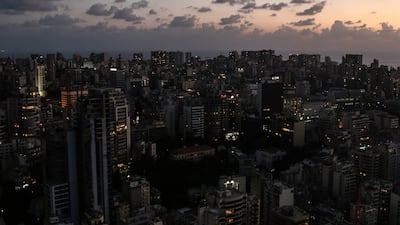
The near collapse of the national grid has increased the duration of power cuts across Lebanon. EPA -
Residents of Beirut are experiencing power cuts of up to 20 hours a day. EPA


These exceptional donations come in addition to pre-existing aid.
Some cash assistance, however, is already provided by allies and donors.
In May, Iraq flew in $2 million in cash to the army following its request to avoid the crumbling Lebanese banking sector.
The army’s biggest traditional donor is the US, which this year is transferring $59 million to reimburse for border security operations. This sum can be used at the army’s discretion.
Yet more is needed. Figures quoted by foreign embassies in Beirut show that aid disbursed until now constitutes no more than a fraction of the army’s requirements.
In July, Qatar started making regular donations of 70 tonnes of food every month, only 3.5 per cent of the 2,000 tonnes a month needed for soldiers and their families.
senior advisor in civil-military relations in Arab states for the Carnegie Middle East Center
Fighting over scarce resources is increasingly worrying foreign donors, who are concerned about the operational capacity of militant groups such as ISIS in Lebanon.
Flare-ups over fuel shortages can easily turn sectarian in a country still traumatised by 15 years of civil war that ended in 1990.
“We are noticing people falling back on local identities — clans, neighbourhoods, villages,” said a source. Traditional political parties, which represent the country’s different religious communities, are losing ground and struggling to arbitrate disputes, said another.
Once again, the army has had to step in.
In late August, it deployed to Akkar where two men died in clashes over logging. Shortly after, it intervened after fighting between Christian and Muslim towns in the south over fuel shortages.
Gen Aoun warned in June that the army was the only state institution still holding the country together.
“If unmitigated, the economic and financial crises will inevitably lead to the collapse of all state institutions, including the LAF [Lebanese armed forces], the backbone of the country and the sole remaining functioning institution,” he said.
For now, the army leadership’s flexible and tolerant attitude towards personnel has allowed it to limit desertions and maintain operations.
Aram Nerguizian, senior adviser in civil-military relations in Arab states for the Carnegie Middle East Centre, told The National that as of August between 1,500 and 2,000 soldiers, or less than 2 per cent of the army, had deserted their post since the crisis began.
“They’re being told by their commanders that there’s a light at the end of the tunnel and to hold out. This is an attrition game,” he said.
The European military source agreed, citing remaining incentives and lack of other well-paying jobs as a good reason to stay. “Think about it logically: if you desert, you don’t get your salary, you can’t send your family to the hospital any more, you don’t get fuel coupons and you don’t get help with school fees,” they said.
Multiple sources said the army organises rotations that allow soldiers to work two to three days a week. This both limits transport costs and allows them to hold down a second job.
Only 50 to 60 per cent of the force is on duty on any given day, according to one source.
But Mr Nerguizian said that if soldiers don't get enough financial aid, then the military risks being sucked into Lebanon's political clientelist networks and could start either racketeering or selling its services.
“That’s a golden opportunity for the establishment and cartels to say, hey come make some quick money on the side,” he said.
“It’s not happening yet, but it’s a risk.”

