


When French President Emmanuel Macron set out an ambitious road map to save Lebanon from economic collapse and rebuild Beirut after a deadly blast last year, the first step he required from politicians was to form a government capable of enacting reforms.
Such a move would have granted Lebanon access to billions of dollars in debt relief, loans and other projects at a time of severe financial crisis.
More than a year later, Lebanon’s fragmented political parties have finally agreed on a Cabinet headed by three-time Prime Minister Najib Mikati.
But 13 months of stalling as politicians squabbled for ministerial portfolios eroded the international community’s trust in the country’s leadership as the economic crisis worsened.
Economic collapse has devalued the local currency, pushed more than 70 per cent of the population into poverty and created shortages of subsidised goods such as fuel and medicine, which are imported using scarce US dollars.
Experts and diplomats have told The National they are cautiously optimistic about the new government and will be closely monitoring its actions in the coming weeks.
“What's expected from this government is very simple: holding proper elections on time and engaging with the IMF, because it’s the only way out of the crisis,” said Sami Nader, director of the Levant Institute for Strategic Affairs think tank.
The International Monetary Fund said a rescue package would be based upon political reform.
Mr Mikati on Friday pledged to hold the scheduled 2022 parliamentary elections on time. Lebanon’s last elections, held in 2018, had been postponed for five years.
IMF negotiations
-
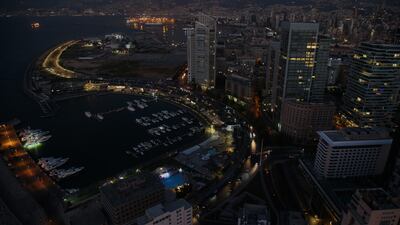
A view of Lebanon's capital, Beirut, with the lights on only in some buildings. Lebanese rely on highly polluting diesel generators run by private neighbourhood operators to make up for shortfalls in electricity supply from the state utility. EPA -
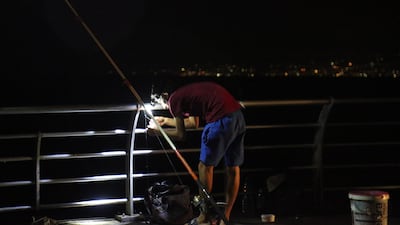
A fisherman uses a headlamp at the seaside corniche in Beirut, Lebanon. EPA -

A vendor sells LED balloons in full darkness at the corniche in Beirut. EPA -
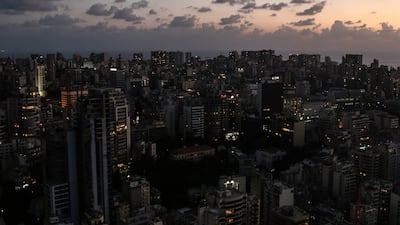
The near collapse of the national grid has increased the duration of power cuts across Lebanon. EPA -
Residents of Beirut are experiencing power cuts of up to 20 hours a day. EPA


Diplomatic sources and other experts have also told The National that the priority for the government should be restarting negotiations with the IMF.
The previous government had launched talks last year to secure a programme that would lift the country out of crisis after Lebanon defaulted for the first time on its debt.
Deliberations broke down when the government, Parliament and central bank quarrelled over the numbers of the bank’s losses.
“Whatever they do, the most important thing is that the ministers agree on an economic plan,” Mr Nader said, pointing out that when negotiations crashed last year, the government itself was split on the matter.
To secure an IMF programme, Lebanon would need to make sweeping reforms that have been demanded by international lenders and western countries for years.
These include overhauling a bloated public sector — starting with the country’s bankrupt public electricity company. Electricite du Liban's budget takes up roughly a quarter of Lebanon's annual public debt, yet the country has not had 24-hour electricity in 30 years.
Other reforms include tackling corruption and a forensic audit of the central bank.
While the new finance minister signed a new audit contract this week, a previous attempt last year ended in failure.
The central bank refused to provide restructuring consultancy Alvarez & Marsal with the proper paperwork to conduct the audit, citing banking secrecy concerns.
The new government’s economic team has a background close to the IMF and World Bank, which is a positive sign, a Middle Eastern diplomatic source told The National.
“But the political decision-making process is controlled by Hezbollah,” they said.
-
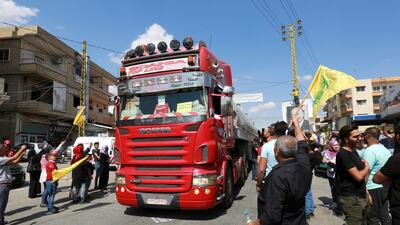
People wave Hezbollah flags as a convoy of tankers carrying Iranian fuel oil arrive in Baalbeck, Lebanon. Reuters -
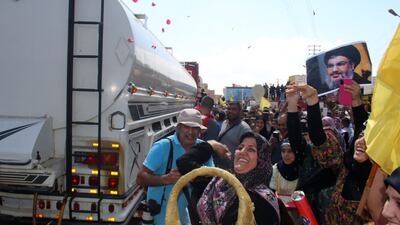
Dozens of tankers carrying Iranian fuel and transported by the Shiite Hezbollah movement, arrived from Syria in Lebanon, which is in the grip of severe fuel shortages. AFP -
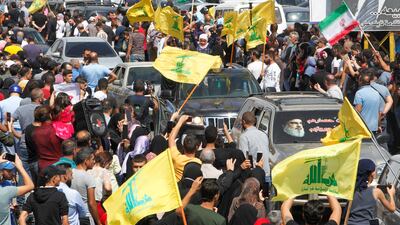
Hezbollah supporters cheer and fire guns into the air. Reuters -

Hezbollah says the arrival of the fuel will ease Lebanon's crippling energy crisis. Reuters -
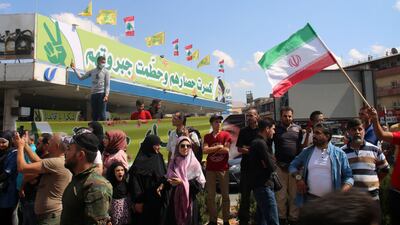
Fuel importers say the shipment will last only three days. AFP -

The delivery breaches US sanctions imposed on Tehran after former president Donald Trump pulled America out of a nuclear deal between Iran and world powers three years ago. AP Photo -
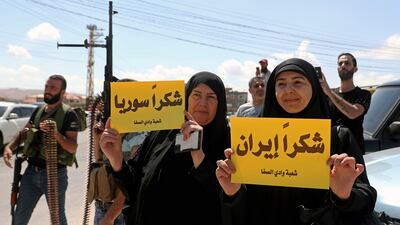
Hezbollah supporters with placards in Arabic that read "Thank you Iran," right, and "Thank you Syria." AP Photo -
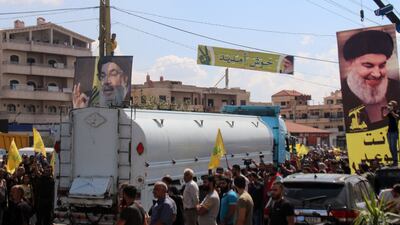
Hezbollah supporters with posters of the Shiite movement's leader Hassan Nasrallah as they gather to welcome tankers carrying Iranian fuel. AFP


The Iran-backed group, which wields significant power in Lebanon, has previously said it will not oppose an IMF package. But Hezbollah generally opposes austerity measures and any plans backed by the US.
“This shall create challenges for the government and the Lebanese people don't have the luxury of time,” the diplomatic source said.
One of the early jobs for the government is to update its financial recovery plan and go to the negotiating table with the IMF armed with unified numbers for the banking sector's losses.
Any real steps taken with the IMF, World Bank and creditors will give positive impressions regionally and internationally, the source said
“Donors have always expressed their readiness to support when such steps are taken.”
The Lebanese pound is officially pegged at 1,507.5 to the dollar and the central bank, Banque du Liban, currently finances wheat and some medicine imports at that exchange rate.
The IMF will probably ask to remove this peg because it is no longer sustainable and does not represent the real value of the Lebanese pound — which has fallen by about 90 per cent.
This essentially means lifting subsidies, which is another requirement from the international community.
“But politically speaking, these are very costly measures, especially before elections,” the diplomatic source said.
Parliamentary and presidential elections are scheduled in eight months, after which the current government will resign.
“Given the government’s short term in office, the best anticipated result is a wise management of the crisis.”
Lifting subsidies
Lebanon has been reeling from shortages of fuel and medicines because the central bank does not have enough foreign currency to continue financing imports of subsidised goods. The country relies on fuel to generate electricity.
Fuel shortages have led to frequent power cuts — sometimes up to 24 hours at a time — jeopardising safety at hospitals and creating long queues at petrol stations.
An IMF programme will likely go hand in hand with lifting subsidies and replacing them with social safety nets for the poor to avoid a humanitarian disaster.
In June, Parliament approved more than half a billion dollars in cash assistance to finance ration cards for 500,000 families — partly expected to be financed by Banque du Liban's dwindling foreign currency reserves.
A western source said that the way that ration card money will be disbursed will be “an important test”.
“There are fears that during an election year, the cards could be used for political purposes,” the source said.
Lebanon’s entrenched political class has been internationally criticised for corruption and for mismanaging the country’s finances, leading to financial ruin.
The country does not have a unified list of needy families. Instead, sectarian political parties often use financial aid to maintain their networks of supporters.
International lenders and donor countries say they want to ensure loans and cash assistance the country received is not squandered.
Mr Macron invested significant political capital to devise a French road map to save Lebanon that is backed by the international community.
As Lebanese politicians failed to enact reforms, France and the EU ramped up the pressure with threats of sanctions against political figures obstructing government formation and engaging in corruption.
After a government was finally formed this month, the French presidency issued a statement stressing the need for political leaders to follow up on their promise of enacting “the reforms necessary to Lebanon's future and to enable the international community to provide it with decisive assistance”.
Economic reforms
Diplomatic sources said they will be watching the government’s ministerial statement especially closely to gauge its resolve to deal with the crisis.
The plan, which has not been made public, outlines the government’s agenda for the country and should be discussed and approved by Parliament next week.
Mr Mikati has said before that IMF negotiations and reform would be on the agenda.
Another test for the new government is how it will allocate over $1.1 billion in Special Drawing Rights — an IMF asset — which was scheduled to be delivered in US dollars on Thursday.
“What they will be used for will be a revealing test for the international community,” the western diplomat said.
He added that passing budgets for 2021 and 2022 is another measure of good government the international community expects from the government.
Lebanon has not yet passed a budget for 2021.

