


The Iraqi Parliament on Thursday unanimously approved a law that criminalises the normalisation of relations with Israel.
The law was submitted by the influential Shiite cleric Moqtada Al Sadr, whose political movement was the clear winner in October's national elections.
The move is aimed to boost his profile as an anti-Israel politician and to alleviate his rival's concerns that his allies from Sunni and Kurdish parties will push for normalisation.
Iran-backed parties have continually spoken of the possibility that Israel could establish covert alliances within Iraq, in several instances singling out Mr Al Sadr's allies, the Kurdish Democratic Party, which they have accused of building bridges with the Israeli government.
The US has said it is “deeply disturbed” by the passing of the law.
The State Department said the law jeopardised freedom of expression and promoted “an environment of anti-Semitism”.
“This legislation stands in stark contrast to progress Iraq’s neighbours have made by building bridges and normalising relations with Israel,” said spokesman Ned Price.
The law expands on Iraq’s 1969 Penal Code, which stipulates that citizens who communicate with Israel will face prosecution and possibly the death penalty.
The current law goes into more detail, requiring all government institutions, officials, media outlets, companies and individuals to refrain from establishing relations with Israel.
It will apply not only Iraqi citizens, but also to foreigners visiting Iraq and any Israel-linked organisations and companies.
-
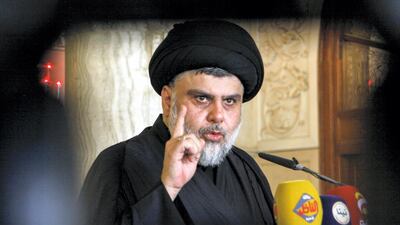
Iraqi Shiite cleric Moqtada Al Sadr delivering a speech to his supporters following Friday prayers, in September 2018. AFP -
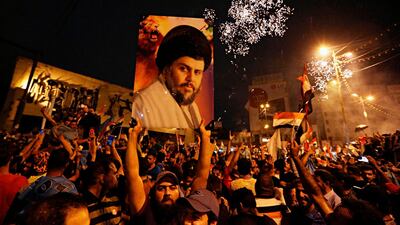
Supporters of Mr Al Sadr, who has gained popularity as a nationalist voice, campaigning against corruption. AP -
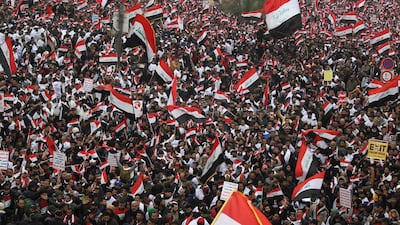
Thousands of Iraqis gathered in Baghdad on January 24, 2020, for a march called by the Shiite cleric Moqtada Al Sadr to demand that US troops leave Iraq. AFP -
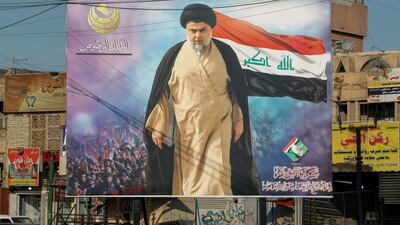
A poster of Mr Al Sadr in the Sadr City district of Baghdad. Reuters -
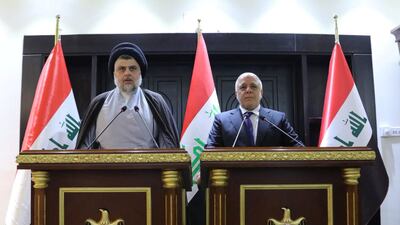
Mr Al Sadr, left, speaking at a news conference with Iraqi Prime Minister Haider Al Abadi, in Baghdad. Reuters -
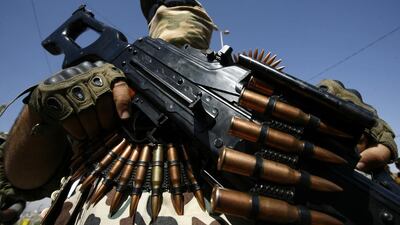
An Iraqi fighter from the Saraya AL Salam (Peace Brigades), a group formed by Mr Al Sadr, takes part in a parade in the central city of Kufa. AFP -

Mehdi Army fighters loyal to Shiite cleric Moqtada Al Sadr training in Basra in 2014, as Iraqi forces were massing north of Baghdad to strike back at Sunni Islamists. Reuters


It forbids “contact and communication of any kind and means with the occupying Zionist entity, its nationals and representatives, whether individuals or institutions or organisations, for any reason”.
The law also prohibits the “promotion of any ideas, ideologies, principles or Israeli or Zionist conduct in any form” as well as “financial or moral assistance” to Israel or any institution linked to it.
Those who violate the law will face potential “execution or lifelong imprisonment”.
A history of conflict
After the vote, Sadrist MPs waived Iraqi flags inside the Parliament and shouted: “No, no to Israel!” In a statement, Mr Al Sadr called on Iraqis to celebrate in the streets.
Since its establishment in 1948, Iraq has not recognised the state of Israel as a legitimate state and both countries are technically still in a state of war.
Iraq took part in the war following Israel's foundation in 1948 as well as the wars in 1967 and 1973.
It was the only Arab country that did not sign the ceasefire agreement that ended violent hostilities in 1949.
Israel has long considered Iraq, especially when it was under Saddam Hussein’s rule from the late 1970s to 2003, as a major security threat.
In 1981, Israel destroyed an unfinished nuclear reactor near Baghdad out of fear Iraq was developing nuclear weapons — a brazen air strike that took the world by surprise.
Being preoccupied by war with Iran, Iraq did not retaliate.
During the 1991 Gulf War launched by a US-led international coalition to oust Saddam's army from Kuwait, Iraq attacked Israeli territory with Scud missiles.
Even with the removal of Saddam’s regime and banning his Baath Party after the 2003 invasion, the issue of establishing relations with Israel has been a contentious one.
As a result of the decades-long conflict, Iraq lost what was once one of the largest Jewish communities in the Middle East, which dated back to the 6th century BC and ended with an exodus after the creation of Israel in 1948.
Today, only a handful of Jews are believed to remain in Baghdad, along with several hundred in the Kurdish region.
The 2003 invasion brought to power a number of Iran-backed political parties, many with influential militias that have fuelled anti-Israeli and anti-American sentiment in the country.
In recent years, normalisation of ties with Israel has taken root in the region as part of the Abraham Accords, a region-wide Middle East peace initiative.
The UAE, Sudan, Bahrain and Morocco have all announced normalisation agreements with Israel. Egypt and Jordan had already signed peace treaties with Israel in 1979 and 1993, respectively.
This has prompted calls in Iraq to follow their lead.
In September last year, more than 300 prominent tribal leaders and dignitaries gathered in Erbil, the capital of the semi-autonomous Kurdish region in northern Iraq, and called for ties with Israel to be normalised.
The meeting was arranged by a US think tank, the Centre for Peace Communications.
The Iraqi government rejected the meeting and issued arrest warrants for those who had attended.
Unlike Baghdad, authorities in the Kurdish region have friendly ties with Israel, but not diplomatic relations.
In previous years, Israel helped the Kurds to purchase their oil that they unilaterally exported to the international market, despite Baghdad's objections and a legal challenge. Israel also backed the Kurds' quest for independence when they held a referendum in 2017.
The bill comes nearly two months after Iran fired a dozen ballistic missiles at a civilian residential area near Erbil in the Kurdish region, claiming it had meant to hit an Israeli base. Baghdad and the Kurdish Regional Government strongly denied Iran's allegation that an Israeli base was present on Iraqi soil.

