• US President Joe Biden waves from a plane at King Abdulaziz International Airport in Jeddah. AFP
    US President Joe Biden waves from a plane at King Abdulaziz International Airport in Jeddah. AFP
  • US President Joe Biden boards a plane at King Abdulaziz International Airport in Jeddah. AFP
    US President Joe Biden boards a plane at King Abdulaziz International Airport in Jeddah. AFP
  • Mr Biden walks to the plane. AFP
    Mr Biden walks to the plane. AFP
  • President Sheikh Mohamed in discussion with Mr Biden during the Gulf Co-operation Council GCC+3 Jeddah Security and Development Summit. Photo: Abdulla Al Neyadi for the Presidential Court
    President Sheikh Mohamed in discussion with Mr Biden during the Gulf Co-operation Council GCC+3 Jeddah Security and Development Summit. Photo: Abdulla Al Neyadi for the Presidential Court
  • US President Joe Biden attends the Gulf Co-operation Council GCC+3 Jeddah Security and Development Summit at a hotel in the Saudi Arabian Red Sea coastal city. AFP
    US President Joe Biden attends the Gulf Co-operation Council GCC+3 Jeddah Security and Development Summit at a hotel in the Saudi Arabian Red Sea coastal city. AFP
  • Saudi Arabia's Crown Prince Mohammed bin Salman attends the Gulf Co-operation Council GCC+3 meeting in Jeddah. AFP
    Saudi Arabia's Crown Prince Mohammed bin Salman attends the Gulf Co-operation Council GCC+3 meeting in Jeddah. AFP
  • US President Joe Biden and Saudi Arabia's Crown Prince Mohammed bin Salman at the GCC+3 Jeddah Security and Development Summit. AFP
    US President Joe Biden and Saudi Arabia's Crown Prince Mohammed bin Salman at the GCC+3 Jeddah Security and Development Summit. AFP
  • President Sheikh Mohamed attended a traditional summit 'family photo call' in the company of, from left: Asaad bin Tariq Al Said, Omani Deputy Prime Minister for International Relations and Co-operation Affairs and the Special Representative of the Sultan; Sheikh Mohamed; Egypt's President Abdel Fattah El Sisi; Bahrain's King Hamad bin Isa bin Salman Al Khalifa; US President Joe Biden; Saudi Crown Prince Mohammed bin Salman; Jordan's King Abdullah II; Qatar's Emir Sheikh Tamim bin Hamad Al Thani; Kuwait's Crown Prince Mishal Al Ahmad Al Jaber Al Sabah, and Iraq's Prime Minister Mustafa Al Kadhimi. AFP
    President Sheikh Mohamed attended a traditional summit 'family photo call' in the company of, from left: Asaad bin Tariq Al Said, Omani Deputy Prime Minister for International Relations and Co-operation Affairs and the Special Representative of the Sultan; Sheikh Mohamed; Egypt's President Abdel Fattah El Sisi; Bahrain's King Hamad bin Isa bin Salman Al Khalifa; US President Joe Biden; Saudi Crown Prince Mohammed bin Salman; Jordan's King Abdullah II; Qatar's Emir Sheikh Tamim bin Hamad Al Thani; Kuwait's Crown Prince Mishal Al Ahmad Al Jaber Al Sabah, and Iraq's Prime Minister Mustafa Al Kadhimi. AFP
  • President Sheikh Mohamed is received by Saudi Arabia's Crown Prince Mohammed bin Salman upon his arrival at King Abdulaziz International Airport. Photo: Abdulla Al Neyadi for the Presidential Court
    President Sheikh Mohamed is received by Saudi Arabia's Crown Prince Mohammed bin Salman upon his arrival at King Abdulaziz International Airport. Photo: Abdulla Al Neyadi for the Presidential Court
  • President Sheikh Mohamed is received by Saudi Arabia's Prince Mohamed bin Salman upon his arrival at King Abdulaziz International Airport. Photo: Abdulla Al Neyadi for the Presidential Court
    President Sheikh Mohamed is received by Saudi Arabia's Prince Mohamed bin Salman upon his arrival at King Abdulaziz International Airport. Photo: Abdulla Al Neyadi for the Presidential Court
  • President Sheikh Mohamed greets Sheikh Mishal Al Sabah, Crown Prince of Kuwait, during the GCC+3 Jeddah Security and Development Summit. Photo: Rashed Al Mansoori / Presidential Court
    President Sheikh Mohamed greets Sheikh Mishal Al Sabah, Crown Prince of Kuwait, during the GCC+3 Jeddah Security and Development Summit. Photo: Rashed Al Mansoori / Presidential Court
  • US President Joe Biden and Secretary of State Antony Blinken meet Egyptian President Abdel Fattah El Sisi, Foreign Minister Sameh Shoukry and other officials during a bilateral meeting at a hotel in Saudi Arabia's Red Sea coastal city of Jeddah before the GCC+3 meeting. AFP
    US President Joe Biden and Secretary of State Antony Blinken meet Egyptian President Abdel Fattah El Sisi, Foreign Minister Sameh Shoukry and other officials during a bilateral meeting at a hotel in Saudi Arabia's Red Sea coastal city of Jeddah before the GCC+3 meeting. AFP
  • US President Joe Biden meets Iraqi Prime Minister Mustafa Al Kadhimi, in Jeddah before the beginning of the GCC+3 meeting. Reuters
    US President Joe Biden meets Iraqi Prime Minister Mustafa Al Kadhimi, in Jeddah before the beginning of the GCC+3 meeting. Reuters
  • Saudi Arabia's Crown Prince Mohammed bin Salman receives Sheikh Mishal Al Sabah, Crown Prince of Kuwait, before the GCC + 3 Jeddah Security and Development Summit on Saturday. SPA
    Saudi Arabia's Crown Prince Mohammed bin Salman receives Sheikh Mishal Al Sabah, Crown Prince of Kuwait, before the GCC + 3 Jeddah Security and Development Summit on Saturday. SPA
  • Saudi Arabia's Crown Prince Mohammed bin Salman and Egypt's President Abdel Fattah El Sisi arrive for the Jeddah summit. SPA
    Saudi Arabia's Crown Prince Mohammed bin Salman and Egypt's President Abdel Fattah El Sisi arrive for the Jeddah summit. SPA
  • US President Joe Biden participates in a working session with Saudi Crown Prince Mohammed bin Salman at Al Salam Palace in Jeddah. AP
    US President Joe Biden participates in a working session with Saudi Crown Prince Mohammed bin Salman at Al Salam Palace in Jeddah. AP
  • US President Joe Biden and US Secretary of State Antony Blinken in a bilateral meeting with Saudi officials led by Crown Prince Mohammed bin Salman at Al Salam Palace. Reuters
    US President Joe Biden and US Secretary of State Antony Blinken in a bilateral meeting with Saudi officials led by Crown Prince Mohammed bin Salman at Al Salam Palace. Reuters
  • Saudi Arabia's Crown Prince Mohammed bin Salman takes part in a working session with US President Joe Biden and his team. AFP
    Saudi Arabia's Crown Prince Mohammed bin Salman takes part in a working session with US President Joe Biden and his team. AFP
  • Saudi Arabia's King Salman greets US President Joe Biden at Al Salam Palace in Jeddah. Photo: @spagov
    Saudi Arabia's King Salman greets US President Joe Biden at Al Salam Palace in Jeddah. Photo: @spagov
  • King Salman and US President Joe Biden in discussions at Al Salam Palace in Jeddah. Photo: @spagov
    King Salman and US President Joe Biden in discussions at Al Salam Palace in Jeddah. Photo: @spagov
  • US President Joe Biden meets Saudi Crown Prince Mohammed bin Salman in Jeddah. Photo: @spagov
    US President Joe Biden meets Saudi Crown Prince Mohammed bin Salman in Jeddah. Photo: @spagov
  • US President Joe Biden arrives at King Abdulaziz International Airport in Jeddah. Photo: @spagov
    US President Joe Biden arrives at King Abdulaziz International Airport in Jeddah. Photo: @spagov
  • US President Joe Biden is welcomed by Saudi Arabian officials. AFP
    US President Joe Biden is welcomed by Saudi Arabian officials. AFP
  • Mr Biden disembarks from Air Force One at King Abdulaziz International Airport, following a flight from Tel Aviv. AFP
    Mr Biden disembarks from Air Force One at King Abdulaziz International Airport, following a flight from Tel Aviv. AFP
  • US Presidents Joe Biden salutes as he boards Air Force One at Ben Gurion International Airport in Lod, near Tel Aviv en route to a meeting with the GCC+3 in Jeddah, Saudi Arabia. Reuters
    US Presidents Joe Biden salutes as he boards Air Force One at Ben Gurion International Airport in Lod, near Tel Aviv en route to a meeting with the GCC+3 in Jeddah, Saudi Arabia. Reuters
  • Israel's President Isaac Herzog, second right, and caretaker Prime Minister Yair Lapid, centre, bid farewell to US President Joe Biden at Ben Gurion Airport. AFP
    Israel's President Isaac Herzog, second right, and caretaker Prime Minister Yair Lapid, centre, bid farewell to US President Joe Biden at Ben Gurion Airport. AFP
  • US President Joe Biden meets clergy at the Church of Nativity in Bethlehem, in the occupied West Bank. Reuters
    US President Joe Biden meets clergy at the Church of Nativity in Bethlehem, in the occupied West Bank. Reuters
  • US President Joe Biden is introduced to local people at the Church of Nativity in Bethlehem. Reuters
    US President Joe Biden is introduced to local people at the Church of Nativity in Bethlehem. Reuters
  • US President Joe Biden arrives at the Church of Nativity in Bethlehem, on the second full day of his Middle East visit. AFP
    US President Joe Biden arrives at the Church of Nativity in Bethlehem, on the second full day of his Middle East visit. AFP
  • US President Joe Biden and Palestinian President Mahmoud Abbas address the media after their meeting at the Muqataa Presidential Compound in Bethlehem, the occupied West Bank. AFP
    US President Joe Biden and Palestinian President Mahmoud Abbas address the media after their meeting at the Muqataa Presidential Compound in Bethlehem, the occupied West Bank. AFP
  • A photo of journalist Shireen Abu Akleh is placed on a chair as reporters wait for US President Joe Biden and Palestinian President Mahmoud Abbas to speak. She was killed in a raid by Israeli forces in May. The caption reads: 'Shireen Abu Akleh, voice of Palestine'. AP
    A photo of journalist Shireen Abu Akleh is placed on a chair as reporters wait for US President Joe Biden and Palestinian President Mahmoud Abbas to speak. She was killed in a raid by Israeli forces in May. The caption reads: 'Shireen Abu Akleh, voice of Palestine'. AP
  • US President Joe Biden with Palestinian President Mahmoud Abbas at a welcome ceremony at the Palestinian Muqataa Presidential Compound in Bethlehem, in the occupied West Bank. AFP
    US President Joe Biden with Palestinian President Mahmoud Abbas at a welcome ceremony at the Palestinian Muqataa Presidential Compound in Bethlehem, in the occupied West Bank. AFP
  • Palestinian President Mahmoud Abbas welcomes US President Joe Biden to the Israeli-occupied West Bank. Reuters
    Palestinian President Mahmoud Abbas welcomes US President Joe Biden to the Israeli-occupied West Bank. Reuters
  • A Palestinian security officer stands guard near the Church of the Nativity in Bethlehem in the occupied West Bank before US President Joe Biden’s official visit. AFP
    A Palestinian security officer stands guard near the Church of the Nativity in Bethlehem in the occupied West Bank before US President Joe Biden’s official visit. AFP
  • Palestinian and Israeli human rights campaigners lift banners during a rally near Augusta Victoria Hospital in East Jerusalem as US President Joe Binden visits. AFP
    Palestinian and Israeli human rights campaigners lift banners during a rally near Augusta Victoria Hospital in East Jerusalem as US President Joe Binden visits. AFP
  • US President Joe Biden greets fans as he attends the opening ceremony of the Maccabiah Games at Teddy Stadium in Jerusalem. AFP
    US President Joe Biden greets fans as he attends the opening ceremony of the Maccabiah Games at Teddy Stadium in Jerusalem. AFP
  • US President Joe Biden poses for a picture with US athletes competing in the Maccabiah Games. AFP
    US President Joe Biden poses for a picture with US athletes competing in the Maccabiah Games. AFP
  • People use the lights of their phones during the opening ceremony of the Maccabiah Games in Jerusalem, attended by US President Joe Biden. Reuters
    People use the lights of their phones during the opening ceremony of the Maccabiah Games in Jerusalem, attended by US President Joe Biden. Reuters
  • US athletes attend the opening ceremony of the Maccabiah Games in Jerusalem. AFP
    US athletes attend the opening ceremony of the Maccabiah Games in Jerusalem. AFP
  • The Maccabiah Games coincided with the US President Joe Biden's visit to the Middle East. AFP
    The Maccabiah Games coincided with the US President Joe Biden's visit to the Middle East. AFP
  • US President Joe Biden, centre, Israel's caretaker Prime Minister Yair Lapid, right, and President Isaac Herzog attend the opening ceremony for the Maccabiah Games in Jerusalem. Reuters
    US President Joe Biden, centre, Israel's caretaker Prime Minister Yair Lapid, right, and President Isaac Herzog attend the opening ceremony for the Maccabiah Games in Jerusalem. Reuters
  • A Palestinian protester carries a placard during a demonstration in the occupied West Bank city of Ramallah as US President Joe Biden visited Israel. AFP
    A Palestinian protester carries a placard during a demonstration in the occupied West Bank city of Ramallah as US President Joe Biden visited Israel. AFP
  • In Gaza City, Palestinian demonstrators wave their national flag as they gather to protest against the visit by US President Joe Biden to Israel. AFP
    In Gaza City, Palestinian demonstrators wave their national flag as they gather to protest against the visit by US President Joe Biden to Israel. AFP
  • A billboard, part of a campaign organised by the Centre for Human Rights B'Tselem, installed before US President Joe Biden's arrival for an official visit in the West Bank city of Bethlehem. PA
    A billboard, part of a campaign organised by the Centre for Human Rights B'Tselem, installed before US President Joe Biden's arrival for an official visit in the West Bank city of Bethlehem. PA
  • US President Joe Biden receives the Israeli Presidential Medal of Honour from Israeli President Isaac Herzog in Jerusalem. AP Photo
    US President Joe Biden receives the Israeli Presidential Medal of Honour from Israeli President Isaac Herzog in Jerusalem. AP Photo
  • US President Joe Biden, centre left, and President Isaac Herzog with children after Mr Biden's arrival at the presidential residence in Jerusalem. AFP
    US President Joe Biden, centre left, and President Isaac Herzog with children after Mr Biden's arrival at the presidential residence in Jerusalem. AFP
  • US President Joe Biden signs the guest book in the presence of President Isaac Herzog on arriving at the presidential residence in Jerusalem. AFP
    US President Joe Biden signs the guest book in the presence of President Isaac Herzog on arriving at the presidential residence in Jerusalem. AFP
  • US President Joe Biden with President Isaac Herzog and Mrs Michal Herzog in Jerusalem. AFP
    US President Joe Biden with President Isaac Herzog and Mrs Michal Herzog in Jerusalem. AFP
  • US and Saudi Arabian flags in a square in Jeddah, Saudi Arabia, before US President Joe Biden's visit. AP
    US and Saudi Arabian flags in a square in Jeddah, Saudi Arabia, before US President Joe Biden's visit. AP
  • US President Joe Biden and caretaker Israeli Prime Minister Yair Lapid at a press conference at the Waldorf Astoria Hotel in Jerusalem. EPA
    US President Joe Biden and caretaker Israeli Prime Minister Yair Lapid at a press conference at the Waldorf Astoria Hotel in Jerusalem. EPA
  • President Sheikh Mohamed delivers the opening speech during the I2U2 summit, a meeting between the leaders of the UAE, India, Israel and the US. Seen with Sheikh Abdullah bin Zayed, UAE Minister of Foreign Affairs and International Co-operation. Photo: Presidential Court
    President Sheikh Mohamed delivers the opening speech during the I2U2 summit, a meeting between the leaders of the UAE, India, Israel and the US. Seen with Sheikh Abdullah bin Zayed, UAE Minister of Foreign Affairs and International Co-operation. Photo: Presidential Court
  • President Sheikh Mohamed speaks with Indian Prime Minister Narendra Modi, US President Joe Biden and Israeli Prime Minister Yair Lapid during the I2U2 summit. Photo: Presidential Court
    President Sheikh Mohamed speaks with Indian Prime Minister Narendra Modi, US President Joe Biden and Israeli Prime Minister Yair Lapid during the I2U2 summit. Photo: Presidential Court
  • US President Joe Biden and caretaker Iraeli Prime Minister Yair Lapid address a joint press conference. AFP
    US President Joe Biden and caretaker Iraeli Prime Minister Yair Lapid address a joint press conference. AFP
  • US President Joe Biden and Israeli caretaker Prime Minister Yair Lapid during their meeting at a hotel in Jerusalem. AFP
    US President Joe Biden and Israeli caretaker Prime Minister Yair Lapid during their meeting at a hotel in Jerusalem. AFP
  • US President Joe Biden speaks to Holocaust survivors Dr Gita Cycowicz and Rena Quint in the Hall of Remembrance, at Yad Vashem in Jerusalem. AP
    US President Joe Biden speaks to Holocaust survivors Dr Gita Cycowicz and Rena Quint in the Hall of Remembrance, at Yad Vashem in Jerusalem. AP
  • US President Joe Biden participates in a wreath-laying ceremony in the Hall of Remembrance at Yad Vashem Holocaust Remembrance Centre in Jerusalem. AP
    US President Joe Biden participates in a wreath-laying ceremony in the Hall of Remembrance at Yad Vashem Holocaust Remembrance Centre in Jerusalem. AP
  • Israel's President Isaac Herzog speaks with US Secretary of State Antony Blinken and US President Joe Biden during their visit to Hall of Remembrance at Yad Vashem Holocaust Remembrance Centre in Jerusalem. Reuters
    Israel's President Isaac Herzog speaks with US Secretary of State Antony Blinken and US President Joe Biden during their visit to Hall of Remembrance at Yad Vashem Holocaust Remembrance Centre in Jerusalem. Reuters
  • Israeli Defence Minister Benny Gantz, left, US President Joe Biden, second left, caretaker Prime Minister Yair Lapid, right, and Brig Gen Shawn Harris, defence attache to the US embassy, in front of Israel's Iron Dome defence system during a tour at Ben Gurion Airport. AP
    Israeli Defence Minister Benny Gantz, left, US President Joe Biden, second left, caretaker Prime Minister Yair Lapid, right, and Brig Gen Shawn Harris, defence attache to the US embassy, in front of Israel's Iron Dome defence system during a tour at Ben Gurion Airport. AP
  • US President Joe Biden waves as he leaves Israel's Ben Gurion Airport on his way to Jerusalem. EPA
    US President Joe Biden waves as he leaves Israel's Ben Gurion Airport on his way to Jerusalem. EPA
  • US President Joe Biden, centre, stands for the national anthems alongside Secretary of State Antony Blinken, second left, Israel's President Herzog, third left, caretaker Prime Minister Yair Lapid, third right, and departing prime minister Naftali Bennett, second right, at Ben Gurion Airport. AFP
    US President Joe Biden, centre, stands for the national anthems alongside Secretary of State Antony Blinken, second left, Israel's President Herzog, third left, caretaker Prime Minister Yair Lapid, third right, and departing prime minister Naftali Bennett, second right, at Ben Gurion Airport. AFP
  • Caretaker Israeli Prime Minister Yair Lapid and President Isaac Herzog welcome US President Joe Biden to Israel as his trip begins. Reuters
    Caretaker Israeli Prime Minister Yair Lapid and President Isaac Herzog welcome US President Joe Biden to Israel as his trip begins. Reuters

How Arab states are dealing with a multipolar world


Ahmed Maher
  • English
  • Arabic

The apparent disengagement of the US from the Middle East has put traditional alliances with Washington in the Arab world to the test, and seen its major powers increasingly perceive the world today as multipolar, analysts say.

Responses from Middle Eastern countries to Russia's invasion of US-backed Ukraine have shown a pragmatic approach to the European crisis.

Meanwhile, the failure to address Iran’s missile and drone programme as part of the spluttering nuclear talks, the preoccupation with China and now Russia, as well as a series of foreign policy miscalculations by US President Joe Biden, have encouraged policymakers in the region to rethink the reliability of their traditional American ally.

“Having long been frustrated by shifting US priorities, Arab states have embraced this pragmatic national interest-oriented approach to politics to avoid having to pick sides and balance their economic ties with China against the security relationships with the US,” Sanam Vakil, deputy director of the Middle East North Africa programme at the London-based Chatham House think tank, told The National.

“With the outcome of the war [in Ukraine] also uncertain, this policy also helps Arab states protect their longer-term ties with all countries.”

The US president is visiting the Middle East this week. His first stops are Israel and Palestine, where he will hold high-profile meetings.

Mr Biden will then attend a summit in Saudi Arabia that will bring together leaders from the GCC, as well as Iraq, Egypt and Jordan.

In the coastal Saudi city of Jeddah, the American president is scheduled to meet King Salman and Crown Prince Mohammed bin Salman.

Last month, Mr Biden said that the purpose of his first visit to the Middle East as president wasn’t to pressure Saudi Arabia into producing more oil to stabilise global energy markets, as fuel prices hit a record $5 per gallon in his country in June.

“No, I’m not going to ask them,” he told reporters in Madrid, on the sidelines of a Nato summit last month.

“All the Gulf states are meeting. I’ve indicated to them that I thought they should be increasing oil production generically, not to Saudi Arabia in particular. I hope we see them in their own interests concluding that makes sense to do.”

Amid reports of strained ties over US policies in the region and the murder of Saudi journalist Jamal Khashoggi, Saudi and American officials have been keen in recent months — through press statements by the Saudi embassy in Washington and briefings by the US State Department and the White House — to demonstrate how bilateral ties remain “historic and strong”.

But with the US also sending signals that it might be losing interest in the region, China has emerged as a strong commercial and security partner to fill the potential void.

In March, Saudi Arabia’s Minister of State for Foreign Affairs Adel Al Jubeir met China’s special envoy for Middle East affairs Zhai Jun in Riyadh, where they announced the establishment of a high-level joint committee to boost 32 years of diplomatic ties between the two G20 giants.

The kingdom is China’s second largest oil supplier, after Russia, while China is the leading trading partner and exporter to the Saudi market — with trade volume estimated in 2020 at more than $30 billion. In second place is India.

Saudi Crown Prince Mohammad bin Salman meets China's President Xi Jinping in Beijing. Photo: Saudi Press Agency

Saudi Arabia incorporated the Chinese language in its curriculum last year. This is intended to enhance the employability of future generations, as Mandarin is spoken by about one-fifth of the world’s population.

Prince Mohammed visited China in 2019 and was received by Chinese President Xi Jinping.

“Saudi Arabia first of all is driven by its primary export commodity, oil, so China is its largest market and Russia is the second largest oil exporter and hence an essential partner in OPEC+,” Ali Al Shihabi, a Saudi political analyst and member of the advisory board of Neom — a planned mega city-state in the Saudi Arabian desert as part of the Vision 2030 project — told The National.

Arab pragmatism

The response of the Arab world’s heavyweights like the UAE, Saudi Arabia and Egypt to the Russian-Ukraine war has revealed a pragmatic and principled approach to the European crisis.

Last month, Dr Anwar Gargash, Diplomatic Adviser to the UAE President and former Minister of State for Foreign Affairs, said the UAE's principles “are not swayed by outbursts, emotions and the politics of axes” when it comes to the crisis in Ukraine.

“This applies to our stand on the war in Ukraine, which is based on international law, refusing to use force, respecting the sovereignty of states, and resolving disputes through the political and diplomatic track,” Dr Gargash said.

“We live in a region that has always suffered from violence and we are aware of its meanings, impacts and negative repercussions on all aspects of life.”

Almost a month after the start of the war in Ukraine, UAE Minister of Foreign Affairs and International Co-operation Sheikh Abdullah bin Zayed visited Moscow and met with his Russian counterpart, Sergey Lavrov.

Sheikh Abdullah emphasised the need for a diplomatic solution to the war between the two agricultural powerhouses.

Minister of Foreign Affairs and International Co-Operation Sheikh Abdullah bin Zayed and Russian Foreign Minister Sergey Lavrov following talks in Moscow. AP

The UAE, China and India abstained in a February 26 UN Security Council resolution condemning Russia's invasion — a bill vetoed by Moscow — but supported a March 2 General Assembly vote deploring the war and calling for the immediate halt to all hostilities.

As the US always stresses that its foreign policy is based on its national security and its own interests, first and foremost, it is quite natural that Arab countries should think likewise, analysts say.

It is understandable that Arab countries will examine the dynamics of nudging a bit away from the orbit of the world’s superpower and biggest economy, to explore strategic partnerships with world powers, they add.

“It should be noted that power is never infinite. Even in the heyday of its hegemony, the US could not always enforce the outcomes it wanted,” Nael M Shama, an Egyptian political scholar and guest contributor to the Washington-based Middle East Institute think tank, told The National.

“Today, as ever, outcomes on any given issue are determined by a plethora of factors and actors. Obviously, the less crucial to the national interest of the US, the less willing any US administration will be to engage with it.”

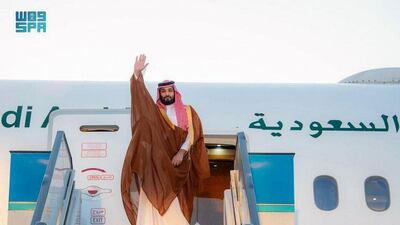
  • Saudi Crown Prince Mohammed bin Salman left Turkey's capital Ankara on Thursday. SPA
    Saudi Crown Prince Mohammed bin Salman left Turkey's capital Ankara on Thursday. SPA
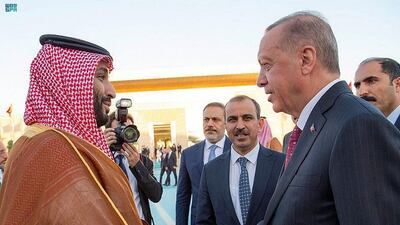
  • Turkish President Recep Tayyip Erdogan says goodbye to Saudi Crown Prince Mohammed bin Salman. SPA
    Turkish President Recep Tayyip Erdogan says goodbye to Saudi Crown Prince Mohammed bin Salman. SPA
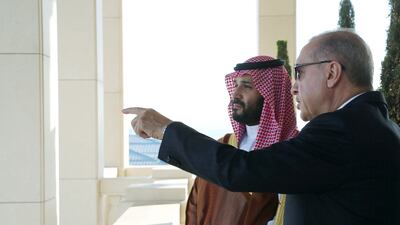
  • Turkish President Recep Tayyip Erdogan and Saudi Crown Prince Mohammed bin Salman meet at the Presidential Palace in Ankara. Reuters
    Turkish President Recep Tayyip Erdogan and Saudi Crown Prince Mohammed bin Salman meet at the Presidential Palace in Ankara. Reuters
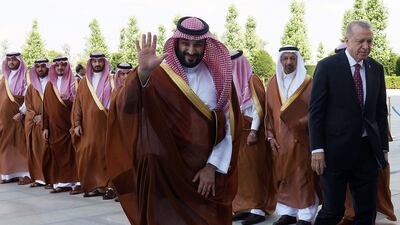
  • Turkey's President Recep Tayyip Erdogan posing with Crown Prince of Saudi Arabia Mohammed bin Salman during an official ceremony at the Presidential Complex in Ankara. AFP
    Turkey's President Recep Tayyip Erdogan posing with Crown Prince of Saudi Arabia Mohammed bin Salman during an official ceremony at the Presidential Complex in Ankara. AFP
  • Turkey's President Recep Tayyip Erdogan (R) posing with Crown Prince of Saudi Arabia Mohammed bin Salman (L) during an official ceremony at the Presidential Complex in Ankara. AFP
    Turkey's President Recep Tayyip Erdogan (R) posing with Crown Prince of Saudi Arabia Mohammed bin Salman (L) during an official ceremony at the Presidential Complex in Ankara. AFP
  • Turkey's President Recep Tayyip Erdogan (2ndR) welcoming Crown Prince of Saudi Arabia Mohammed bin Salman (R) during an official ceremony at the Presidential Complex in Ankara. AFP
    Turkey's President Recep Tayyip Erdogan (2ndR) welcoming Crown Prince of Saudi Arabia Mohammed bin Salman (R) during an official ceremony at the Presidential Complex in Ankara. AFP
  • Crown Prince of Saudi Arabia Mohammed bin Salman waves as he is welcomed by Turkey's President Recep Tayyip Erdogan (R) during an official ceremony at the Presidential Complex in Ankara. AFP
    Crown Prince of Saudi Arabia Mohammed bin Salman waves as he is welcomed by Turkey's President Recep Tayyip Erdogan (R) during an official ceremony at the Presidential Complex in Ankara. AFP
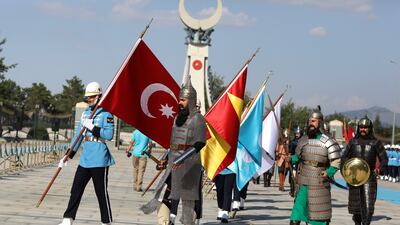
  • Honour guard members representing former Turkish states walk after a ceremony for Saudi Crown Prince Mohammed bin Salman shake hands during a welcoming ceremony, in Ankara. AP
    Honour guard members representing former Turkish states walk after a ceremony for Saudi Crown Prince Mohammed bin Salman shake hands during a welcoming ceremony, in Ankara. AP
  • This is Prince Mohammed's first visit to Turkey since 2018. AFP
    This is Prince Mohammed's first visit to Turkey since 2018. AFP
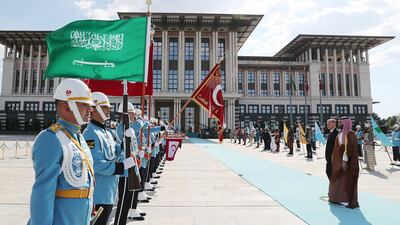
  • Mr Erdogan and Prince Mohammed review a guard of honour during a welcoming ceremony at the Presidential Complex. Reuters
    Mr Erdogan and Prince Mohammed review a guard of honour during a welcoming ceremony at the Presidential Complex. Reuters

Security alliance in the region

Egypt and Israel are other regional powers that walk a diplomatic tightrope — with the US and Europe on the one hand, Russia and China on the other — to enhance and protect their own interests.

Both countries are strategic allies of the US in the region and have been the largest recipients of American security aid since their landmark US-brokered peace agreement in 1979.

Last month, Egyptian President Abdel Fattah El Sisi was principal guest at Russia’s St Petersburg International Economic Forum, participating online. A high-profile Egyptian delegation of ministers and business figures attended the forum.

Egypt, the world’s top wheat buyer, depends on imports from Russia and Ukraine for about 80 per cent of its needs.

On the same day, Egypt, Israel and the EU signed in Cairo a preliminary agreement to increase liquefied natural gas sales to Europe, which has been seeking ways to reduce its dependence on Russian gas.

European Commission President Ursula von der Leyen looks on as, from left, EU Energy Commissioner Kadri Simson, Egyptian Minister of Petroleum Tarek El Molla and Israeli Energy Minister Karine Elharrar sign an agreement at the East Mediterranean Gas Forum in Cairo. Reuters

Since the start of the Ukraine war, Israel has been aware of the importance of maintaining warm ties with Moscow.

Russia backs the Syrian government and operates a naval base in the port of Tartus. Israel and Moscow co-ordinate to prevent Israeli and Russian forces from clashing in Syrian airspace when Israel launches air strikes in Syria against suspected weapons depots belonging to Iran’s proxy in Lebanon, Hezbollah.

But Russia and China cannot replace the US as a strategic security partner in the Middle East.

This comes amid reports and official statements in Israel that the US decided to sponsor an air defence alliance in the region to protect it from Iranian missiles launched by Tehran proxies, analysts say.

Ms Vakil from Chatham House says Russia, China and India have aligned their interests in the region, mainly due to their own commercial and trade gains.

“China and India [in particular] have commercial relations that supersede any strategic intent to counter the US [in the region],” she said.

“Additionally, China has long been a free rider of US security in the Middle East and has made no effort to supplant the US or wade into any of the myriad regional conflicts. Russia has proved important in OPEC+ arrangements and is a key actor in Syria but it too has limited ability, particularly now, to stabilise the region or address regional security challenges.”


What are NFTs?

Are non-fungible tokens a currency, asset, or a licensing instrument? Arnab Das, global market strategist EMEA at Invesco, says they are mix of all of three.

You can buy, hold and use NFTs just like US dollars and Bitcoins. “They can appreciate in value and even produce cash flows.”

However, while money is fungible, NFTs are not. “One Bitcoin, dollar, euro or dirham is largely indistinguishable from the next. Nothing ties a dollar bill to a particular owner, for example. Nor does it tie you to to any goods, services or assets you bought with that currency. In contrast, NFTs confer specific ownership,” Mr Das says.

This makes NFTs closer to a piece of intellectual property such as a work of art or licence, as you can claim royalties or profit by exchanging it at a higher value later, Mr Das says. “They could provide a sustainable income stream.”

This income will depend on future demand and use, which makes NFTs difficult to value. “However, there is a credible use case for many forms of intellectual property, notably art, songs, videos,” Mr Das says.

Updated: July 13, 2022, 11:30 AM