Tunisia's President Kais Saied, right, receives Ennahda leader and parliament speaker Rached Ghannouchi at the presidential palace in November 2019. Tunisian Presidency / AFP

What is Article 80 of Tunisia’s constitution?


Ahmed Maher
  • English
  • Arabic

Tunisia’s President Kais Saied on Sunday sacked the prime minister, suspended Parliament and lifted the immunity of its members, citing a constitutional provision for times of “imminent danger” to the country.

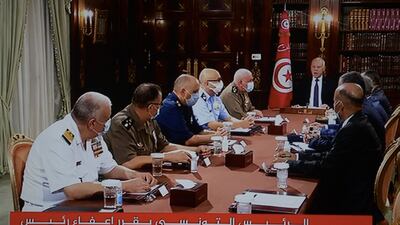
In a speech broadcast after an emergency meeting of military and security officers at Carthage Palace, Mr Saied said he was taking over the executive authority and would name a new head of Cabinet to replace Hichem Mechichi.

The president said his actions were based on Article 80 of the country’s 2014 constitution.

“We took these decisions so that social peace returns to Tunisia and that we save the country,” he said.

His opponents, including key political movements and parties, accuse Mr Saied of staging a coup against democracy.

Mr Mechichi has the backing of the largest party in parliament, Ennahda, which is entitled in this capacity by the constitution to nominate the PM.

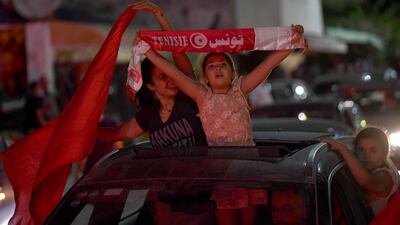
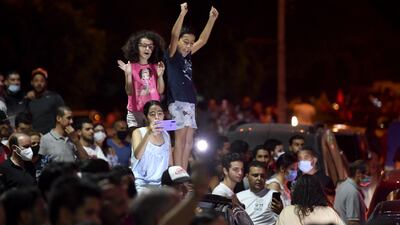
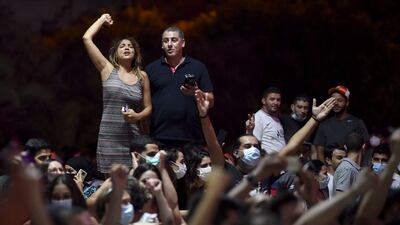
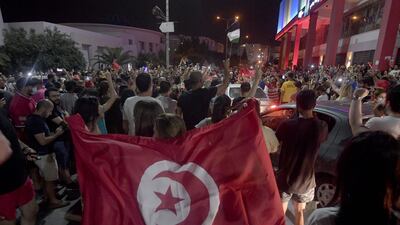
  • People celebrate on the streets after Tunisian President Kais Saied announced the dissolution of parliament and Prime Minister Hichem Mechichi's government in Tunis on July 25, 2021.
    People celebrate on the streets after Tunisian President Kais Saied announced the dissolution of parliament and Prime Minister Hichem Mechichi's government in Tunis on July 25, 2021.
  • The president announced the suspension of Tunisia's parliament following a day of protests against the ruling party.
    The president announced the suspension of Tunisia's parliament following a day of protests against the ruling party.
  • Thousands of Tunisians waved flags and honked horns in cities and towns across the country.
    Thousands of Tunisians waved flags and honked horns in cities and towns across the country.
  • Crowds sang the national anthem.
    Crowds sang the national anthem.
  • Tunisia has been in a political crisis for months, as the country tackles an economic crunch and the pandemic.
    Tunisia has been in a political crisis for months, as the country tackles an economic crunch and the pandemic.
  • The street celebrations were held under the watch of military personnel, reports said.
    The street celebrations were held under the watch of military personnel, reports said.
  • A woman raises the Tunisian flag.
    A woman raises the Tunisian flag.
  • President Kais Saied, flanked by military officials, announces the dissolution of parliament and Prime Minister Mechichi's government.
    President Kais Saied, flanked by military officials, announces the dissolution of parliament and Prime Minister Mechichi's government.
  • Mr Saied said he would assume executive authority with the assistance of a new prime minister.
    Mr Saied said he would assume executive authority with the assistance of a new prime minister.

What does Article 80 say?

According to Article 80 of the Tunisia’s constitution, relating to emergency measures, “The President of the Republic, in a state of imminent danger threatening the integrity of the country and the country’s security and independence, is entitled to take the measures necessitated by this exceptional situation, after consulting the Prime Minister and the Speaker of the Cabinet”.

The article does not authorise the president to dissolve the Parliament, and stipulates that the measures imposed are aimed at restoring stability and ensuring that state institutions function properly.

It also provides for the emergency measures to be challenged, stating that “thirty days after implementation of these measures, the Constitutional Court, at the request of the Speaker of the Parliament or 30 of its members, is entrusted with a decision on the continuation of the exceptional situation or not”.

The court must “declare its decision publicly within a maximum period of 15 days, and the implementation of these measures shall be terminated when the reasons for them cease to exist”.

But although the 2014 constitution provides for a Constitutional Court to resolve such situations, none has been established.

Often hailed as the sole success of the 2011 Arab unrest that toppled several regimes in the region, the Tunisian uprising has not led to stability economically or politically.

Mr Saied’s decision on Sunday followed violent protests over the government’s handling of the recent surge in Covid cases and continuing economic hardship.


Dubai Bling season three

Cast: Loujain Adada, Zeina Khoury, Farhana Bodi, Ebraheem Al Samadi, Mona Kattan, and couples Safa & Fahad Siddiqui and DJ Bliss & Danya Mohammed 

Rating: 1/5

'Cheb%20Khaled'
%3Cp%3E%3Cstrong%3EArtist%3A%20%3C%2Fstrong%3EKhaled%3Cbr%3E%3Cstrong%3ELabel%3A%20%3C%2Fstrong%3EBelieve%3Cbr%3E%3Cstrong%3ERating%3A%3C%2Fstrong%3E%204%2F5%3C%2Fp%3E%0A
ALRAWABI%20SCHOOL%20FOR%20GIRLS
%3Cp%3ECreator%3A%20Tima%20Shomali%3C%2Fp%3E%0A%3Cp%3EStarring%3A%C2%A0Tara%20Abboud%2C%C2%A0Kira%20Yaghnam%2C%20Tara%20Atalla%3C%2Fp%3E%0A%3Cp%3ERating%3A%204%2F5%3C%2Fp%3E%0A

Mercer, the investment consulting arm of US services company Marsh & McLennan, expects its wealth division to at least double its assets under management (AUM) in the Middle East as wealth in the region continues to grow despite economic headwinds, a company official said.

Mercer Wealth, which globally has $160 billion in AUM, plans to boost its AUM in the region to $2-$3bn in the next 2-3 years from the present $1bn, said Yasir AbuShaban, a Dubai-based principal with Mercer Wealth.

Within the next two to three years, we are looking at reaching $2 to $3 billion as a conservative estimate and we do see an opportunity to do so,” said Mr AbuShaban.

Mercer does not directly make investments, but allocates clients’ money they have discretion to, to professional asset managers. They also provide advice to clients.

“We have buying power. We can negotiate on their (client’s) behalf with asset managers to provide them lower fees than they otherwise would have to get on their own,” he added.

Mercer Wealth’s clients include sovereign wealth funds, family offices, and insurance companies among others.

From its office in Dubai, Mercer also looks after Africa, India and Turkey, where they also see opportunity for growth.

Wealth creation in Middle East and Africa (MEA) grew 8.5 per cent to $8.1 trillion last year from $7.5tn in 2015, higher than last year’s global average of 6 per cent and the second-highest growth in a region after Asia-Pacific which grew 9.9 per cent, according to consultancy Boston Consulting Group (BCG). In the region, where wealth grew just 1.9 per cent in 2015 compared with 2014, a pickup in oil prices has helped in wealth generation.

BCG is forecasting MEA wealth will rise to $12tn by 2021, growing at an annual average of 8 per cent.

Drivers of wealth generation in the region will be split evenly between new wealth creation and growth of performance of existing assets, according to BCG.

Another general trend in the region is clients’ looking for a comprehensive approach to investing, according to Mr AbuShaban.

“Institutional investors or some of the families are seeing a slowdown in the available capital they have to invest and in that sense they are looking at optimizing the way they manage their portfolios and making sure they are not investing haphazardly and different parts of their investment are working together,” said Mr AbuShaban.

Some clients also have a higher appetite for risk, given the low interest-rate environment that does not provide enough yield for some institutional investors. These clients are keen to invest in illiquid assets, such as private equity and infrastructure.

“What we have seen is a desire for higher returns in what has been a low-return environment specifically in various fixed income or bonds,” he said.

“In this environment, we have seen a de facto increase in the risk that clients are taking in things like illiquid investments, private equity investments, infrastructure and private debt, those kind of investments were higher illiquidity results in incrementally higher returns.”

The Abu Dhabi Investment Authority, one of the largest sovereign wealth funds, said in its 2016 report that has gradually increased its exposure in direct private equity and private credit transactions, mainly in Asian markets and especially in China and India. The authority’s private equity department focused on structured equities owing to “their defensive characteristics.”

Bullet%20Train
%3Cp%3E%3Cstrong%3EDirector%3A%3C%2Fstrong%3E%20David%20Leitch%3Cbr%3E%3Cstrong%3EStars%3A%3C%2Fstrong%3E%20Brad%20Pitt%2C%20Aaron%20Taylor-Johnson%2C%20Brian%20Tyree%20Henry%2C%20Sandra%20Bullock%3Cbr%3E%3Cstrong%3ERating%3A%3C%2Fstrong%3E%203%2F5%3C%2Fp%3E%0A
How to protect yourself when air quality drops

Install an air filter in your home.

Close your windows and turn on the AC.

Shower or bath after being outside.

Wear a face mask.

Stay indoors when conditions are particularly poor.

If driving, turn your engine off when stationary.

Abu Dhabi GP schedule

Friday: First practice - 1pm; Second practice - 5pm

Saturday: Final practice - 2pm; Qualifying - 5pm

Sunday: Etihad Airways Abu Dhabi Grand Prix (55 laps) - 5.10pm

From Zero

Artist: Linkin Park

Label: Warner Records

Number of tracks: 11

Rating: 4/5

AL%20BOOM
%3Cp%20style%3D%22text-align%3Ajustify%3B%22%3E%26nbsp%3B%26nbsp%3B%26nbsp%3BDirector%3AAssad%20Al%20Waslati%26nbsp%3B%3C%2Fp%3E%0A%3Cp%20style%3D%22text-align%3Ajustify%3B%22%3E%0DStarring%3A%20Omar%20Al%20Mulla%2C%20Badr%20Hakami%20and%20Rehab%20Al%20Attar%0D%3Cbr%3E%0D%3Cbr%3EStreaming%20on%3A%20ADtv%0D%3Cbr%3E%0D%3Cbr%3ERating%3A%203.5%2F5%0D%3Cbr%3E%0D%3Cbr%3E%3C%2Fp%3E%0A
Who was Alfred Nobel?

The Nobel Prize was created by wealthy Swedish chemist and entrepreneur Alfred Nobel.

  • In his will he dictated that the bulk of his estate should be used to fund "prizes to those who, during the preceding year, have conferred the greatest benefit to humankind".
  • Nobel is best known as the inventor of dynamite, but also wrote poetry and drama and could speak Russian, French, English and German by the age of 17. The five original prize categories reflect the interests closest to his heart.
  • Nobel died in 1896 but it took until 1901, following a legal battle over his will, before the first prizes were awarded.
Global state-owned investor ranking by size

1.

United States

2.

China

3.

UAE

4.

Japan

5

Norway

6.

Canada

7.

Singapore

8.

Australia

9.

Saudi Arabia

10.

South Korea

Updated: July 27, 2021, 8:16 AM