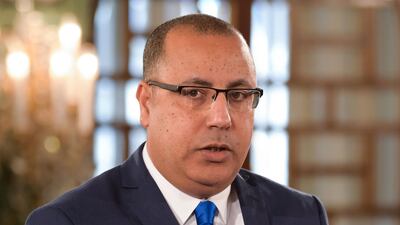
Tunisia's President Kais Saied picked Hichem Mechichi to be the next prime minister and form a new government.
Mr Mechichi, who served as Tunisia's interior minister, succeeds Elyes Fakhfakh, who resigned this month. The president's office confirmed the appointment on Saturday.
Mr Mechichi, a 46-year-old lawyer, was not one of the names proposed by the ruling political parties.
As well as being the interior minister in the outgoing government, Mr Mechichi has been a counsellor to Mr Saied, handling legal matters.
He has previously been chief of staff at the transport ministry and also served in the social affairs ministry.
Mr Mechichi now has a month to form a government against a background of political tensions among the major parties.
At that point, his choice will be put to a parliamentary vote of confidence and will need an absolute majority to succeed. Failing that, parliament will be dissolved and new elections organised within three months.
In elections held in October, the Ennahda party came out on top but fell far short of a majority – holding 54 of 217 seats in parliament – and eventually agreed to join a coalition government.
Mr Fakhfakh, a former finance and tourism minister, and leader of the obscure Ettakatol party, was asked to lead the broad coalition in February.
After his appointment, he quickly formed a government of experts in an attempt to lead the nation out of an economic crisis.
Mr Fakhfakh resigned last week after almost half of parliament’s lawmakers filed a no-confidence motion in his rule amid a showdown with the biggest party in the assembly.
The motion was the result of allegations of conflicts of interest involving Mr Fakhfakh, linked to documents published by an independent MP last month that appeared to show Mr Fakhfakh owns shares in companies that won deals worth $15 million (Dh55.1m) from the state.
Mr Fakhfakh has denied he did anything improper and attempted to stave off his downfall by promising a Cabinet reshuffle.
His rivals are still not safe. Parliament speaker and Ennahda leader Rashed Ghannouchi is also facing a motion of censure, accused of "exceeding his prerogatives".
Mr Mechichi will face an uphill battle to bring Tunisia's warring parliament together to face the coronavirus crisis and the economic issues the outbreak exacerbated.
-
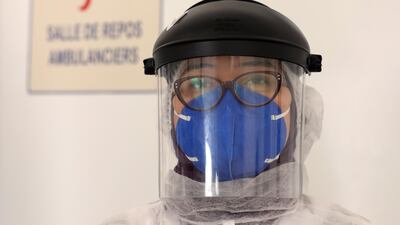
Abir Mdini, a physician of SAMU Tunisia, wears protective equipment before visiting the coronavirus patients in Tunis, Tunisia. EPA -
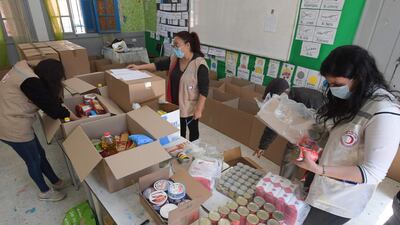
Members of Tunisian Red Crescent prepare food packages for the elderly and low-income families in the coastal town of Ezzahra near Tunis during the coronavirus pandemic. AFP -
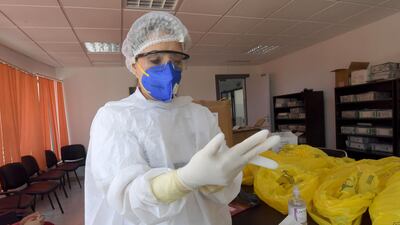
Saida Zelfani, a physician of SAMU Tunisia, dressed in personal protective equipment (PPE) puts on latex glove before attempting to get a swab sample of suspected Covid-19 patients in the capital Tunis. AFP -
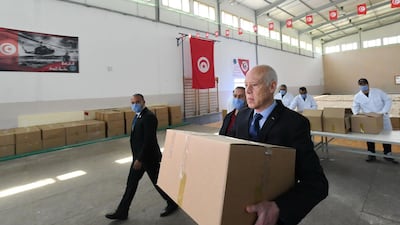
President Kais Saied taking part in the distribution of aid packages amid the coronavirus pandemic, in Gammarth town on the outskirts of Tunis. AFP -
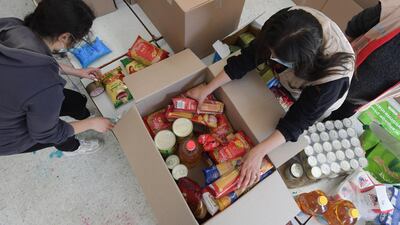
Members of Tunisian Red Crescent prepare food packages for the elderly and low-income families in the coastal town of Ezzahra near Tunis. AFP -
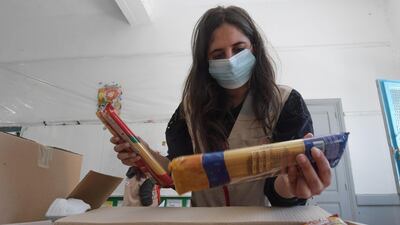
A member of Tunisian Red Crescent prepares food packages for the elderly and low-income families in the coastal town of Ezzahra near Tunis. AFP -
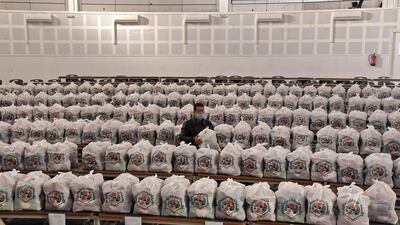
An employee of the Tunisian Social Solidarity Union prepares food packages for the elderly and low-income families in Tunis. AFP -
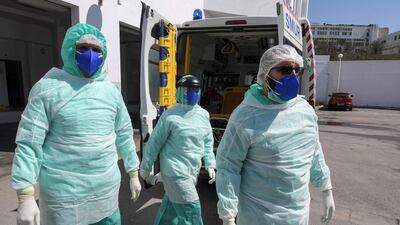
Medical and paramedical staff of SAMU Tunisia dressed in personal protective equipment (PPE) head out to visit a coronavirus patient in the capital Tunis. AFP -
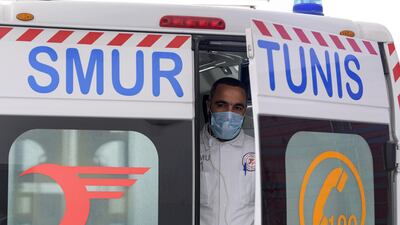
A paramedic rescuer of SAMU Tunisia looks out from the back of an ambulance in the capital Tunis. AFP


Nearly a decade after the uprising that deposed long-time dictator Zine El Abidine Ben Ali, the country is still struggling to combat inequality in different regions.
Southern Tunisia is one of the country’s most marginalised regions, with above-average unemployment, failing infrastructure and a stunted private sector.
Protests have rocked the southern towns of Remada and Tataouine, with demonstrators demanding the government honour a 2017 pledge to invest millions of Tunisian dinars to develop the region and provide jobs to thousands.
Tunisia’s constitution splits power between the head of state and the government, leading to several periods of political struggles between them in recent years.

