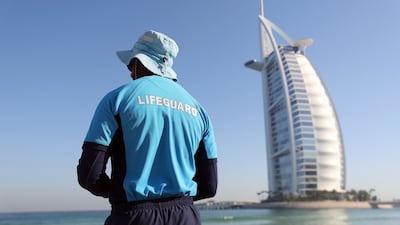
As temperatures begin to cool across the UAE, outdoor activities are making a welcome return, with beaches once again becoming popular destinations for residents and visitors alike.
While some brave the summer heat for a day by the sea, others are returning to the water after months away. With this in mind, water safety experts are urging beachgoers to familiarise themselves with essential precautions, particularly families with young children and those who are less confident swimmers.
“I would hope that most families choose lifeguarded beaches, stay within designated swimming areas and follow the advice of the lifeguards,” says Paul Stokes, founder and head coach at Ocean Warriors Lifesaving Club.

“That’s really what beach safety is about. It’s not about being frightened of the ocean. It’s about understanding it, respecting it and knowing what you would do if something changed.”
What are the biggest beach safety risks in the UAE?
The UAE is home to dozens of beaches, including popular destinations such as Dubai’s Jumeirah and Kite Beach, Abu Dhabi’s Saadiyat Beach and Ras Al Khaimah’s Al Hamra Beach, as well as quieter spots such as Dibba “Secret” Beach in Fujairah.
While many of the busier ones have lifeguards, they are not all always monitored, which makes beach safety even more important. UAE beaches with lifeguards are usually monitored from sunrise to sunset, with floodlights set up at designated night beaches.

Stokes says one of the biggest risks beachgoers face is being unfamiliar with the beach they are visiting.
“People should look for information boards and beach signs and actually read them. They should check where the lifeguarded swimming areas are and understand what the red and yellow flags mean," he says.
"They should also understand dangers such as rips and currents, wave types, effects of tides, weather, water temperature, marine life, prevailing winds, sun and heat exposure and the type of beach they are on.”
The green flag means conditions are safe for swimming; yellow means exercise caution; red signals that you should not enter the water; purple means the potential presence of harmful marine life, such as jellyfish; and red and yellow flags are used to identify designated, lifeguarded swimming areas.
Experts say that, beyond understanding beach conditions, it is equally important to recognise your own swimming abilities and those of your children.
“Beach safety is about knowing your child, knowing your own ability and understanding the environment you’re swimming in,” adds Daniel Wright, Learn to Swim manager at Hamilton Aquatics. “The sea is very different to a swimming pool, so before you get in, think about things like the depth, water temperature, waves and currents.”
How can parents keep children safe around the water?
Experts agree that the number one thing parents and carers can do to ensure children are safe at the beach is to supervise them at all times.
“There’s a great line from an Australian water safety campaign: ‘Watch me, not your phone’,” says Wright. “It’s simple, but it really says it all. It can take just seconds for a swimmer to get into difficulty, so putting the phone away and keeping your eyes on them whilst they are in the water should be a top priority.”

While statistics on drownings and water-related incidents are not centralised or published annually across all seven emirates, figures from National Ambulance offer some insight into the risks.
In 2021, the service responded to more than 194 drowning-related incidents at swimming pools and beaches across the Northern Emirates. Among the most common risk factors were swimming when lifeguards were off duty and lapses in supervision.
Teaching children basic water safety rules and regularly reinforcing those rules are also essential, including staying in shallow water and swimming within designated lifeguarded areas.
“Nothing beats constant, active adult supervision,” says Stokes. “When your children are in or around the water, your eyes should always be on them and you should be actively engaged with what they are doing."
He also recommends that children wear bright-coloured, high-visibility swimming costumes and rash vests – orange and pink have been identified as the easiest colours to see in the water.
He adds: “I would recommend always having a plan and a checklist. Have a family discussion about the ‘what if’ scenarios. What happens if someone gets into difficulty? Where is the lifeguard? What do the flags mean? Who would call for help?”
While learning to swim is one of the most vital water safety skills for young children, practising basic skills such as treading water and floating is also important. The idea of “self-rescue” is also taught at swimming schools, where children who can’t yet swim learn to stay afloat and wait for help, or manage to reach a ledge to hold onto.
How can you tell if someone is drowning?
A common misconception is that a drowning person makes a lot of noise, calling for help, while visibly splashing around. In reality, most drownings are quiet and fast, as the person struggles to stay afloat, using all their energy to keep their head out of the water rather than call for help.
“A good tip for parents is to watch for when your child starts losing their footing or can no longer stand comfortably,” says Wright. “You may notice them tiptoeing as the water gets deeper, with the waterline creeping up towards their chin; that’s a good sign to step in before they get into difficulty.”

Stokes identifies the four types of swimmers who might get into difficulty in the water and describes what they might look like.
He explains that a non-swimmer in difficulty may appear upright in the water, facing the shore and making climbing-like movements with their arms as they struggle to keep their head above the surface.
A weak swimmer may show signs of distress through ineffective strokes, with their head tilted back and sitting low in the water.
An injured swimmer may wave or call for help while holding the affected part of their body, while an unconscious person may be floating face down, with water washing over them.
"If you see someone potentially drowning or in difficulty, your priority should be to call for help and alert the lifeguards," says Wright.
"Wanting to make a rescue is brave, but attempting a rescue without the right training can put you in serious danger, too. A rescuer without training can very quickly become another casualty.”