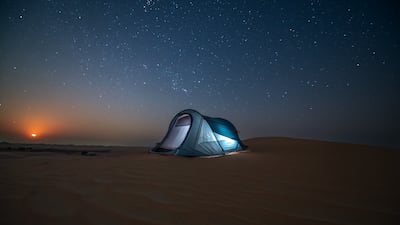

There's a unique peace that comes with watching the sunset in the UAE desert, surrounded by the vastness and beauty of the Arabian landscape. It's difficult to tear your eyes away as the glowing orange sun disappears behind the honey-coloured dunes.
Even the air smells different in the desert. As my heels sink into the soft sand, I almost feel guilty for disturbing the patterns nature has created: red grains painting ripples across a golden canvas. I'm told the reddish hue is the result of iron in the sand reacting with moisture and oxygen, forming a layer of oxidised grains. Nature's art.
I'm at Al Quaa, popularly known as the Milky Way spot, about a 90-minute drive from Abu Dhabi towards Al Ain. Considered the darkest location in the UAE, its unobstructed views of the night sky make it ideal for stargazing and camping during the cooler months.

Here's what to expect from an overnight glamping stay with Arabian Wanderers.
The journey

We are collected at 3pm from a petrol station in Abu Dhabi, before being driven through the city until we reach sandy terrain. Camels and livestock begin to appear as we approach our destination.
About 100 people join each trip, but the experience is intended to feel personalised, so we are divided into groups of 20 and assigned an adventure leader before heading to separate camps across the desert.
After a short ride, we arrive at our campsite and make our way to the top of a dune to watch the sunset. Pink, orange and yellow hues melt together on the skyline while 4x4 vehicles zoom past, expertly navigating the desert. Al Quaa is windy and the desert is typically five degrees cooler than the city.
Tents, food, drinks, chairs and bathrooms are included in the experience. We start a bonfire soon after the sun goes down and get to know our campmates, a combination of people from all over the UAE and tourists. Our camp leader, Umni, prepares games and questions for us. Arguably, the best part of camping is sitting around a fire and sharing stories.
The food that follows is a mixed grill of kebab and meat skewers, alongside salads and hummus. We also enjoy marshmallows by the fire and chat a little longer before our next adventure begins.
Saturn the diamond ring
Being in the darkest spot in the UAE means the stars appear to shine brighter in the night sky than they do in the city. Although I've spent a few winter nights in the desert, it is a new experience to learn about the sky while stargazing.
The set-up is simple: cushions lie on the sand, angled to give a full view of the night sky while reclining.
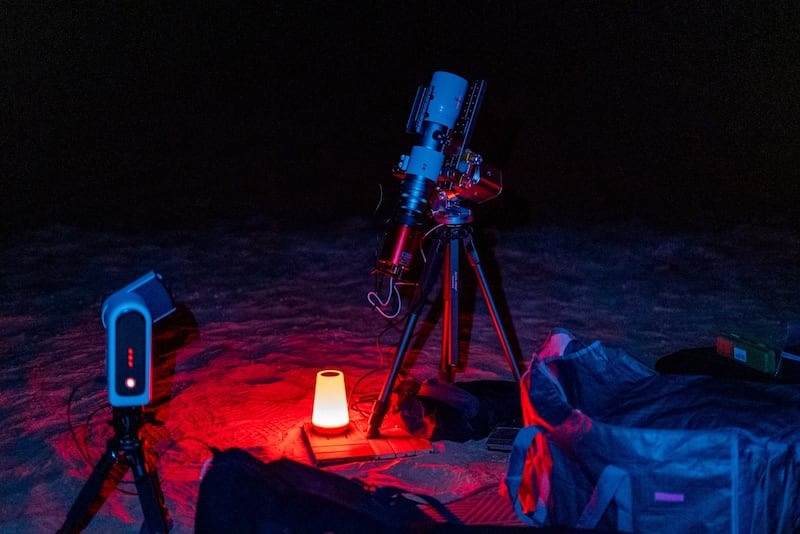
Our teacher, Rashid, is an astrophysicist whose favourite star is Sirius, the brightest in our night sky. It is 10pm and Sirius has not come out yet, but Rashid says if we look hard enough, it will call to us soon.
We are encouraged to put our phones away, to avoid our eyes having to repeatedly readjust. This leaves the crescent moon as our only source of light. Avoiding a full moon night is essential to see the stars in full view.
We take turns looking through the telescope as the moon slowly disappears into the horizon, its craters visible even from 380,000km away.

The group then pivots to Saturn, sitting bright in the sky, though unrecognisable to the untrained eye. Through the telescope, Saturn looks like a diamond ring, white and glowing.
While using the telescope is enjoyable, you don't need it to see the stars on a clear night.
When we settle on to the cushions, Rashid gives us a history lesson about the Bedouin who once navigated the desert by looking for the North Star. By identifying the constellations during different seasons, they were able to determine which way was north.
We also examine constellations and star clusters, from Orion's Belt to Pleiades (or Seven Sisters). Occasionally, a shooting star flashes by and is gone in an instant.
If you're interested in mapping out the stars and identifying them, apps such as SkyView Lite or Stellarium help to enrich the experience.
The more I look at the stars, the smaller I feel. The reminder that I am merely one person compared to the billions of people on Earth and stars in the sky is both freeing and humbling.
One for the glampers

I'm not a fan of camping after trying it a few times, so the upgraded prospect of glamping was exciting. The glamping accommodation is much larger than a traditional tent – big enough to include an air mattress, an air couch, two side tables and some lamps.
Fairy lights decorate the exterior and two chairs with floor cushions are also provided.
The tent has a mechanism allowing it to be zipped completely, or left partially open with a screen to let air in.
Early bird catches the worm

Going to my tent that night, I wonder how it would feel to live in the desert. The vastness is both liberating and suffocating. I remind myself that this is just one night away from the hustle and bustle of city life and it's a relief.
But the night is short and morning soon arrives. I wake up at 5.30am to watch the sunrise, and it does not disappoint. I sit down at the top of a high dune and feel the cool sand escape between my fingers. Soon, the entire camp join me and we quietly watch the colours melt into one another. When the burning red sun reaches the middle of the sky with hues of pink all around it, I take a mental snapshot, hoping I'll never forget it.
The verdict
It is no secret that desert nights are among the most popular activities during the UAE winter. While I'm no stranger to desert bonfires and barbecues, the stargazing session with an astronomer and watching the sunrise were unforgettable.
Whether you're seeking a short weekend break from city life or looking for a special experience, the desert is the perfect spot.
Packages for Arabian Wanderers' glamping experiences range between Dh450 and 1,650 per person depending on the day and type of accommodation. Reservations can be made by calling 052 206 7219

