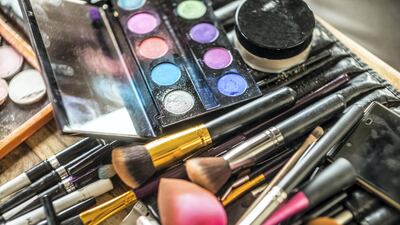
Is your dressing table or bathroom cabinet brimming with make-up, perfumes, skin creams and other beauty products that never get used but you refuse to throw away? Mine too. But now seems like a good time to sort through the mess.
This’ll be one of those jobs that feels like a chore beforehand, but will be oddly satisfying once you’re done – and, if you can keep things in order, it will pay off for weeks and months to come.
Make-up and beauty products are often treated as pick-me-up buys; little treats that don’t cost too much, so we end up overstocking. Also, in our constant quest to find exactly the right concealer / moisturiser / shade of red lipstick, there’s often a fair amount of collateral damage – products that were almost the right fit, but not quite, and now loiter in your bathroom cabinet.
Here's a step-by-step guide to reorganising that clutter.
Get everything out in the open
Empty those drawers, tip out your make-up bag, rustle around in your handbags for those stray lipsticks. Get everything out where you can see it. It’ll give you some perspective on your buying habits. It may be that you are that rare woman who only buys what she needs, and only replaces a product once another is finished. Or, you may discover, once you have everything laid out in front of you, that you are a bit of a hoarder. This may be something to ruminate over moving forward.
Go for the cull
Newsflash: that lipstick that you’ve been saving since the early 2000s needs to go. All make-up has a use-by date, and its shelf life is shorter than you might think.
Once opened, liquid products should generally be used within six months, while other beauty products shouldn’t, as a rule, be kept for longer than a year. Old products may potentially be harbouring germs, and that caked-up mascara and splodgy nail polish are of no use to anyone.
Be honest
What do you actually use – and what actually suits you? We know that palette looks lovely on the outside, but have you actually ever applied the emerald green eyeshadow that is housed within? Your tastes may also have changed since you last sorted through your make-up, so be realistic about what you’ll actually use, and put everything else to the side.
With things that you haven’t used yet, why not wait until our social distancing days are behind us and see if you have any friends that might benefit from the unused items you no longer need. A blusher that looks all wrong on you may be perfect for one of your pals.
Categorise
Separate skincare, haircare and beauty products, and then create sub-categories that make sense to you. For make-up, you can divide things by skin, eyes and lips, for example. Or you might prefer to divide by day make-up and night make-up, or regular use and special occasion. Either way, have a dedicated container for each sub-category. If you are feeling particularly zealous, you can then organise products by colour – this is particularly useful for lipsticks, eyeshadows and nail polishes.
Clean
Take the time to disinfect brushes, sponges and the inside of your make-up and toiletry bags. A build-up of dirt and oils on your make-up brushes can cause breakouts, so you should be cleaning them regularly (aim for once a week).
A foolproof method is to squeeze a dollop of shampoo or dishwasher liquid into a mug and then fill with warm water; swirl your brushes in the mixture and gentle massage the bristles, before cleaning with clean water and laying flat to dry. Use a disinfecting wipe to clean out plastic-lined make-up bags, and throw soft cloth ones straight into the washing machine.
Store properly
If you really want to get organised, invest in a set of clear containers, or a dedicated acrylic make-up box, with drawers and dividers. A transparent container will remind you what you have and so you’ll be more inclined to use it. Beauty bloggers swear by Glamboxes’s Glam Luxe Makeup Box, but you can also find similar items at the likes of Muji and Ikea.
You can also transform items you already have in your home into handy make-up containers. Once you’ve burnt that fancy scented candle to the bottom, reuse the container to store make-up brushes or eye pencils. Similarly, the boxes that sunglasses come in make excellent storage facilities for mascaras, and lip and eye pencils. Nail polishes can be kept in a glass biscuit jar. Just make sure to keep everything out of direct sunlight.
Waste not want not
Finally, why not make a vow to start using what you have before you buy anything new? It’ll be good for your wallet and good for the environment. Or at least promise that before your next purchase, you’ll stop and think about all the unused items you already have waiting for you (now tidily organised) in your bathroom?
_________________
Read more:
Got vinegar and baking soda in the cupboard? Nine DIY cleaning products to make at home
14 easy ways to make home improvements
Huda Kattan bares all: 'I grew up thinking my skin wasn’t light enough, which wasn’t right'
_________________

Dengue%20fever%20symptoms
%3Cul%3E%0A%3Cli%3EHigh%20fever%3C%2Fli%3E%0A%3Cli%3EIntense%20pain%20behind%20your%20eyes%3C%2Fli%3E%0A%3Cli%3ESevere%20headache%3C%2Fli%3E%0A%3Cli%3EMuscle%20and%20joint%20pains%3C%2Fli%3E%0A%3Cli%3ENausea%3C%2Fli%3E%0A%3Cli%3EVomiting%3C%2Fli%3E%0A%3Cli%3ESwollen%20glands%3C%2Fli%3E%0A%3Cli%3ERash%3C%2Fli%3E%0A%3C%2Ful%3E%0A%3Cp%3EIf%20symptoms%20occur%2C%20they%20usually%20last%20for%20two-seven%20days%3C%2Fp%3E%0A
Kandahar%20
%3Cp%3E%3Cstrong%3EDirector%3A%3C%2Fstrong%3E%20Ric%20Roman%20Waugh%3C%2Fp%3E%0A%3Cp%3E%3Cstrong%3EStars%3A%C2%A0%3C%2Fstrong%3EGerard%20Butler%2C%20Navid%20Negahban%2C%20Ali%20Fazal%3C%2Fp%3E%0A%3Cp%3E%3Cstrong%3ERating%3A%3C%2Fstrong%3E%202.5%2F5%3C%2Fp%3E%0A
Mercer, the investment consulting arm of US services company Marsh & McLennan, expects its wealth division to at least double its assets under management (AUM) in the Middle East as wealth in the region continues to grow despite economic headwinds, a company official said.
Mercer Wealth, which globally has $160 billion in AUM, plans to boost its AUM in the region to $2-$3bn in the next 2-3 years from the present $1bn, said Yasir AbuShaban, a Dubai-based principal with Mercer Wealth.
“Within the next two to three years, we are looking at reaching $2 to $3 billion as a conservative estimate and we do see an opportunity to do so,” said Mr AbuShaban.
Mercer does not directly make investments, but allocates clients’ money they have discretion to, to professional asset managers. They also provide advice to clients.
“We have buying power. We can negotiate on their (client’s) behalf with asset managers to provide them lower fees than they otherwise would have to get on their own,” he added.
Mercer Wealth’s clients include sovereign wealth funds, family offices, and insurance companies among others.
From its office in Dubai, Mercer also looks after Africa, India and Turkey, where they also see opportunity for growth.
Wealth creation in Middle East and Africa (MEA) grew 8.5 per cent to $8.1 trillion last year from $7.5tn in 2015, higher than last year’s global average of 6 per cent and the second-highest growth in a region after Asia-Pacific which grew 9.9 per cent, according to consultancy Boston Consulting Group (BCG). In the region, where wealth grew just 1.9 per cent in 2015 compared with 2014, a pickup in oil prices has helped in wealth generation.
BCG is forecasting MEA wealth will rise to $12tn by 2021, growing at an annual average of 8 per cent.
Drivers of wealth generation in the region will be split evenly between new wealth creation and growth of performance of existing assets, according to BCG.
Another general trend in the region is clients’ looking for a comprehensive approach to investing, according to Mr AbuShaban.
“Institutional investors or some of the families are seeing a slowdown in the available capital they have to invest and in that sense they are looking at optimizing the way they manage their portfolios and making sure they are not investing haphazardly and different parts of their investment are working together,” said Mr AbuShaban.
Some clients also have a higher appetite for risk, given the low interest-rate environment that does not provide enough yield for some institutional investors. These clients are keen to invest in illiquid assets, such as private equity and infrastructure.
“What we have seen is a desire for higher returns in what has been a low-return environment specifically in various fixed income or bonds,” he said.
“In this environment, we have seen a de facto increase in the risk that clients are taking in things like illiquid investments, private equity investments, infrastructure and private debt, those kind of investments were higher illiquidity results in incrementally higher returns.”
The Abu Dhabi Investment Authority, one of the largest sovereign wealth funds, said in its 2016 report that has gradually increased its exposure in direct private equity and private credit transactions, mainly in Asian markets and especially in China and India. The authority’s private equity department focused on structured equities owing to “their defensive characteristics.”
U19 WORLD CUP, WEST INDIES
UAE group fixtures (all in St Kitts)
- Saturday 15 January: UAE beat Canada by 49 runs
- Thursday 20 January: v England
- Saturday 22 January: v Bangladesh
UAE squad:
Alishan Sharafu (captain), Shival Bawa, Jash Giyanani, Sailles
Jaishankar, Nilansh Keswani, Aayan Khan, Punya Mehra, Ali Naseer, Ronak Panoly,
Dhruv Parashar, Vinayak Raghavan, Soorya Sathish, Aryansh Sharma, Adithya
Shetty, Kai Smith
Who was Alfred Nobel?
The Nobel Prize was created by wealthy Swedish chemist and entrepreneur Alfred Nobel.
- In his will he dictated that the bulk of his estate should be used to fund "prizes to those who, during the preceding year, have conferred the greatest benefit to humankind".
- Nobel is best known as the inventor of dynamite, but also wrote poetry and drama and could speak Russian, French, English and German by the age of 17. The five original prize categories reflect the interests closest to his heart.
- Nobel died in 1896 but it took until 1901, following a legal battle over his will, before the first prizes were awarded.
Islamophobia definition
A widely accepted definition was made by the All Party Parliamentary Group on British Muslims in 2019: “Islamophobia is rooted in racism and is a type of racism that targets expressions of Muslimness or perceived Muslimness.” It further defines it as “inciting hatred or violence against Muslims”.
%3Cp%3EMATA%0D%3Cbr%3EArtist%3A%20M.I.A%0D%3Cbr%3ELabel%3A%20Island%0D%3Cbr%3ERating%3A%203.5%2F5%3C%2Fp%3E%0A
Emergency
Director: Kangana Ranaut
Stars: Kangana Ranaut, Anupam Kher, Shreyas Talpade, Milind Soman, Mahima Chaudhry
Rating: 2/5
Tips from the expert
Dobromir Radichkov, chief data officer at dubizzle and Bayut, offers a few tips for UAE residents looking to earn some cash from pre-loved items.
- Sellers should focus on providing high-quality used goods at attractive prices to buyers.
- It’s important to use clear and appealing photos, with catchy titles and detailed descriptions to capture the attention of prospective buyers.
- Try to advertise a realistic price to attract buyers looking for good deals, especially in the current environment where consumers are significantly more price-sensitive.
- Be creative and look around your home for valuable items that you no longer need but might be useful to others.
Who's who in Yemen conflict
Houthis: Iran-backed rebels who occupy Sanaa and run unrecognised government
Yemeni government: Exiled government in Aden led by eight-member Presidential Leadership Council
Southern Transitional Council: Faction in Yemeni government that seeks autonomy for the south
Habrish 'rebels': Tribal-backed forces feuding with STC over control of oil in government territory
Profile
Company: Justmop.com
Date started: December 2015
Founders: Kerem Kuyucu and Cagatay Ozcan
Sector: Technology and home services
Based: Jumeirah Lake Towers, Dubai
Size: 55 employees and 100,000 cleaning requests a month
Funding: The company’s investors include Collective Spark, Faith Capital Holding, Oak Capital, VentureFriends, and 500 Startups.
Indoor Cricket World Cup
Venue Insportz, Dubai, September 16-23
UAE squad Saqib Nazir (captain), Aaqib Malik, Fahad Al Hashmi, Isuru Umesh, Nadir Hussain, Sachin Talwar, Nashwan Nasir, Prashath Kumara, Ramveer Rai, Sameer Nayyak, Umar Shah, Vikrant Shetty
World record transfers
1. Kylian Mbappe - to Real Madrid in 2017/18 - €180 million (Dh770.4m - if a deal goes through)
2. Paul Pogba - to Manchester United in 2016/17 - €105m
3. Gareth Bale - to Real Madrid in 2013/14 - €101m
4. Cristiano Ronaldo - to Real Madrid in 2009/10 - €94m
5. Gonzalo Higuain - to Juventus in 2016/17 - €90m
6. Neymar - to Barcelona in 2013/14 - €88.2m
7. Romelu Lukaku - to Manchester United in 2017/18 - €84.7m
8. Luis Suarez - to Barcelona in 2014/15 - €81.72m
9. Angel di Maria - to Manchester United in 2014/15 - €75m
10. James Rodriguez - to Real Madrid in 2014/15 - €75m
More from Aya Iskandarani
UAE currency: the story behind the money in your pockets
