


Royal wedding fever has gripped Jordan ahead of the marriage of Crown Prince Hussein and Rajwa Al Saif next week.
But excitement is also building in neighbouring Saudi Arabia, the home country of the bride.
The future princess of Jordan is not only a Saudi citizen but has family connections to the ruling Saudi royal family.
She is connected to the Al Sauds through another of Saudi Arabia's most influential families – the Sudairis.
Here's everything you need to know about her roots.
Al Sudairi and Al Saud
Rajwa Al Saif is the daughter of Saudi businessman Khalid Al Saif and Azza Al Sudairi.
Through her mother, she can trace her roots back to one of the most influential women in the kingdom's history, Hussa bint Ahmed Al Sudairi, known as the "mother of kings".
Hussa bint Ahmed (1900-1969) is Rajwa Al Saif's great-grand-aunt and was the seventh wife of the founder of the Kingdom of Saudi Arabia, King Abdulaziz.
Their marriage helped solidify already close connections between the ruling Al Saud and the prominent Al Sudairi families – King Abdulaziz's mother, Sara bint Ahmed, also came from the Al Sudairi tribe.
King Abdulaziz, who ruled from 1902 until his death in 1953, is thought to have had about 100 children from dozens of wives and concubines.
These included seven sons with Hussa bint Ahmed, who were among King Abdulaziz's favourites and came to be known as the “Sudairi Seven” due to their prominence in the Saudi royal family.
Two of them – Fahd and Salman – ruled as kings of Saudi Arabia, while two others – Sultan and Nayef – became crown princes.
“The Sudairis were the powerhouse at the heart of the Al Saud, owing partly to their numbers (no other grouping of blood brothers numbered more than three), but mainly to their mutual loyalty, ambition and extraordinary appetite for work – qualities instilled in them by their mother,” historian Robert Lacey wrote in his book Inside the Kingdom.
“To her dying day, the formidable Hussa insisted that all seven of her boys, no matter how grand they had become, should gather in her home once a week for lunch."
Hussa bint Ahmed was the daughter of Ahmed bin Mohammed Al Sudairi, a pivotal figure considered by many to have been one of King Abdulaziz’s right-hand men during his conquest of Arabia and foundation of the third state of the Kingdom of Saudi Arabia.
Rajwa's mother's grandfather, Abdulaziz bin Ahmed Al Sudairi, was the “mother of kings” Hussa bin Ahmed's brother.
Abdulaziz had run Al Jouf province, before being appointed governor of Al Qurayyat city. Later, King Abdulaziz named him the emir of the Al Qurayyat region, giving him responsibility for all of the north-western border strip of the kingdom at a time when the neighbouring governments of the region were riven with rivalry.
-
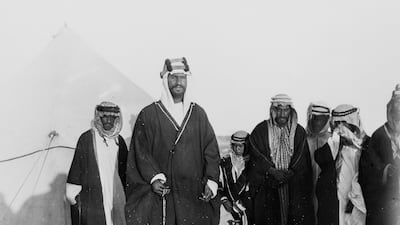
Abdulaziz bin Abdul Rahman Al Saud (C) recaptured the Al Saud's ancestral capital Riyadh in 1902. He went on to expand the realm and became the first king of the Kingdom of Saudi Arabia in 1932. Photo: Royal Geographical Society -
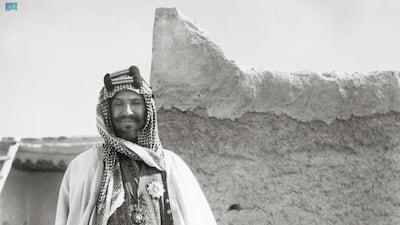
Abdulaziz - who was known as Ibn Saud in the West - was notoriously tall and physically strong and widely thought of as a charismatic leader. Here he is pictured during a visit to Basrah in 1916. SPA -
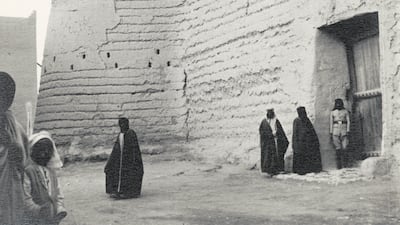
A photo of the Masmak Fort in Riyadh from 1934. The fort was the site where Abdulaziz and his men famously overcame the defenders to recapture Riyadh from the Al Rashid in 1902. Photo: Gerald de Gaury / Royal Geographical Society via Getty Images -

Abdulaziz's men on the march. As Sultan of Najd, Abdulaziz encouraged the creation of a fierce fighting force known as the Ikhwan. The Ikhwan proved effective in defeating rival tribes and families to consolidate Saudi rule in central Arabia. Universal Images Group via Getty Images. -
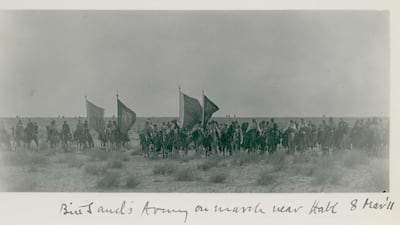
Abdulaziz's army on march near Habl, 1911, photographed by the British military official Captain Shakespear. Captain Shakespear died during a skirmish between Abdulaziz's forces and rivals in 1915. Photo: Royal Geographical Society -
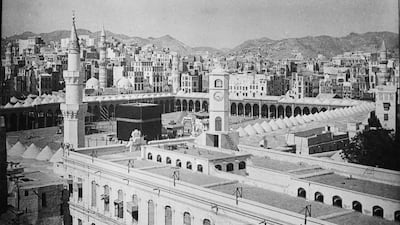
The Islamic holy city of Makkah in 1910. The Saudis captured the Hejaz region, including Makkah, after a short war with the rival Hashemite family in 1924-1926. Today it remains part of Saudi Arabia. Photo: Library of Congress -
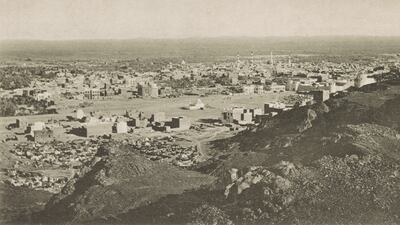
Madinah as seen from Mount Sela' from the north-west, 1913. Photo: Library of Congress -
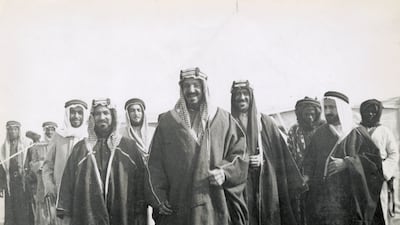
King Abdulaziz with Kuwaiti ruler Sheikh Ahmad al Sabah to his right and his son Saud to the left, who later succeeded him as king, in Saudi Arabia, 1934. Photo: Gerald de Gaury / Royal Geographical Society via Getty Images -

King Abdulaziz famously met with American president Franklin Delano Roosevelt in 1945 onboard a warship in Egypt. It was the furthest Abdulaziz travelled from his home. Hulton Archive / Getty Images -
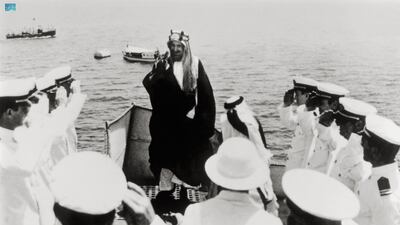
King Abdulaziz is greeted by American soldiers in 1945.


Like the Al Saud, the Al Sudairi hail from the Najd region of central Arabia. Their lineage can be traced back to the Badarin line of the wider Al Dawasir clan in Arabia. The tribe was considered a “sharifian” or noble tribe that lived on the edge of the Rub Al Khali desert in about 1400.
Nearly 150 years later, the Al Sudairi ruled the town of Al Ghat in Sudair, an area in Najd north-west of Riyadh which took its name from the tribe.
History lecturer and Ahmed Al Arf at Al Qassim University, who has studied and traced the history of the Al Sudairi tribe, said the family contributed heavily during all three eras of the states of Saudi Arabia.
“The Al Sudairi tribe from the town of Al Ghat played a pivotal role during the first, second and third states of the country. The first Ahmed bin Mohammed Al Sudairi was the father of Sara bint Ahmed who married King Abdulaziz. The second Ahmed Al Sudairi gave birth to Abdulaziz and Hussa, both of whom would play a role through their relation to King Abdulaziz during the third state of the country,” he said in a documentary.
With this background, Rajwa Al Saif's marriage to Crown Prince Hussein across the border in Jordan has generated considerable interest in Saudi Arabia.
Her engagement to Crown Prince Hussein took place in her father's home in Riyadh in August.
The wedding will take place in Amman on Thursday.


