

Live updates: follow the latest news on Covid-19 variant Omicron
South African President Cyril Ramaphosa on Sunday called on countries to "immediately and urgently" reverse scientifically "unjustified" travel bans linked to the discovery of the new coronavirus variant Omicron.
Dozens of nations from Europe to Asia have blacklisted South Africa and its neighbours since the country's scientists revealed Omicron on November 25.
The flight bans have angered several African leaders.
"We call upon all those countries that have imposed travel bans on our country and our southern African sister countries to immediately and urgently reverse their decisions," Mr Ramaphosa said in his first address to the nation after last week's detection of the new variant.
The World Health Organisation has declared Omicron to be a variant of concern, while scientists are still assessing its virulence.
A "deeply disappointed" Mr Ramaphosa said the ban was "not informed by science".
The countries that have already imposed travel restrictions on southern Africa include Saudi Arabia, Kuwait, Qatar, the US, Britain and the Netherlands.
Earlier on Sunday, Malawian President Lazarus Chakwera accused western countries of "Afrophobia" for shutting their borders.
And in Botswana, the other southern African country to detect the strain – among a group of foreign diplomatic visitors in the first instance – two ministers warned against "geo-politicising this virus".
-

Travellers queue for PCR tests at OR Tambo International Airport in Johannesburg after several countries banned flights from South Africa following the discovery of the Omicron coronavirus variant. AFP -
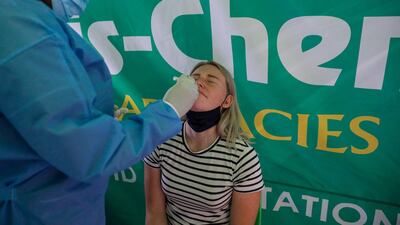
A healthcare worker tests a passenger at OR Tambo International Airport in Johannesburg. Several countries across the world have banned ban flights from southern Africa following the discovery of the Omicron variant. AFP -

A healthcare worker helps a traveller to obtain his PCR test result at OR Tambo International Airport in Johannesburg, after several countries banned flights from South Africa following the discovery of a new coronavirus variant called Omicron. AFP -

Travellers queue at a check-in counter at OR Tambo International Airport in Johannesburg, after several countries banned flights from South Africa. AFP -

Several countries across the world have banned flights from southern Africa following the discovery of the Omicron variant. AFP -

A passenger checks a noticeboard displaying cancelled flights at OR Tambo International Airport in Johannesburg. AFP -

Noticeboards display cancelled flights at OR Tambo International Airport in Johannesburg. AFP -

Passengers wait to board flights at OR Tambo International Airport in Johannesburg. Reuters -

People wait at OR Tambo International Airport in Johannesburg. Many nations moved to stop air travel from southern Africa on Friday in reaction to news of the Omicron coronavirus variant that was detected in South Africa. AP -
People line up to get on a flight to Paris at OR Tambo International Airport in Johannesburg, South Africa. Many nations have halted air travel from southern Africa in reaction to news of a new, potentially more transmissible coronavirus variant. AP -

Flights are cancelled at Cape Town International Airport. Antonie Robertson / The National


"We are concerned that there seem to have been attempts to stigmatise the country where it was detected," Health Minister Edwin Dikoloti, said on Sunday.
The head of the WHO in Africa was equally worried.
"With the Omicron variant now detected in several regions of the world, putting in place travel bans that target Africa attacks global solidarity," WHO regional director general Matshidiso Moeti said.
Mr Ramaphosa said the travel ban would "further damage the economies [and] undermine their ability to respond to and recover from the pandemic".
South Africa, the continent's most industrialised country, is struggling with slow economic growth and an unemployment rate of more than 34 per cent.
The travel curbs are another major blow to its key tourism industry, which had high hopes for the coming southern hemisphere summer.
Mr Ramaphosa blasted the G20 countries for abandoning commitments made at a meeting in Rome last month to support the recovery of the tourism sector in developing countries.
"Instead of prohibiting travel, the rich countries of the world need to support the efforts of developing economies to access and to manufacture enough vaccine doses for their people without delay," he said.
"These restrictions are unjustified."
Mr Ramaphosa called on rich countries to stop fuelling vaccine inequality, describing shots as the "most powerful tool" to limit Omicron's transmission.
He appealed to South Africans to be vaccinated and said the government was considering making vaccines mandatory for some activities and locations to increase uptake.
"Vaccines do work," Mr Ramaphosa said. "Vaccines are saving lives."
Just more than 35 per cent of adults in South Africa have been fully inoculated after a slow start to the vaccine campaign, with hesitancy widespread.
The country is Africa's worst hit by Covid-19, with about 2.9 million cases and 89,797 deaths reported.
Omicron is believed to be fuelling a rise in infections, with 1,600 new cases recorded on average in the past seven days, compared to 500 a day in the previous week.

