


Finance ministers and central bankers from around the world are set to arrive in Washington for the 2025 International Monetary Fund and World Bank Spring Meetings this week, with US President Donald Trump's tariffs likely to dominate discussions.
Mr Trump has upset global trade since returning to office this year, and his since-pared-down “reciprocal” tariffs drew a rare condemnation from IMF Managing Director Kristalina Georgieva.
Many of those harshest tariffs were targeted at developing countries, some of which like Jordan and Sri Lanka are in reform programmes with the IMF.
Meanwhile, Syria is also expected to have a presence in Washington as it seeks to shore up support for the country's reconstruction needs. The delegation arrives in Washington after Syria's President Ahmad Al Shara held talks with leaders from the UAE, Saudi Arabia, Iraq and others on the country's postwar future.
Trump tariffs
The uncertainty surrounding Mr Trump's policies is sure to cast a lower outlook for the world economy. The IMF in January projected the global economy to expand by 3.3 per cent this year, with the US economy set to grow by 2.7 per cent.
“Our new growth projections will include notable markdowns, but not recession,” Ms Georgieva said in her curtain-raiser speech last week.
The IMF will release its updated World Economic Outlook on Tuesday.
While Ms Georgieva did rule out a global recession this year, economists are raising their probabilities for a potential US downturn.
“Ultimately, this is a shift in regime,” Adam Posen, president of the Peterson Institute for International Economics, told reporters.
While tariffs have driven the uncertainty facing the world's largest economy, Mr Posen also pointed to the potential negative impact Mr Trump's immigration policies could pose on the labour and housing markets.
“This means that I think we have a very high chance of recession,” he said, raising his own odds of a US slowdown to 65 per cent.
Syria in focus
Another major area of focus this week will be the future of Syria's reconstruction. Five months after the fall of Bashar Al Assad, Syria's new self-declared government has been seeking support from the international community to support its reconstruction needs.
But any funding from the IMF likely cannot be accomplished without the approval of the US, which is the fund's largest shareholder. Washington's sanctions on Syria remain largely in place.
Mr Trump's administration has not yet officially recognised the current Syrian government.
The Saudi government and World Bank are expected to host a meeting this week to discuss steps to restore IMF and the bank's support for Syria, Reuters reported.
-

Qatar's Emir Sheikh Tamim hosts a meeting between Iraqi Prime Minister Mohammed Shia Al Sudani, centre, and Syrian President Ahmad Al Shara, left, in Doha -
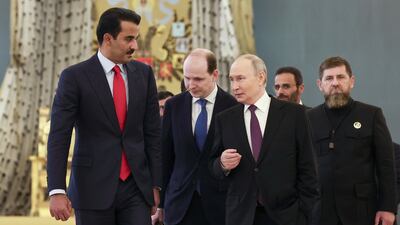
Sheikh Tamim had earlier delivered an olive branch from Syria to Russian President Vladimir Putin during a meeting in Moscow -

Mr Al Shara’s presence in Doha coincided with a visit by Lebanese President Joseph Aoun, left, who has vowed to build relations with the new Syria and work on resolving the border tensions that have led to deadly clashes in recent months -

Egypt's President Abdel Fattah El Sisi also visited Doha around the same time as Mr Al Shara. Cairo viewed the replacement of Bashar Al Assad’s regime by rebels with hardline Islamist roots as a seismic shift in the Middle East’s geopolitical landscape -

Sheikh Tamim with the Syrian President in Doha -

Saudi Arabia's Defence Minister Prince Khalid bin Salman makes a rare visit to Iran.


Syria's Finance Minister Mohammed Bernieh and Central Bank Governor Abdul Qadir Al Hasriya are both registered to attend the gatherings, a World Bank official previously told The National.
The visit comes after Gulf nations have shown signs of growing support for the new Syrian government.
Saudi Arabia is planning to pay off settling Syria's arrears with the World Bank, Reuters reported, which could allow Syria to receive grants necessary for Syria's reconstruction and support its public sector.

