

US President Donald Trump will bring a new layer of uncertainty surrounding Syria's likely debt restructuring challenges after the fall of the Assad regime.
Syria's two largest creditors, Iran and Russia, will make it difficult to gain support from the international community to restructure its debt, according to a new report from the Peterson Institute for International Economics.
Although the full amount is not known, Syria could owe Iran and Russia between $30 billion and $50 billion, the report said.
While the interim government might not agree to repay the debt it incurred during former president Bashar Al Assad's rule, the report said it could argue some of its Assad-era obligations are “odious” or illegitimate, meaning a government borrowed money without the will of its people.
But the change in US administration could complicate that.
“These days, there's a bit of uncertainty because of the new rekindling of relations between the US and Russia,” Adnan Mazarei, a non-resident senior fellow at the Peterson Institute and the report's author, told The National.
Since assuming office, Mr Trump has adopted a more conciliatory approach towards Russia than his predecessor Joe Biden. Mr Trump previously suggested Ukraine started the three-year war before reversing course, which came before the US opposed a resolution at the UN that condemned Russia's aggression and supported Ukraine's territorial integrity.
Mr Mazarei said the rapprochement from the US to Russia now makes it less clear if Washington would recognise Syria's claims that its debts to Russia are odious.
“The waters are muddier,” Mr Mazarei said, as he compared Syria's situation to Iraq, whose outstanding debt of $160 billion represented 573 per cent of its gross domestic product after the collapse of Saddam Hussein's regime in 2003.
After negotiations with Paris Club and non-Paris Club creditors, Iraq received substantial support from the US, UN and other creditors. This helped to protect Iraq from attachment by private creditors, aiding to enable its debt restructuring process.
The Paris Club is an informal group of creditor nations whose objective is to find workable solutions to payment problems faced by debtor nations.
“Compared with Iraq, the debt to the private sector should be very, very small, so that won't be difficult,” Mr Mazarei said. “The problem is the debt to Russia.”
This comes as Syria faces enormous rebuilding costs, with the cost of reconstruction estimated at $250 billion.
-

Malak holds her twin brother's arm as they stand amid the rubble of their house, after the overthrow of Syria's Bashar Al Assad, in Jobar, January 3, 2025. Reuters -

People gather for an event in memory of the deceased, near a damaged cemetery, in Jobar. Reuters -

A man stands among damaged graves at the cemetery in Jobar. Reuters -

Situated on the outskirts of Damascus, Jobar was hit hard by heavy clashes between government forces and rebels during the civil war, and emptied of its population in 2018. Reuters -
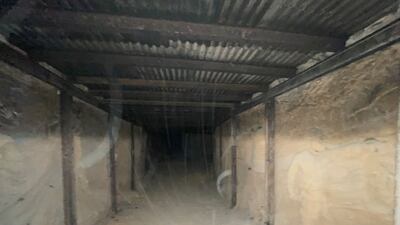
One of the tunnels that helped the rebels survive the regime's siege of Jobar for years. Khaled Yacoub Oweis / The National -
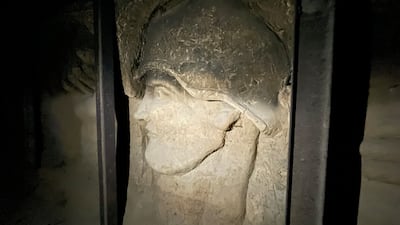
A bas relief depicting a Syrian regime soldier, in a former rebel tunnel. Khaled Yacoub Oweis / The National -

Soldier holding a lamp. The former regime's media called the art works 'masterpieces'. Khaled Yacoub Oweis / The National -

A former rebel fighter at the ruins of the ancient Jobar synagogue, which was badly damaged by air strikes. Khaled Yacoub Oweis / The National -
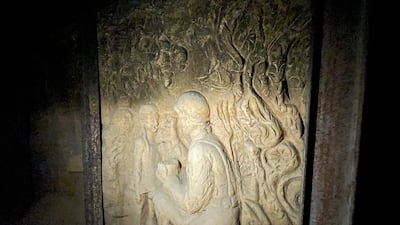
Sculpture of a regime soldier feeding a child. Khaled Yacoub Oweis / The National -
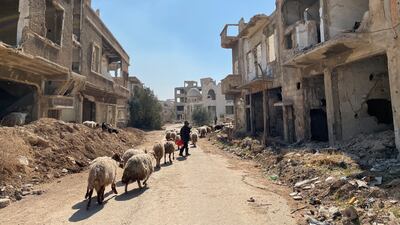
Some shepherds tend to their sheep in the area, with the animals grazing on the undergrowth between abandoned buildings. Khaled Yacoub Oweis / The National -
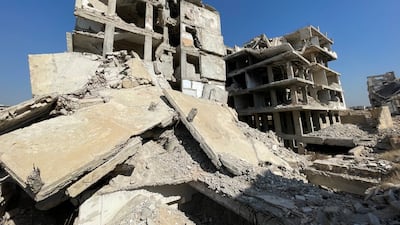
Like many parts of the country, buildings in Jobar will need to be demolished as part of a reconstruction programme, but Syria lacks the funds and skilled manpower. Khaled Yacoub Oweis / The National -

The old quarter of Jobar. Photo: Khaled Yacoub Oweis / The National -

Remnants of the synagogue. Photo: Khaled Yacoub Oweis / The National -
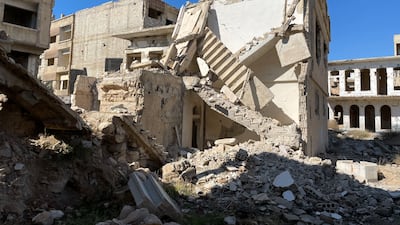
Destroyed buildings in Jobar. Khaled Yacoub Oweis / The National


“There are huge expenditures to be had,” Mr Mazarei said.
He added that, when adjusted for inflation, the real size of Syria's economy was 85 per cent lower than what it was before the outbreak of the civil war in 2010.
Further, the World Bank's estimate of GDP ($17.5 billion) is smaller than the $20 billion to $23 billion Syria's interim government said it owes.
This included a significant decline in oil output – which fell to one-tenth of its 400,000 barrels per day production from 2011 – as well as land and agricultural infrastructure that were destroyed, he said.
“So all of that has to be factored in the sense that it's going to take a long while for the new Syrian government to exert control over all of the country and the potential revenue generation from those regions,” Mr Mazarei said.
“Something has to give. And in these circumstances … it has to be they cannot repay their debt.”

