


Dubai International Airport (DXB) dethroned Hartsfield-Jackson Atlanta International Airport as the busiest airport in the world, after the longest government shutdown in US history led to massive flight cancellations.
DXB handled 5.29 million seats in November, an increase of five per cent year on year, edging out the Atlanta hub to second place with 5.12 million seats, according to aviation data provider OAG.
Hartsfield-Jackson Atlanta International Airport has historically ranked as the world's busiest airport by domestic and international passenger traffic. By contrast, Dubai has ranked the world's busiest international hub as it does not handle any domestic traffic.

“We actually exceeded Atlanta … because of the government shutdown, they had to cancel some of their flights,” Paul Griffiths, chief executive of Dubai Airports, said in an interview at the Dubai Airshow. “I addressed a US delegation the other day and I said 'I've got some terrible news'.”
The now-resolved government shutdown in the US, which lasted a record 43 days, had a disruptive effect on air travel. US airlines cancelled thousands of flights when the Federal Aviation Administration (FAA) ordered them to reduce schedules to keep air travel safe.
The shutdown cost the US more than $6 billion in lost travel spending and “unnecessary pain for travellers and federal workers”, the US Travel Association said in a November 12 statement.
Annual passenger growth
Meanwhile, DXB expects to end the year with 95.2 million passengers, Mr Griffiths said on Wednesday. “We always have a very strong December, hopefully we may revise that [forecast] again.”
The airport will continue to grow next year, projecting a “conservative estimate” of 99.5 million next year and 101.4 million in 2027, he said.
DXB handled a record number of passengers in the third quarter of this year, with 24.2 million travellers passing through its gates, up 1.9 per cent compared to the same period last year, state-owned operator Dubai Airports said on Wednesday.
Dubai hosted 13.95 million overnight visitors in the first nine months of this year, an increase of 5 per cent from the same period last year, according to the Department of Economy and Tourism. The emirate is seeking to attract more international tourists, while drawing more expatriates to live, work and retire in the city.
DXB, the world's busiest international airport, handled 70.1 million passengers in the first nine months of this year, up 2.1 per cent on the same period last year.
India remained DXB’s top country market in the first nine months of the year with 8.8 million passengers, followed by Saudi Arabia (5.5 million), the UK (4.6 million), Pakistan (3.2 million) and the US (2.4 million).
The airport is focusing on the use of biometrics, AI and technology to funnel more people through its gates more quickly.
During the third quarter, 99.6 per cent of departing travellers cleared passport control in under 10 minutes, and 99.8 per cent of arriving passengers waited less than 15 minutes, Dubai Airports said. Security screening times stayed below five minutes for 99.7 per cent of travellers.
International investments in DWC
Dubai Airports is currently focused on fully developing a new terminal at Al Maktoum International Airport (DWC), which is expected to become the city’s main international gateway in the early 2030s.
The UK Export Finance (UKEF)'s expression of interest on Tuesday for up to $3.5 billion in funding for the expansion of DWC is a “massively confident” endorsement of the project and British companies that will contribute to construction of the project, Mr Griffiths said.
The export credit finance model will bake it more attractive for the airport and British companies to do business, he said.
The move will also “demonstrate to other international investors that there is an opportunity here”, he said. “There's so much technology going on in the airports and logistics space from all over the world and we're obviously wanting to showcase the very best of it here in Dubai.”
There will probably be other expressions of interest from governments. “Having a positive initial indication from the British government is a statement of confidence.”
-
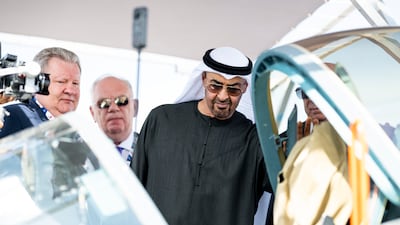
President Sheikh Mohamed views an aircraft during a tour of Dubai Airshow at Dubai World Central. UAE Presidential Court -
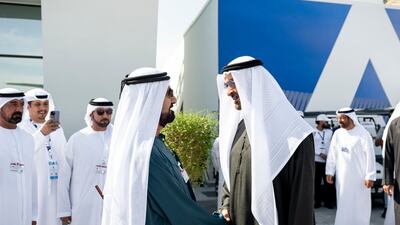
Sheikh Mohamed greets Sheikh Mohammed bin Rashid, Vice President and Ruler of Dubai. UAE Presidential Court -

Sheikh Mohamed views an exhibit. UAE Presidential Court -
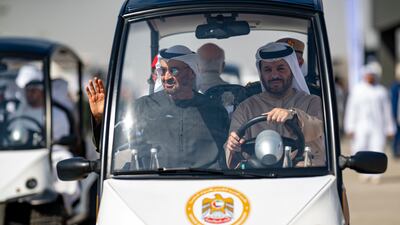
Sheikh Mohamed and Faisal Al Bannai, adviser to the UAE President for Strategic Research and Advanced Technology Affairs, at the airshow. UAE Presidential Court -
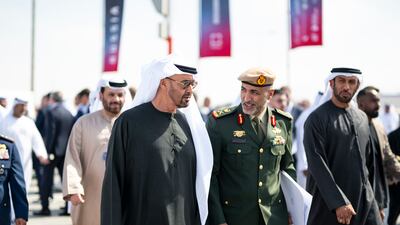
Sheikh Mohamed speaks to Staff Maj Gen Musallam Al Rashidi, Director of the Office of the Supreme Commander of the Armed Forces. UAE Presidential Court -
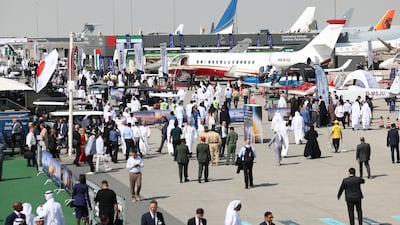
The airshow has more 1,500 exhibitors from about 150 countries. EPA -
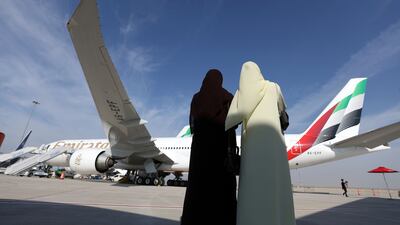
Visitors take a closer look at an Emirates Boeing 777. Chris Whiteoak / The National -
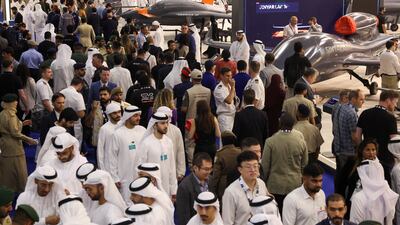
The airshow, which runs until Friday, is expected to attract thousands of trade visitors. Reuters -

Sheikh Mohammed visits the exhibition. Photo: Government of Dubai Media Office -
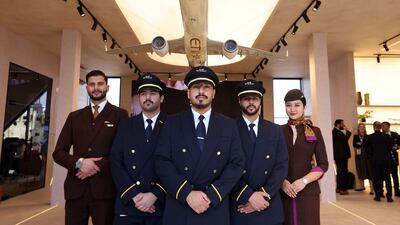
Etihad staff are dressed for the occasion. Chris Whiteoak / The National -
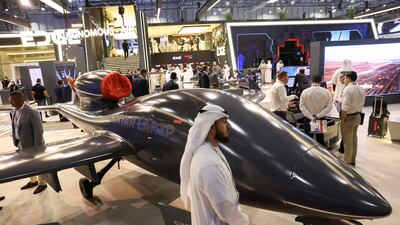
Modern aircraft are in display. Reuters -
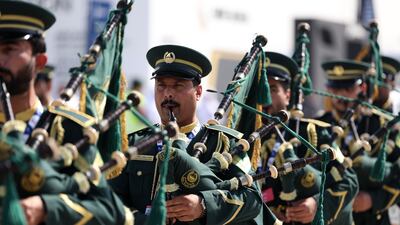
The Dubai Police Band are providing entertainment. Chris Whiteoak / The National -
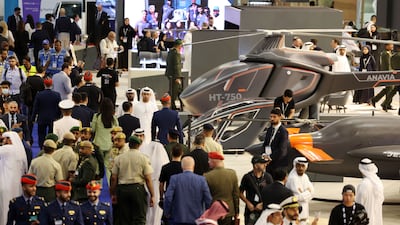
The airshow is a business trade show and is open to industry professionals only. Chris Whiteoak / The National -

Sheikh Mohammed on board a plane. Photo: Government of Dubai Media Office -
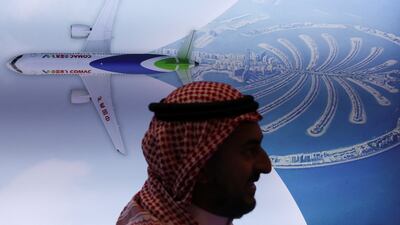
A display by Chinese state-owned aerospace manufacturer Comac. Reuters


Electric flying taxis and tech at DWC
The new airport terminal at DWC will also feature air taxi operations to carry passengers from vertiports at the hub to other destinations in the city to beat road traffic, according to Mr Griffiths.
Dubai is already building a vertiport for eVTOLs near DXB.
“We are building the vertiport behind the Emirates headquarters, near DXB, and we're very excited by that technology. I think it's going to be fantastic. And there would be something similar at DWC, absolutely,” Mr Griffiths said.
The vertiports and vehicles will be part of DWC's new airport master plan and a “major part of our ground and transport infrastructure”.
The design of the new airport is now in its final stages, with a major study under way to examine how the airport will operate, how passengers will get there and facilities such as housing and transport around it.
“An airport is as only as good as its ground to air interface. So if you've got the perfect airport, but you can't get there because the roads and the rail system are not adequate, then you're wasting your time and money,” Mr Griffiths said.
Dubai Airports is working closely with the RTA on the road and rail systems to connect DWC. “We have to start working on those right away,” he said.
DWC will also harness advanced technologies to remove the pain points that passengers face as they pass through an airport such as long queues, long waiting times, unnecessary procedures and removing laptops or shoes out of bags.
“That has no place in a customer-friendly hospitality environment. You don't walk into a five-star hotel and they say, 'take your shoes off.' It's ridiculous, isn't it?” he said.
While there is a need to maintain the highest levels of aviation security, this can be done with modern technology in a more customer-friendly way.
“We're encouraging companies to invest in creating single points of customer relationship, like taking a biometric signature of your face one time from cameras that you can't even see that concealed in the infrastructure,” he said.
“How many industries treat all their customers as crooks until they can prove that they haven't got guns or knives on them? And we all know why, you have to check, but there must be a better and more efficient way of providing an even greater level of security without being that intrusive.”

