


British author Roald Dahl told the story of Pravdinsk in northern Russia, where the ground was frozen so hard it was impossible to bury a corpse in winter. “So, do you know what they do? They simply sharpen his legs and knock him into the ground with a sledgehammer.” But with record heat striking Siberia, this macabre technique will not be needed.
Places in the far north-east hit 21.5°C overnight – shattering records by more than 10°C. The current extreme weather is not just confined to Russia. The UAE had its hottest day yet recorded in May, as Sweihan near Al Ain sweltered at 51.6°C. The country’s summers are now 10 days longer than they used to be.
Parts of Britain have declared a drought after the driest and sunniest spring since records began in 1836. Yet this follows the wettest 18 months in national history. Switzerland had a different problem, after the collapse of a melting glacier destroyed the village of Blatten on Wednesday.
So, what is going on?
In 2015, countries signing the Paris Agreement on climate change agreed to limit global warning to “well below” 2°C by the end of the century, and to target not exceeding 1.5°C. In 2018, the Intergovernmental Panel on Climate Change thought 1.5°C would not be reached until 2040. Now, it is set to be broken in two years.
The battleground is now the 2°C target. Now, that is likely to be overtaken around 2045, on the basis of the average over several years. Indeed, we could experience a year above 2°C as soon as 2029. Likely overall warming by end-century will be 2.5°C, a level that would have been thought disastrous a decade ago. Blatten is not the first place to be wiped out by unchecked climate change, and it will not be the last.
The risk is growing of dramatic and irreversible climatic shifts: an Arctic free of ice in the summer before 2030, the dieback of the Amazon rainforest, a loss of 90 per cent of coral reefs by 2050. Atlantic oceanic circulation could collapse, bringing severe flooding to the US east coast and, paradoxically, freezing temperatures to Europe.
It is no surprise that global warming continues to increase while emissions of carbon dioxide and other greenhouse gases are at record levels.
There is some positive news from China, which might reach a peak in carbon dioxide emissions this year. It is adopting renewable and nuclear power, and switching from oil-fuelled to electric vehicles on a massive scale. As the world’s biggest polluter, it leads the overall trend. But backsliding in the US could undo some of this progress. Right-wing parties in Europe have seized on climate policies as a populist line of attack.
-

Flooding in the Al Barsha area of Dubai. Chris Whiteoak / The National -
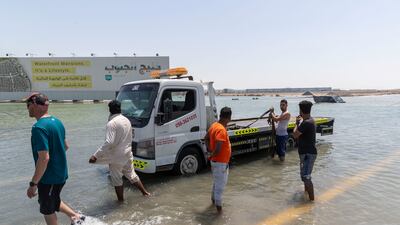
Vehicles being recovered near Al Maktoum airport in Dubai. Antonie Robertson / The National -

Flooding in the Al Barsha area of Dubai. Chris Whiteoak / The National -
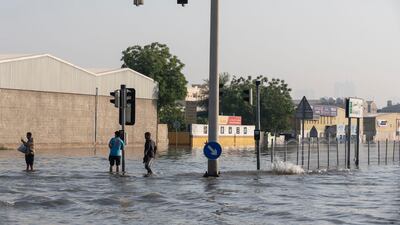
Flooding along Sheikh Zayed Road in Dubai. Antonie Robertson / The National -
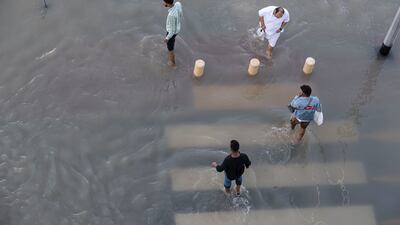
Flooding along Sheikh Zayed Road in Dubai. Antonie Robertson / The National -

Cars move through floodwater in Al Qudra, Dubai. Chris Whiteoak / The National -

Flooding on Dubai's Al Khail Road. Chris Whiteoak / The National -
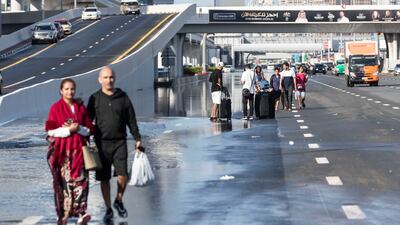
People abandon their cars on Sheikh Zayed Road due to heavy rain. Antonie Robertson/The National -

Flooding on Al Khail Road. Chris Whiteoak / The National -

Flooding in Oman. Photo: Royal Oman Police -

A damaged car in Derna, Libya. Reuters -
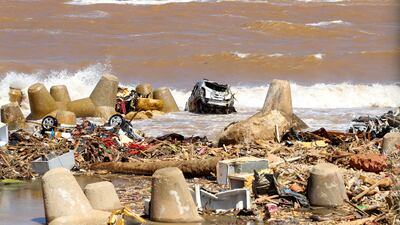
A destroyed vehicle in Derna. AFP -

Abdul Salam Ibrahim Al-Qadi walks on rubble in front of his house, searching for his missing father and brother, in Derna. Reuters -

An aerial view of the destruction in Derna. Reuters -
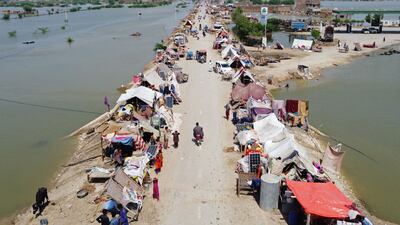
Flood-affected people taking refuge in a makeshift camp after heavy monsoon rains in Jaffarabad district of Balochistan province. AFP -
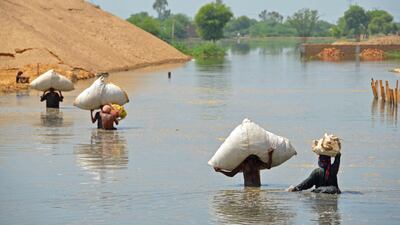
Internally displaced flood-affected people shift husk for their animals in a flood-hit area following heavy rains in Dera Allah Yar in Balochistan. AFP -
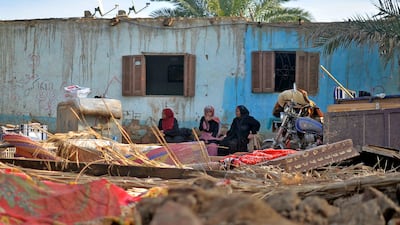
The aftermath of flooding in Egypt's southern city of Aswan, 920 kilometres south of the capital. AFP -

The Nile River from the top of Famine Stela, or Rock of Starvation, Egypt. Reuters -

Volunteers search for people in need following heavy rainfall in east Mosul, Iraq, in March 2020. Reuters -

People clean up after floods in Duhok, Iraq, on March 19. Reuters


In any case, just reducing emissions is not enough – they need to fall to net-zero, where any remaining carbon dioxide releases are counterbalanced by soaking up the gas from the atmosphere – before warming will stop.
Some other factors are playing a part in recent rapid heating. Sulphur dioxide released into the atmosphere was unintentionally helping limit global warming by reflecting some of the sun’s rays. Over the past decade, China has tackled air pollution and switched its district heating systems from sulphurous coal to natural gas. The international shipping industry has also banned the use of high-sulphur fuel oil without scrubbers.
These moves are good for human health and for reducing acid rain, but they have an unfortunate side effect. If India now cleans up its terrible coal pollution, that could push warming even faster.
Sulphur dioxide apart, we are on a far better climate path than a decade or two ago. But this is a choice between the catastrophic and the terrible.
Environmentalists remain stuck on policies that have achieved great success – cheap, mass-scale solar and wind power, batteries and electric vehicles – but not fast enough, and that cannot be the whole answer in the limited time remaining to us.
Many appear secretly delighted when policies and technologies that don’t fit the narrow renewables-only ideology run into technical or commercial problems. These include pricing and trading carbon dioxide emissions, capturing carbon dioxide emissions from fossil fuels, removing carbon dioxide directly from the atmosphere, using hydrogen, or expanding nuclear power.
They call for more “political will” or “ambition”. This ignores that overbold targets have not been met, and that making them even bolder will not overcome the problem that a big new green factory or critical mineral mine or intercontinental power line takes a decade to build.
Bad-faith mongers, now joined by AI chatbot Grok, are trying to chip away at support for climate policies. But there are genuine concerns about the cost and reliability of energy, in a world where political and trade fences are being built ever-higher.
The “pragmatists”, meanwhile, seem to have resigned themselves to living with 2.5°C or more warming, and that many seaside cities, mountain villages, coral reefs, rainforests and ice-caps will disappear. The costs of this dystopian future, and the risks of something truly cataclysmic, greatly exceed the expense of working harder to stop it.
But at least they have thought about the problem, and made a conscious decision, unlike many politicians, business leaders, media commentators and voters, who simply ignore it.
There is a way forward, though not a comfortable one. First, accelerate the current progress on low-carbon energy, but be much more ruthless about hard choices, prioritisation, and keeping costs down. Second, advance the necessary but unpopular technologies – recognise that smashing capitalism or destroying the fossil fuel industry, however appealing to activists, has to come after saving a liveable climate.
Third, learn from the experience of cleaning up sulphur pollution. We have unintentionally made warming go faster. But, intelligent “geoengineering” with smaller amounts of sulphur or other particles can also cool the Earth, buying valuable years to cut carbon dioxide. Like the people of Pravdinsk, we need an ugly but effective solution to our climate problem.

