
The UK’s largest fundraising concert for Palestine raised more than £500,000 ($680,982) from tickets, with online donations and merchandise sales on the night raising the total to £1.5 million ($2.04 million).
More than 12,000 people gathered at London’s Wembley Arena for the Together For Palestine event on Wednesday night.
The concert, organised by musician and producer Brian Eno, with appearances from footballer Eric Cantona and pop singer Paloma Faith, marked an end to the perceived silence of the mainstream music industry on the war in Gaza.
-
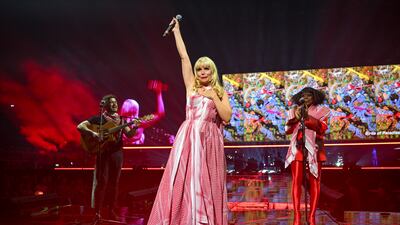
LONDON, ENGLAND - SEPTEMBER 17: Paloma Faith performs onstage during the Together For Palestine concert at Wembley Arena on September 17, 2025 in London, England. (Photo by Samir Hussein/WireImage for ABA) -
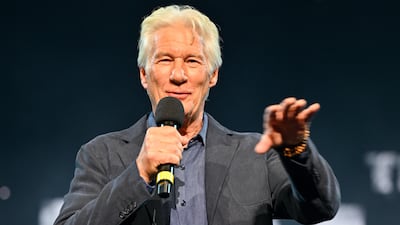
Richard Gere speaks during the concert. The event was billed as 'a gathering of artists, musicians and people for whom silence feels impossible'. WireImage -
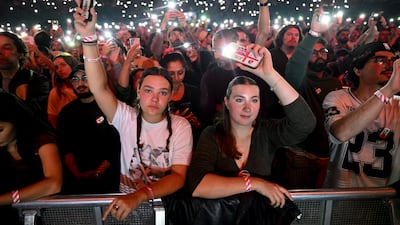
Audience members during the concert. The money the event raises is set to be distributed to Palestinian-led organisations such as Taawon, Palestine Children’s Relief Fund and Palestine Medical Relief Service. WireImage -
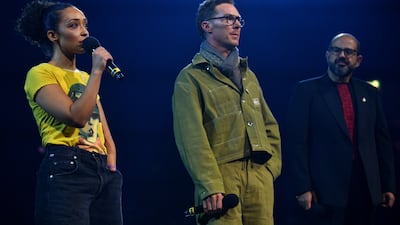
Ruth Negga, left, Benedict Cumberbatch, centre, and Amer Hlehel speak on stage at the event. Getty Images -
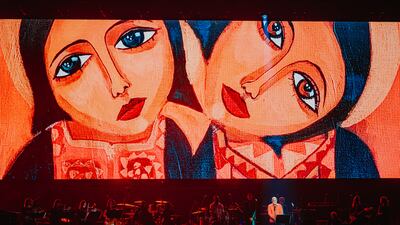
The humanitarian fundraiser was executive-produced by legendary British musician Brian Eno. Luke Dyson -
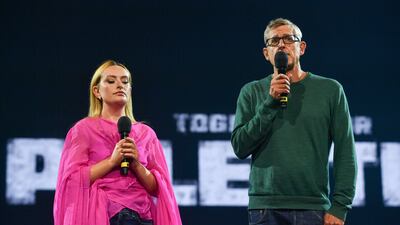
Amelia Dimoldenberg and Louis Theroux speak during the show. Getty Images -
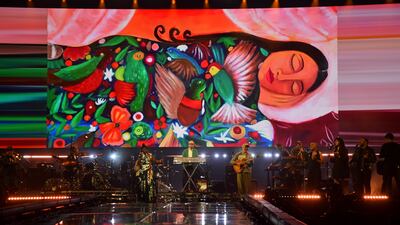
LONDON, ENGLAND - SEPTEMBER 17: Hot Chip performs onstage during the Together For Palestine concert at Wembley Arena on September 17, 2025 in London, England. (Photo by Jim Dyson/Getty Images for ABA) -
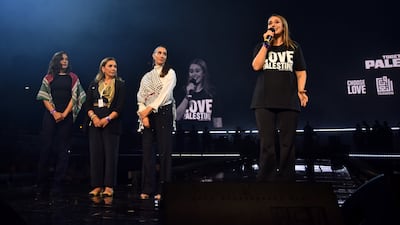
Guest speaks during the concert. Getty Images


Actor Riz Ahmed and comedian Guz Khan, the evening’s hosts, welcomed guests as paintings by Palestinian artists, curated by Gazan artist Malak Mattar, were projected on stage.
Mattar told of her family’s displacement from Gaza, and how some had been able to reach the UK and were in the audience.
The concert took place days after a UN commission of inquiry declared that genocide was taking place in Gaza, and Israel launched a new ground offensive on Gaza city.

Collaborations between western and Palestinian artists were central to the event. Eno played with Paris-based Palestinian oud player Adnan Joubran, while Blur frontman Damon Albarn performed with the London Arab Orchestra on a series of songs.
Actor Benedict Cumberbatch read a translation of a poem by Mahmoud Darwish, and Palestinian singer and flautist Nai Barghouti collaborated with a gospel choir. The evening opened with a DJ set from British musician Jamie XX and Palestinian Sama Abdulhadi.
“The tragedy is too big and the silence is too dangerous. As Palestinians, even if we want to be just musicians, we cannot. The responsibility is there, and we have to carry it," Joubran said in The National's Tarab podcast this week.
“Many concert halls refuse to welcome any Palestinian musicians because they are scared of showing they're belonging to the Palestinian case."

West African singer Rachel Chinouriri dedicated her song Even to the people of Palestine. “Music is something that not only brings people together, but it has also been part of revolution and change,” she said.
The funds raised will benefit three Palestinian organisations leading in development and health care: Geneva-based Taawon, the US-based Palestinian Children’s Relief Fund and the Palestinian Medical Relief Society.
There have been few shows of support for Palestine in the UK music industry, despite widespread demand from fans. Electronic music band Massive Attack projected a Palestinian flag on stage at a major concert in Bristol last year.
But others have triggered controversy, such as Northern Irish band Kneecap who are accused of waving a flag in support of the Lebanese militia Hezbollah at a London gig, and duo Bob Vylan who chanted "Death to the IDF" at Glastonbury music festival.
Lebanese singer Sura Abdo, one of the artists in Wednesday’s show, said she hoped the concert and its scale would send a message of solidarity to people in Gaza and Palestine.
“It’s a moment to make louder the voices that have been silenced, and to tell the children of Palestine that we’re thinking about them and that we have not forgotten them,” she told The National.
Abdo was moved by the number of high-profile and established artists taking part in the show.
“You meet people who are really good at what they do, and they really believe in this event. They’re showing up with full energy,” she said during rehearsals on Tuesday.
Francesca Albanese, UN special rapporteur on Palestine, received a standing ovation when she appeared on stage, reminding people of the continuing suffering in Gaza and the occupied West Bank.
“As we gather here tonight celebrating life and hope … many Palestinians are holding their loved ones in makeshift tents, waiting for the next bomb,” she said.

Racha Koteiche, a London-based activist whose family were affected by Israel’s military campaign in southern Lebanon last year, was surprised to see so many friendly faces among the crowd.
“I love that I’ve seen so many different people that I recognise here. It’s a chance to come together,” Koteiche said. “If I really think about it I will tear up.”
Her family’s experience in Lebanon had brought her close to the British-Palestinian community from Gaza, and she helps to manage Palestine House, a cafe and arts venue in London.
London doctor Omar Abdel Mannan, who founded the campaign group Health Workers for Palestine, said the concert should have occurred sooner.
“We should have had the concert two years ago before the genocide was officially declared by the UN. But it's never too late,” he said. “What I’m looking forward to is supporting Palestinian NGOs on the ground.
"We’re actually helping the indigenous health worker and charity sector, which has largely been neglected during this. It is high time for them to be supported."

