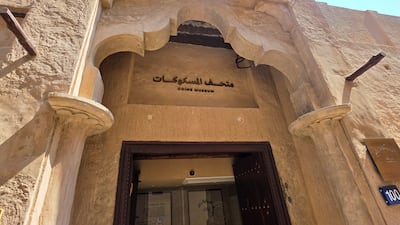

Free, friendly and unexpectedly absorbing, the Dubai Coins Museum offers a guided tour through thousands of years of currency history – if you can find it.
First, a practical note: Google Maps is wrong about where this museum is. Or at least mine was. The pin places it somewhere it is not, and I spent far too long walking around in the height of summer outdoors at midday looking for it. But once I confirmed with a nearby security guard where it was, everything else about the experience was straightforward and genuinely warm.
The Dubai Coins Museum sits within the Al Fahidi Historical Neighbourhood, the city's oldest surviving residential quarter, where wind-tower architecture and narrow lanes give you a sense of history, culture and place. The museum itself is compact, but the collection is outstanding.


Why go there?
It is free, and you get a tour from a friendly Emirati guide who walks you through the collection personally, answering questions and bringing obvious enthusiasm to the subject.
Despite my decision to visit during summer – in the middle of the day – the museum was surprisingly busy. It was not heaving, but consistently occupied, with several groups moving through at once, each with a tour guide. For a small, free institution in a city where cultural tourism often feels like an afterthought, that was unexpected.
What you'll see
The collection traces the history of currency from ancient trade tokens, such as cowrie shells, pearls and salt, to early Islamic dirhams through to more recent Gulf coinage, with objects sourced from across the Arab world and beyond.

It covers the development of coin design, the spread of Islamic monetary systems, the role of trade routes in shaping currency standards and the gradual formalisation of money as both a practical and a political instrument.
It also traces the evolution of the UAE dirham, from when the Trucial States traded in Indian rupees, through the first Qatar and Dubai riyals, to commemorative coins of recent decades.
The Islamic coins are a particular strength. The collection spans several centuries and multiple dynasties, and the guided tour puts them in proper historical context rather than leaving visitors to read captions alone.
My guide also tested me along the way, and I found the museum full of fascinating titbits. For example, I learned that dirhams and dinars were called that because they were made from silver and gold, respectively.

The journey also includes interactive elements, such as a screen where you can play a game to forge your own ancient coin and learn the process.
Meanwhile, the progression from barter systems through to standardised coinage is presented clearly and chronologically, making it accessible to younger visitors without feeling simplified to adults.
Star attraction
The early Islamic dinars and dirhams – thin, text-heavy coins bearing Quranic inscriptions and the names of caliphs – are particularly impressive, especially when you learn they can hold up to 160 words in Arabic calligraphy, according to my guide.

The coin collection, overall, is very impressive and includes rarities you’re unlikely to find elsewhere, such as the tweezer-shaped Larin coin that was in circulation along the Arabian Gulf coast around 631 to 635 AD. I’m told it was shaped this way to make it easier for pearl divers to hold onto it underwater.
What to know before you go
Do not rely on Google Maps for the location. Once you arrive at Al Fahidi, ask a security guard to show you the way. It’s very simple and close to the public car park.
Once there, allow about half an hour for the guided tour, though the guide is happy to extend the visit if you have questions. It’s very small, but air-conditioned and moves at a relaxed pace.
It’s ideal to combine your visit with a walk around other museums in the area, such as the nearby Coffee Museum, or the Sheikh Mohammed Centre for Cultural Understanding. Bur Dubai souq and Dubai Creek are also within easy walking distance if you’re there at a less hot time.
Also, round off your visit to the area with some Arabic gahwa and dates at Al Khayma Heritage Restaurant or the landmark Arabian Tea House, which are mere steps away.
Ticket price and location
Entry is free. It’s open daily from 8am to 5pm at Al Fahidi Historical Neighbourhood.

