White House National Security Adviser Jake Sullivan speaks during a White House press briefing. EPA

US says it expects Israel to avoid attacking 'no-strike' zones in Gaza


Jihan Abdalla
  • English
  • Arabic

Live updates: Follow the latest news on Israel-Gaza

The White House on Monday said that it expects Israel to avoid attacking areas in southern Gaza that it identified as “no-strike” zones to allow Palestinian civilians to find safety during Israeli military operations.

White House National Security Adviser Jake Sullivan said that the administration of President Joe Biden is having daily conversations with Israeli leaders about protecting civilians in Gaza, and would continue to push for the entry of more humanitarian aid into the besieged enclave.

“They [Israel] have also indicated that there are areas where there will be no-strike zones,” Mr Sullivan told journalists.

“And in those zones, we do expect Israel to follow through on it.

“There are other areas in the south that Hamas continues to occupy with military infrastructure where targeted, precise strikes are part of Israel's ongoing military operations.”

The comments come as Israel's military called for evacuations in southern Gaza – an area that Palestinian civilians were ordered to flee to as Israel mounted attacks by air, land and sea.

Almost 16,500 Palestinians, the majority of the civilians, have been killed and most of the territory's 2.3 million residents have been displaced. Israeli bombardments have reduced large parts of the coastal enclave to rubble.

On Friday, a week-long temporary truce expired, bringing with it renewed Israeli bombardments. Scores of people have been killed and sporadic rocket fire into Israel has sent people into shelters.

During the truce, which was negotiated by the US, Qatar and Egypt, dozens of hostages held by Hamas were released in exchange for Palestinian detainees held in Israeli prisons. In addition, humanitarian aid flowed more easily into Gaza.

When Hamas fighters attacked Israel on October 7, they killed about 1,200 people and took about 240 hostage.

Mr Sullivan blamed Hamas for the collapse of talks that should have led to more hostages being released and the truce extended.

“Hamas is refusing to release civilian woman who should have been part of the agreement,” he said.

“And it is that refusal by Hamas that has caused the end of the hostage agreement and therefore the end of the pause in hostilities.”

He said there are still “intensive discussions” taking place between the US, Israel, Qatar and Egypt on finding ways to secure another truce that would lead to the release of additional hostages.

Renewed misery in Gaza as Israel recommences air strikes – in pictures

  • Palestinians help a man injured in an Israeli strike in Rafah, in the southern Gaza Strip. AFP
    Palestinians help a man injured in an Israeli strike in Rafah, in the southern Gaza Strip. AFP
  • Palestinians assess the damage after an Israeli strike in Rafah. AFP
    Palestinians assess the damage after an Israeli strike in Rafah. AFP
  • A drone flies above Gaza after a temporary truce between Israel and Palestinian militant group Hamas expired. Reuters
    A drone flies above Gaza after a temporary truce between Israel and Palestinian militant group Hamas expired. Reuters
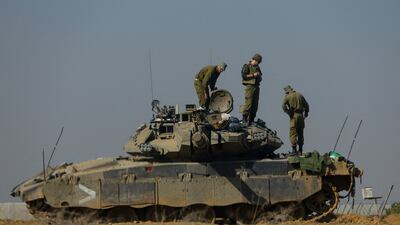
  • Israeli soldiers work on a tank near the border with Gaza. Reuters
    Israeli soldiers work on a tank near the border with Gaza. Reuters
  • Palestinians help a boy injured in an Israeli strike in Rafah. AFP
    Palestinians help a boy injured in an Israeli strike in Rafah. AFP
  • A Palestinian girl sits on the floor of Nasser hospital in Khan Younis after an Israeli strike. Reuters
    A Palestinian girl sits on the floor of Nasser hospital in Khan Younis after an Israeli strike. Reuters
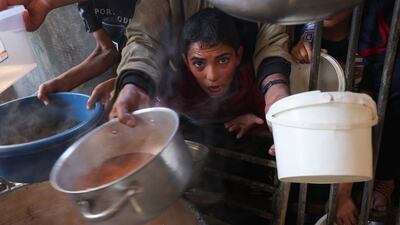
  • Palestinians wait to receive food aid as the conflict between Israel and Hamas continues. Reuters
    Palestinians wait to receive food aid as the conflict between Israel and Hamas continues. Reuters
  • A woman injured in an Israeli strike sits amid the rubble in Rafah. AFP
    A woman injured in an Israeli strike sits amid the rubble in Rafah. AFP
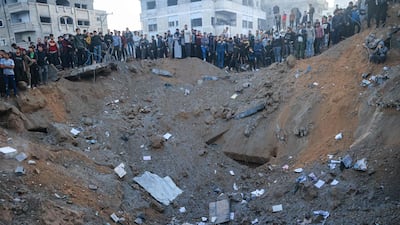
  • Palestinians stand on the edge of a crater after an Israeli strike in Rafah. AFP
    Palestinians stand on the edge of a crater after an Israeli strike in Rafah. AFP
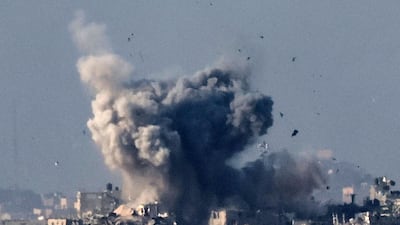
  • Smoke billows over the Gaza Strip on Saturday after a temporary truce between Israel and Hamas ended. AFP
    Smoke billows over the Gaza Strip on Saturday after a temporary truce between Israel and Hamas ended. AFP
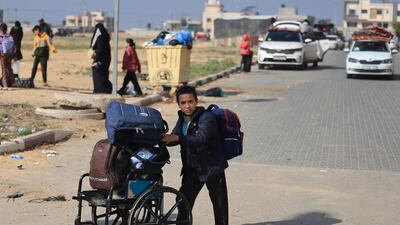
  • A Palestinian boy carries bags on a wheelchair as he flees with family members after receiving notice of an imminent Israeli strike. AFP
    A Palestinian boy carries bags on a wheelchair as he flees with family members after receiving notice of an imminent Israeli strike. AFP
  • People mourn next to the bodies of Palestinians killed in Israeli strikes at Nasser hospital, in Khan Younis. Reuters
    People mourn next to the bodies of Palestinians killed in Israeli strikes at Nasser hospital, in Khan Younis. Reuters
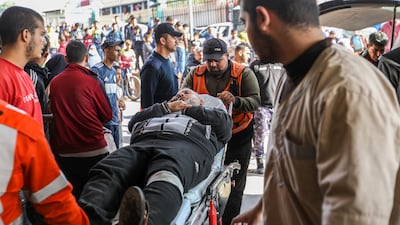
  • Palestinians wounded in Israeli air strikes arrive at Nasser Hospital. Getty Images
    Palestinians wounded in Israeli air strikes arrive at Nasser Hospital. Getty Images
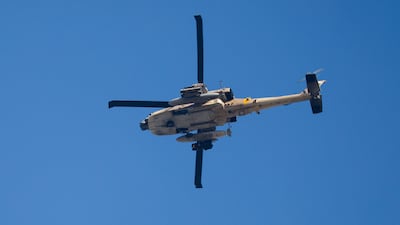
  • An Apache helicopter of the Israeli military patrols over a territory near Gaza. Reuters
    An Apache helicopter of the Israeli military patrols over a territory near Gaza. Reuters
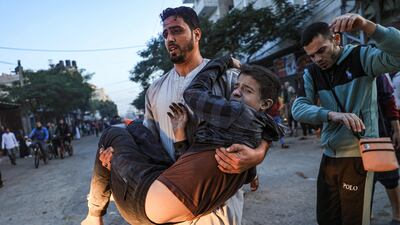
  • A Palestinian man carries a child injured during Israeli bombardment in Rafah. AFP
    A Palestinian man carries a child injured during Israeli bombardment in Rafah. AFP
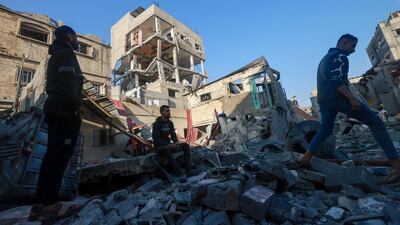
  • Palestinians inspect a building damaged during Israeli bombardment in Rafah. AFP
    Palestinians inspect a building damaged during Israeli bombardment in Rafah. AFP
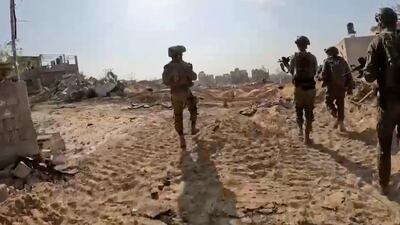
  • Israeli soldiers operate in the Gaza Strip, after a temporary truce expired between Israel and the Palestinian group Hamas. Reuters
    Israeli soldiers operate in the Gaza Strip, after a temporary truce expired between Israel and the Palestinian group Hamas. Reuters
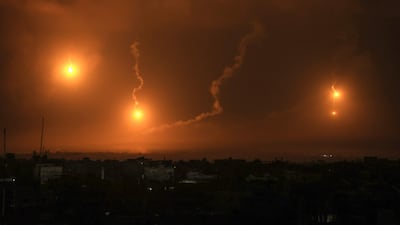
  • Israeli flares light the sky above Khan Younis in the southern Gaza Strip. AFP
    Israeli flares light the sky above Khan Younis in the southern Gaza Strip. AFP
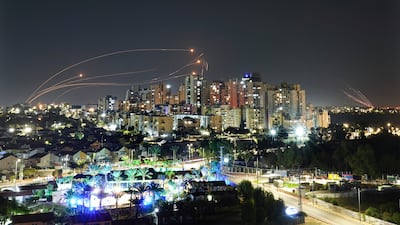
  • The Israeli Iron Dome air defence system fires to intercept a rocket fired from the Gaza Strip, in Ashkelon, Israel. AP
    The Israeli Iron Dome air defence system fires to intercept a rocket fired from the Gaza Strip, in Ashkelon, Israel. AP

In Search of Mary Shelley: The Girl Who Wrote Frankenstein
By Fiona Sampson
Profile

How to improve Arabic reading in early years

One 45-minute class per week in Standard Arabic is not sufficient

The goal should be for grade 1 and 2 students to become fluent readers

Subjects like technology, social studies, science can be taught in later grades

Grade 1 curricula should include oral instruction in Standard Arabic

First graders must regularly practice individual letters and combinations

Time should be slotted in class to read longer passages in early grades

Improve the appearance of textbooks

Revision of curriculum should be undertaken as per research findings

Conjugations of most common verb forms should be taught

Systematic learning of Standard Arabic grammar

Results

2pm: Serve U – Maiden (TB) Dh60,000 (Dirt) 1,400m; Winner: Violent Justice, Pat Dobbs (jockey), Doug Watson (trainer)

2.30pm: Al Shafar Investment – Conditions (TB) Dh100,000 (D) 1,400m; Winner: Desert Wisdom, Bernardo Pinheiro, Ahmed Al Shemaili

3pm: Commercial Bank of Dubai – Handicap (TB) Dh68,000 (D) 1,200m; Winner: Fawaareq, Sam Hitchcott, Doug Watson

3.30pm: Shadwell – Rated Conditions (TB) Dh100,000 (D) 1,600m; Winner: Down On Da Bayou, Xavier Ziani, Salem bin Ghadayer

4pm: Dubai Real Estate Centre – Maiden (TB) Dh60,000 (D) 1,600m; Winner: Rakeez, Patrick Cosgrave, Bhupat Seemar

4.30pm: Al Redha Insurance Brokers – Handicap (TB) Dh78,000 (D) 1,800m; Winner: Capla Crusader, Bernardo Pinheiro, Rashed Bouresly

The years Ramadan fell in May

1987

1954

1921

1888

MATCH INFO

Delhi Daredevils 174-4 (20 ovs)
Mumbai Indians 163 (19.3 ovs)

Delhi won the match by 11 runs

The specs

Engine: 2.0-litre 4cyl turbo

Power: 261hp at 5,500rpm

Torque: 405Nm at 1,750-3,500rpm

Transmission: 9-speed auto

Fuel consumption: 6.9L/100km

On sale: Now

Price: From Dh117,059

Lewis Hamilton in 2018

Australia 2nd; Bahrain 3rd; China 4th; Azerbaijan 1st; Spain 1st; Monaco 3rd; Canada 5th; France 1st; Austria DNF; Britain 2nd; Germany 1st; Hungary 1st; Belgium 2nd; Italy 1st; Singapore 1st; Russia 1st; Japan 1st; United States 3rd; Mexico 4th

If you go

The flights
There are various ways of getting to the southern Serengeti in Tanzania from the UAE. The exact route and airstrip depends on your overall trip itinerary and which camp you’re staying at. 
Flydubai flies direct from Dubai to Kilimanjaro International Airport from Dh1,350 return, including taxes; this can be followed by a short flight from Kilimanjaro to the Serengeti with Coastal Aviation from about US$700 (Dh2,500) return, including taxes. Kenya Airways, Emirates and Etihad offer flights via Nairobi or Dar es Salaam.   

Tottenham's 10 biggest transfers (according to transfermarkt.com):

1). Moussa Sissokho - Newcastle United - £30 million (Dh143m): Flop

2). Roberto Soldado - Valencia -  £25m: Flop

3). Erik Lamela - Roma -  £25m: Jury still out

4). Son Heung-min - Bayer Leverkusen -  £25m: Success

5). Darren Bent - Charlton Athletic -  £21m: Flop

6). Vincent Janssen - AZ Alkmaar -  £18m: Flop

7). David Bentley - Blackburn Rovers -  £18m: Flop

8). Luka Modric - Dynamo Zagreb -  £17m: Success

9). Paulinho - Corinthians -  £16m: Flop

10). Mousa Dembele - Fulham -  £16m: Success

Glossary of a stock market revolution

Reddit

A discussion website

Redditor

The users of Reddit

Robinhood

A smartphone app for buying and selling shares

Short seller

Selling a stock today in the belief its price will fall in the future

Short squeeze

Traders forced to buy a stock they are shorting 

Naked short

An illegal practice  

Real estate tokenisation project

Dubai launched the pilot phase of its real estate tokenisation project last month.

The initiative focuses on converting real estate assets into digital tokens recorded on blockchain technology and helps in streamlining the process of buying, selling and investing, the Dubai Land Department said.

Dubai’s real estate tokenisation market is projected to reach Dh60 billion ($16.33 billion) by 2033, representing 7 per cent of the emirate’s total property transactions, according to the DLD.

Mercer, the investment consulting arm of US services company Marsh & McLennan, expects its wealth division to at least double its assets under management (AUM) in the Middle East as wealth in the region continues to grow despite economic headwinds, a company official said.

Mercer Wealth, which globally has $160 billion in AUM, plans to boost its AUM in the region to $2-$3bn in the next 2-3 years from the present $1bn, said Yasir AbuShaban, a Dubai-based principal with Mercer Wealth.

Within the next two to three years, we are looking at reaching $2 to $3 billion as a conservative estimate and we do see an opportunity to do so,” said Mr AbuShaban.

Mercer does not directly make investments, but allocates clients’ money they have discretion to, to professional asset managers. They also provide advice to clients.

“We have buying power. We can negotiate on their (client’s) behalf with asset managers to provide them lower fees than they otherwise would have to get on their own,” he added.

Mercer Wealth’s clients include sovereign wealth funds, family offices, and insurance companies among others.

From its office in Dubai, Mercer also looks after Africa, India and Turkey, where they also see opportunity for growth.

Wealth creation in Middle East and Africa (MEA) grew 8.5 per cent to $8.1 trillion last year from $7.5tn in 2015, higher than last year’s global average of 6 per cent and the second-highest growth in a region after Asia-Pacific which grew 9.9 per cent, according to consultancy Boston Consulting Group (BCG). In the region, where wealth grew just 1.9 per cent in 2015 compared with 2014, a pickup in oil prices has helped in wealth generation.

BCG is forecasting MEA wealth will rise to $12tn by 2021, growing at an annual average of 8 per cent.

Drivers of wealth generation in the region will be split evenly between new wealth creation and growth of performance of existing assets, according to BCG.

Another general trend in the region is clients’ looking for a comprehensive approach to investing, according to Mr AbuShaban.

“Institutional investors or some of the families are seeing a slowdown in the available capital they have to invest and in that sense they are looking at optimizing the way they manage their portfolios and making sure they are not investing haphazardly and different parts of their investment are working together,” said Mr AbuShaban.

Some clients also have a higher appetite for risk, given the low interest-rate environment that does not provide enough yield for some institutional investors. These clients are keen to invest in illiquid assets, such as private equity and infrastructure.

“What we have seen is a desire for higher returns in what has been a low-return environment specifically in various fixed income or bonds,” he said.

“In this environment, we have seen a de facto increase in the risk that clients are taking in things like illiquid investments, private equity investments, infrastructure and private debt, those kind of investments were higher illiquidity results in incrementally higher returns.”

The Abu Dhabi Investment Authority, one of the largest sovereign wealth funds, said in its 2016 report that has gradually increased its exposure in direct private equity and private credit transactions, mainly in Asian markets and especially in China and India. The authority’s private equity department focused on structured equities owing to “their defensive characteristics.”

Updated: December 04, 2023, 9:49 PM