


Leading Republicans in Congress are urging Washington to step up accountability efforts on the third anniversary of the catastrophic Beirut port blast.
Representative Darin LaHood on Friday said that he and other Republicans have sent a letter to Secretary of State Antony Blinken, calling on the administration to issue “targeted sanctions” against Lebanese officials.
The letter includes demands to freeze “any dollar-denominated assets on those who have demonstrated a pattern of obstructing the presidential election process, including Lebanese Speaker Nabih Berri,” according to reports.
Mr LaHood, co-chair of the Congressional Lebanon Friendship Caucus, spoke at a blast anniversary event hosted by the American Task Force on Lebanon. He said that he is “committed and remains focused” on justice and accountability for the Lebanese people “both now and into the future”.
The State Department, for its part, said on Friday that the lack of progress towards accountability is “unacceptable and underscores the need for judicial reform”.
“The victims and their families deserve justice and accountability for those responsible for the disaster and the underlying causes,” spokesman Matthew Miller said.
The August 4, 2020 blast killed more than 200 people, injured thousands and destroyed many parts of the Lebanese capital.
It came after a stock of ammonium nitrate – stored at the port for years – caught fire. No reason has been provided for it being stored there and no senior officials have been held accountable.
The UN human rights council this week reiterated calls for an independent fact-finding mission into the blast, amid a stalled investigation that has been repeatedly blocked and undermined by legal challenges.
The Washington-based Middle East Institute, in new analysis published on Friday, highlighted that the local investigation into the blast, led by Judge Tarek Bitar, “marks a rare but important reminder that there are still courageous actors inside Lebanon fighting to recapture the state and restore the integrity of key national institutions”.
But it also criticised Hezbollah and its allies for nullifying those efforts, filing 21 legal cases against Judge Bitar, and using violence on the outskirts of the area where the chief judiciary operates.
“This makes clear the limitations of these domestic efforts in the absence of robust international support to counterbalance the disproportionate and illiberal power of political violence that is suppressing justice and eroding any credibility of a functional democratic state,” the institute said.
Mr LaHood, a descendant of Lebanese immigrants, agrees that international support is critical for justice.
“We must continue to put pressure on the government of Lebanon to live up to its commitments to the Lebanese people,” he said.
“Our historic relationship is important to preserve and improve upon. We cannot let the victims and families of the blast and its cascading effects be forgotten. They all deserve justice,” Mr LaHood added.
-
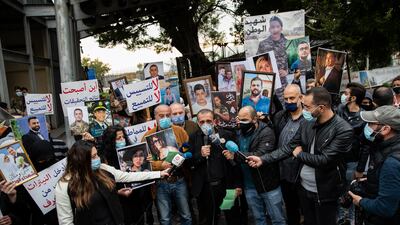
Ibrahim Hoteit, surrounded by the families of the victims of the Beirut blast, addresses the media outside the port of Beirut on the sixth-month anniversary of the explosion in February 2021. -
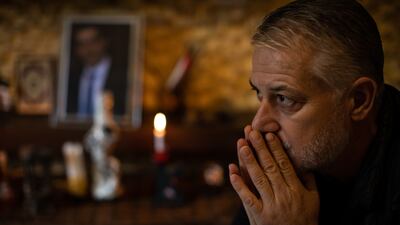
Kayan Tleiss sits in front of the shrine dedicated to his brother in his living room in Khalde, in the southern suburbs of Beirut. -

A photograph of Mohammad Tleiss is flanked by an image of the Virgin Mary and a copy of the Quran in Kayan Tleiss’s living room in Khalde in Beirut. -
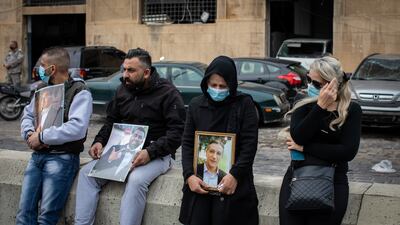
Kayan’s mother, holding a photograph of her son, Mohammed, sits outside the port of Beirut on the sixth-month anniversary of the explosion. -
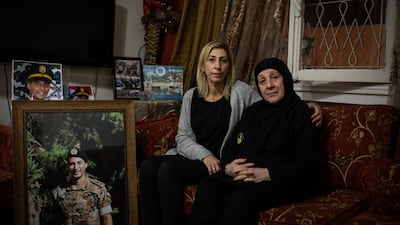
Tharwat and Nada Noureddine sit in their living groom in Mar Elias in Beirut surrounded by photographs of Tharwat’s brother and Nada’s son, Ayman. -

Tharwat Noureddine holds a photograph that Ayman kept on his desk in Beirut. The frame was damaged during the explosion. -

Photographs of Tharwat’s brother and Nada’s son, Ayman, adorn the family's living room in Mar Elias in Beirut. Ayman had returned from five months of training in the US right before the explosion. -

Salam Iskandar, her husband, Jaber, and their son, Ali, sit in their living room in Borj El Brajneh in the southern suburbs of Beirut, surrounded by photographs of Salam's brother, Hamza, who died in the Beirut port blast. All photos: Oliver Marsden / The National -
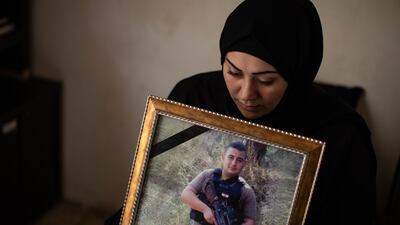
Salam Iskandar holds a photograph of her brother, Hamza, on her lap.



