Three unidentified flying “objects” that the Pentagon shot down over North America did not have any propulsion systems, were not being manoeuvred and were not alien in origin, the White House said on Monday.
The most recent downing happened on Sunday when an object flying at about 6,000 metres was shot down over Lake Huron, one of North America's five Great Lakes. Two other objects had been shot down over the preceding two days, one over Alaska and one in Canada.
“These objects were not being manoeuvred. They did not appear to have any self-propulsion,” White House National Security Council spokesman John Kirby told reporters.
“So the likely hypothesis is that they were being moved by the prevailing winds.”
President Joe Biden ordered the vessels to be shot down after authorities determined they posed a risk to civilian air traffic. Searches for the wreckage, which landed across remote and frozen areas, are under way.
Until more is known about the craft, they all could be described as unidentified flying objects — UFOs — though officials moved to tamp down speculation about any otherworldly origins.
White House Press Secretary Karine Jean-Pierre drew laughter from reporters when she said: “There is no indication of aliens or extraterrestrial activity with these recent takedowns”.
But only a day earlier, a top general declined to rule out any extraterrestrial explanations.
Air Force Gen Glen VanHerck, head of North American Aerospace Defence Command (Norad) and Northern Command, said he would “let the intel community and the counter-intelligence community figure that out”.
“I haven't ruled out anything at this point,” he told reporters on Sunday.
Mr Kirby seemed to dismiss any notion that the as-yet-unidentified flying objects, which the US military has described as “octagonal” or “cylindrical”, are anything but terrestrial in nature.
“I don’t think the American people need to worry about aliens with respect to these craft. Period,” Mr Kirby said.
Unidentified aerial phenomena are a matter of serious Pentagon study and Mr Biden started receiving intelligence briefings on the issue in June 2021, Mr Kirby said.
Additionally, the president on Monday directed an interagency team to study the "broader policy implications" for the detection, analysis and disposition of "unidentified aerial objects" that pose either safety or security risks, Mr Kirby said.
Chinese 'spy balloon'
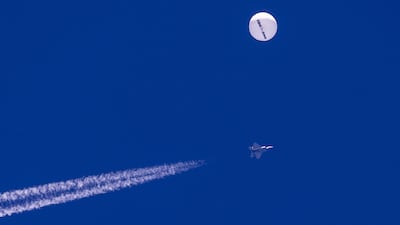
The shoot-downs came less than a week after a Chinese balloon was destroyed over the coast of South Carolina after drifting across the US for several days. The US calls it a “spy balloon” that was being used to surveil sensitive military sites, but Beijing has claimed it was a weather-monitoring station.
Washington issued a sharp denial on Monday after Beijing accused it of sending several American high-altitude balloons over China.
The US rebuttal comes as tension flares between the two superpowers over the downed balloon.
“It's not uncommon as well for the United States to illegally enter the airspace of other countries,” Chinese foreign ministry spokesman Wang Wenbin said.
“Since last year, the US's high-altitude balloons have undergone more than 10 illegal flights into Chinese airspace without the approval of the relevant Chinese departments.”
The White House said that any claim the US government operates surveillance balloons over China is false.
“It is China that has a high-altitude surveillance balloon programme for intelligence collection that it has used to violate the sovereignty of the US and over 40 countries across five continents,” National Security Council spokeswoman Adrienne Watson said.
“This is the latest example of China scrambling to do damage control,” she added, noting that China, which claims the balloon that was shot down was a weather-monitoring platform, has failed to offer any “credible explanations” for intruding into other countries' airspace.
As the Chinese balloon drifted across the US for several days, it caused a political furore in the country, with Republicans accusing Mr Biden of being too slow to shoot it down. But the Pentagon said analysts were able to capture significant intelligence about the balloon as it traversed America.
Secretary of State Antony Blinken cancelled a planned trip to Beijing for what was supposed to have been a willingness to signal a rapprochement between the world's two largest economies.
Mr Biden acted much more quickly to order the shoot downs of three other objects that were subsequently spotted in US and Canadian airspace.
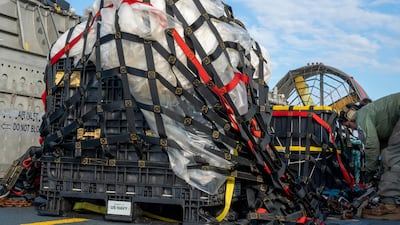
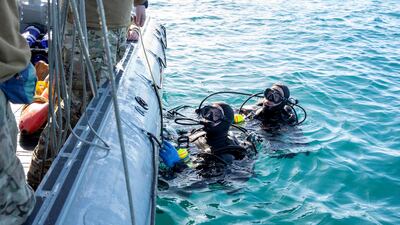
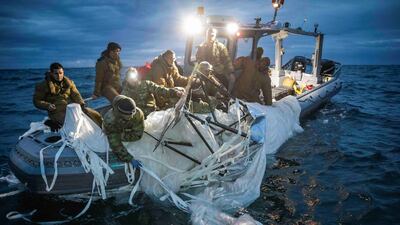
The Chinese “spy balloon” was shot down on February 4 by a US F-22 fighter. US Navy and Coastguard teams have recovered much of the wreckage of the vessel, which landed in waters about 14 metres deep off the eastern state of South Carolina.
Mr Kirby said the balloon was carrying a payload as long as three buses. Some of that has now been recovered from the Atlantic, though rough seas are hampering efforts.
At the weekend, Chinese state-affiliated media reported that an unidentified flying object had been spotted off the country's east coast and that the military was preparing to shoot it down.
Beijing on Monday declined to comment on that report, AFP reported.
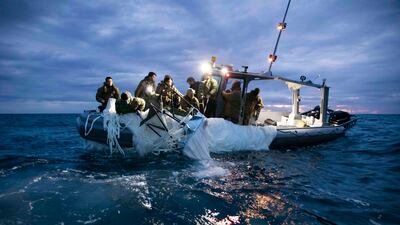
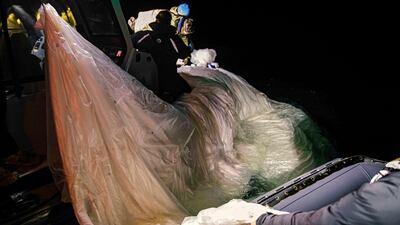
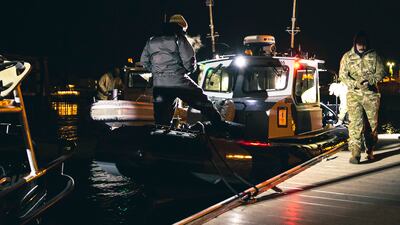
US Navy recovers Chinese balloon — in pictures
Switching%20sides
%3Cp%3EMahika%20Gaur%20is%20the%20latest%20Dubai-raised%20athlete%20to%20attain%20top%20honours%20with%20another%20country.%0D%3C%2Fp%3E%0A%3Cp%3E%3Cstrong%3EVelimir%20Stjepanovic%20(Serbia%2C%20swimming)%20%3C%2Fstrong%3E%0D%3Cbr%3EBorn%20in%20Abu%20Dhabi%20and%20raised%20in%20Dubai%2C%20he%20finished%20sixth%20in%20the%20final%20of%20the%202012%20Olympic%20Games%20in%20London%20in%20the%20200m%20butterfly%20final.%20%0D%3C%2Fp%3E%0A%3Cp%3E%3Cstrong%3EJonny%20Macdonald%20(Scotland%2C%20rugby%20union)%20%3C%2Fstrong%3E%0D%3Cbr%3EBrought%20up%20in%20Abu%20Dhabi%20and%20represented%20the%20region%20in%20international%20rugby.%20When%20the%20Arabian%20Gulf%20team%20was%20broken%20up%20into%20its%20constituent%20nations%2C%20he%20opted%20to%20play%20for%20Scotland%20instead%2C%20and%20went%20to%20the%20Hong%20Kong%20Sevens.%20%0D%3C%2Fp%3E%0A%3Cp%3E%3Cstrong%3ESophie%20Shams%20(England%2C%20rugby%20union)%20%3C%2Fstrong%3E%0D%3Cbr%3EThe%20daughter%20of%20an%20English%20mother%20and%20Emirati%20father%2C%20Shams%20excelled%20at%20rugby%20in%20Dubai%2C%20then%20after%20attending%20university%20in%20the%20UK%20played%20for%20England%20at%20sevens.%20%0D%3C%2Fp%3E%0A
Our family matters legal consultant
Name: Hassan Mohsen Elhais
Position: legal consultant with Al Rowaad Advocates and Legal Consultants.
THE BIO
Bio Box
Role Model: Sheikh Zayed, God bless his soul
Favorite book: Zayed Biography of the leader
Favorite quote: To be or not to be, that is the question, from William Shakespeare's Hamlet
Favorite food: seafood
Favorite place to travel: Lebanon
Favorite movie: Braveheart
THE%C2%A0SPECS
%3Cp%3EEngine%3A%204-cylinder%202.5-litre%20%2F%202-litre%20turbo%0D%3Cbr%3EPower%3A%20188hp%20%2F%20248hp%0D%3Cbr%3ETorque%3A%20244Nm%20%2F%20370Nm%0D%3Cbr%3ETransmission%3A%207-speed%20auto%0D%3Cbr%3EOn%20sale%3A%20now%0D%3Cbr%3EPrice%3A%20From%20Dh110%2C000%0D%3C%2Fp%3E%0A
Mercer, the investment consulting arm of US services company Marsh & McLennan, expects its wealth division to at least double its assets under management (AUM) in the Middle East as wealth in the region continues to grow despite economic headwinds, a company official said.
Mercer Wealth, which globally has $160 billion in AUM, plans to boost its AUM in the region to $2-$3bn in the next 2-3 years from the present $1bn, said Yasir AbuShaban, a Dubai-based principal with Mercer Wealth.
“Within the next two to three years, we are looking at reaching $2 to $3 billion as a conservative estimate and we do see an opportunity to do so,” said Mr AbuShaban.
Mercer does not directly make investments, but allocates clients’ money they have discretion to, to professional asset managers. They also provide advice to clients.
“We have buying power. We can negotiate on their (client’s) behalf with asset managers to provide them lower fees than they otherwise would have to get on their own,” he added.
Mercer Wealth’s clients include sovereign wealth funds, family offices, and insurance companies among others.
From its office in Dubai, Mercer also looks after Africa, India and Turkey, where they also see opportunity for growth.
Wealth creation in Middle East and Africa (MEA) grew 8.5 per cent to $8.1 trillion last year from $7.5tn in 2015, higher than last year’s global average of 6 per cent and the second-highest growth in a region after Asia-Pacific which grew 9.9 per cent, according to consultancy Boston Consulting Group (BCG). In the region, where wealth grew just 1.9 per cent in 2015 compared with 2014, a pickup in oil prices has helped in wealth generation.
BCG is forecasting MEA wealth will rise to $12tn by 2021, growing at an annual average of 8 per cent.
Drivers of wealth generation in the region will be split evenly between new wealth creation and growth of performance of existing assets, according to BCG.
Another general trend in the region is clients’ looking for a comprehensive approach to investing, according to Mr AbuShaban.
“Institutional investors or some of the families are seeing a slowdown in the available capital they have to invest and in that sense they are looking at optimizing the way they manage their portfolios and making sure they are not investing haphazardly and different parts of their investment are working together,” said Mr AbuShaban.
Some clients also have a higher appetite for risk, given the low interest-rate environment that does not provide enough yield for some institutional investors. These clients are keen to invest in illiquid assets, such as private equity and infrastructure.
“What we have seen is a desire for higher returns in what has been a low-return environment specifically in various fixed income or bonds,” he said.
“In this environment, we have seen a de facto increase in the risk that clients are taking in things like illiquid investments, private equity investments, infrastructure and private debt, those kind of investments were higher illiquidity results in incrementally higher returns.”
The Abu Dhabi Investment Authority, one of the largest sovereign wealth funds, said in its 2016 report that has gradually increased its exposure in direct private equity and private credit transactions, mainly in Asian markets and especially in China and India. The authority’s private equity department focused on structured equities owing to “their defensive characteristics.”
How Apple's credit card works
The Apple Card looks different from a traditional credit card — there's no number on the front and the users' name is etched in metal. The card expands the company's digital Apple Pay services, marrying the physical card to a virtual one and integrating both with the iPhone. Its attributes include quick sign-up, elimination of most fees, strong security protections and cash back.
What does it cost?
Apple says there are no fees associated with the card. That means no late fee, no annual fee, no international fee and no over-the-limit fees. It also said it aims to have among the lowest interest rates in the industry. Users must have an iPhone to use the card, which comes at a cost. But they will earn cash back on their purchases — 3 per cent on Apple purchases, 2 per cent on those with the virtual card and 1 per cent with the physical card. Apple says it is the only card to provide those rewards in real time, so that cash earned can be used immediately.
What will the interest rate be?
The card doesn't come out until summer but Apple has said that as of March, the variable annual percentage rate on the card could be anywhere from 13.24 per cent to 24.24 per cent based on creditworthiness. That's in line with the rest of the market, according to analysts
What about security?
The physical card has no numbers so purchases are made with the embedded chip and the digital version lives in your Apple Wallet on your phone, where it's protected by fingerprints or facial recognition. That means that even if someone steals your phone, they won't be able to use the card to buy things.
Is it easy to use?
Apple says users will be able to sign up for the card in the Wallet app on their iPhone and begin using it almost immediately. It also tracks spending on the phone in a more user-friendly format, eliminating some of the gibberish that fills a traditional credit card statement. Plus it includes some budgeting tools, such as tracking spending and providing estimates of how much interest could be charged on a purchase to help people make an informed decision.
* Associated Press
Stage 2
1. Mathieu van der Poel (NED) Alpecin-Fenix 4:18:30
2. Tadej Pogacar (SLV) UAE Team Emirates 0:00:06
3. Primoz Roglic (SLV) Jumbo-Visma 0:00:06
4. Wilco Kelderman (NED) Bora-Hansgrohe 0:00:06
5. Julian Alaphilippe (FRA) Deceuninck-QuickStep 0:00:08
10 tips for entry-level job seekers
- Have an up-to-date, professional LinkedIn profile. If you don’t have a LinkedIn account, set one up today. Avoid poor-quality profile pictures with distracting backgrounds. Include a professional summary and begin to grow your network.
- Keep track of the job trends in your sector through the news. Apply for job alerts at your dream organisations and the types of jobs you want – LinkedIn uses AI to share similar relevant jobs based on your selections.
- Double check that you’ve highlighted relevant skills on your resume and LinkedIn profile.
- For most entry-level jobs, your resume will first be filtered by an applicant tracking system for keywords. Look closely at the description of the job you are applying for and mirror the language as much as possible (while being honest and accurate about your skills and experience).
- Keep your CV professional and in a simple format – make sure you tailor your cover letter and application to the company and role.
- Go online and look for details on job specifications for your target position. Make a list of skills required and set yourself some learning goals to tick off all the necessary skills one by one.
- Don’t be afraid to reach outside your immediate friends and family to other acquaintances and let them know you are looking for new opportunities.
- Make sure you’ve set your LinkedIn profile to signal that you are “open to opportunities”. Also be sure to use LinkedIn to search for people who are still actively hiring by searching for those that have the headline “I’m hiring” or “We’re hiring” in their profile.
- Prepare for online interviews using mock interview tools. Even before landing interviews, it can be useful to start practising.
- Be professional and patient. Always be professional with whoever you are interacting with throughout your search process, this will be remembered. You need to be patient, dedicated and not give up on your search. Candidates need to make sure they are following up appropriately for roles they have applied.
Arda Atalay, head of Mena private sector at LinkedIn Talent Solutions, Rudy Bier, managing partner of Kinetic Business Solutions and Ben Kinerman Daltrey, co-founder of KinFitz