
An Alabama man affiliated with the far-right Oath Keepers militia group pleaded guilty to seditious conspiracy for his actions leading up and through the January 6 riot, making him the first person involved in the violent attack on the US Capitol to be convicted of the rarely used charge.
The sentencing guideline range for Joshua A James, who also pleaded guilty to a charge of obstruction of an official proceeding, was estimated to be seven and a quarter to nine years in prison.
James acknowledged being involved in a physical altercation with a police officer while inside the Capitol and participating in a plan to use force to hinder or delay the transfer of presidential power. James also agreed to co-operate with authorities investigating the riot, including giving evidence before a grand jury.
Authorities say James and others affiliated with the group rode golf carts to the Capitol, moved through the crowd in a military-style “stack” formation and went into the building.
He was accused of pushing past officers who tried to stop rioters from moving towards the Rotunda, joining others who confronted officers and profanely proclaiming the building was his.
A week before the riot, James said in an encrypted chat that he believed teams within the militia group were adequately armed, prosecutors said in court records.
While four other people connected with the Oath Keepers have pleaded guilty to obstruction of Congress and a lesser conspiracy charge, James is the first among the 11 people associated with the group to plead guilty to a seditious conspiracy charge.
The seditious conspiracy prosecution is the boldest publicly known attempt so far by the government to prosecute those who attacked the US Capitol. The group’s founder, Stewart Rhodes, and others have pleaded not guilty to seditious conspiracy and other charges. A seditious conspiracy conviction carries a maximum penalty of 20 years, compared with five years on the lesser conspiracy charge facing other group members.
Those charged with seditious conspiracy are accused of working together to use force to stop the peaceful transfer of presidential power.
Authorities say participants discussed their plans in encrypted chats, travelled to the nation’s capital from across the country, organised into teams, used military tactics, stashed weapons in case they felt they were needed and communicated with each other during the riot on January 6, 2021.
-
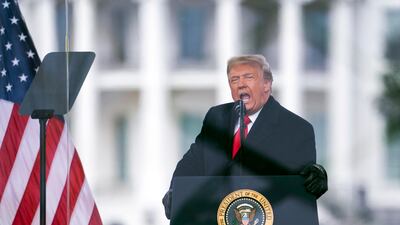
Donald Trump, the president at the time, speaks during a rally protesting the electoral college certification of Joe Biden as president in Washington on January 6, 2021. AP -
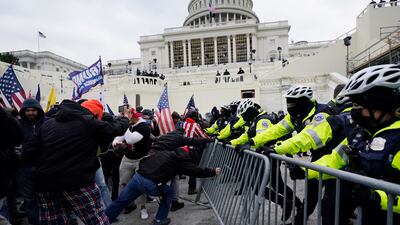
A mob loyal to Mr Trump tries to break through a police barrier at the Capitol. AP -
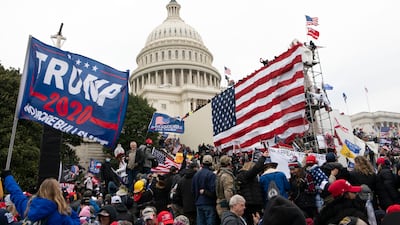
The mob waves pro-Trump flags in front of the Capitol building. AP -
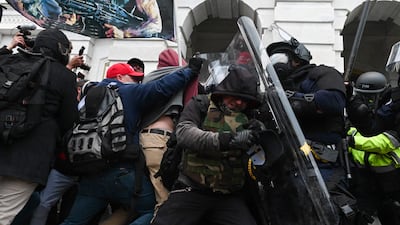
Riot police push back a crowd of rioters at the Capitol building. AFP -
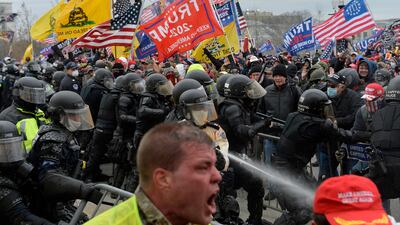
Trump supporters clash with police and security forces as people try to storm the US Capitol building. AFP -
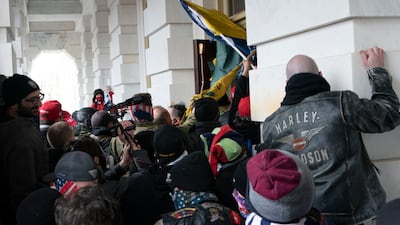
Insurrectionists loyal to Mr Trump try to open a door of the US Capitol building as they riot in Washington. AP -
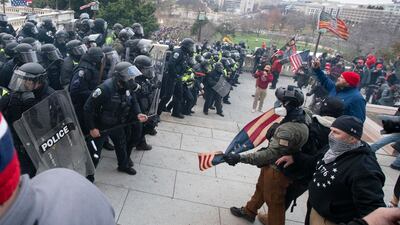
US Capitol Police push back rioters trying to enter the US Capitol. AP -
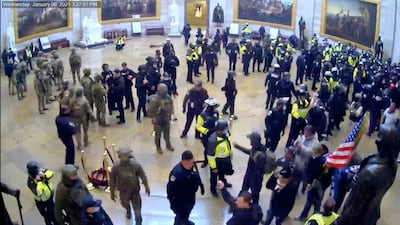
Police and rioters confront each other in the Rotunda of the Capitol. US Capitol Police via AP -
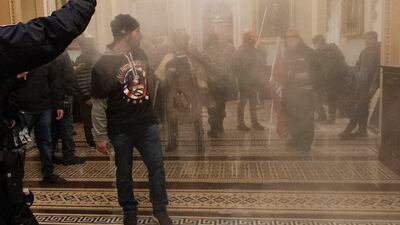
Smoke fills the hallway outside the Senate chamber of the Capitol. AP -
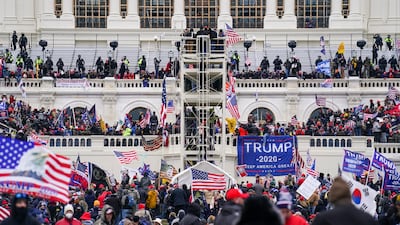
Insurrectionists loyal to Mr Trump breach the Capitol in Washington. AP -

Trump supporters, including Doug Jensen, centre, confront US Capitol Police in the hallway outside the Senate chamber at the Capitol. AP -
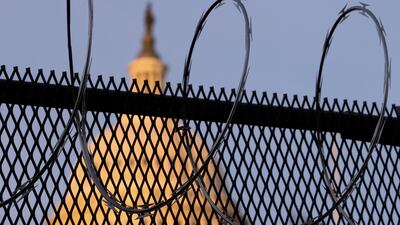
Newly installed razor wire tops the fence surrounding the US Capitol following the January 6 riot. Reuters -
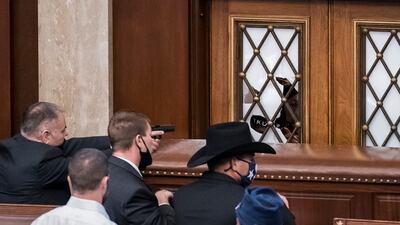
Security agents and members of Congress barricade the door to the House chamber as the violent mob breaches the Capitol. AP -
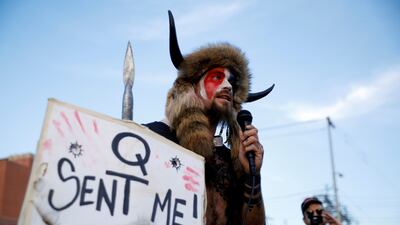
Rioter Jacob Chansley holds a sign referencing QAnon as supporters of Mr Trump gather to protest the early results of the 2020 presidential election. Reuters


Prosecutors say the group set up a “quick reaction force”, or QRF, that kept guns at a hotel in nearby Arlington, Virginia, and were prepared to bring the weapons into Washington if Mr Rhodes or associates believed the need arose.
Days before the attack, one of the accused suggested acquiring a boat to ferry weapons across the Potomac River. In the end, the QRF teams didn’t bring guns into Washington.
At the Capitol, Oath Keepers marched in two teams in stack formation, with team members advancing forward with one hand on the shoulder of the person in front of them.
More than 750 people have been charged with federal crimes related to the riot. More than 220 accused rioters have pleaded guilty, more than 100 have been sentenced and at least 90 others have trial dates.
The longest prison sentence handed down so far to a January 6 rioter was given to Robert Palmer of Largo, Florida.
Palmer, who was sentenced to five and a half years in prison, acknowledged hurling a wooden plank at officers protecting a Capitol entrance, spraying a fire extinguisher, then throwing it when it was done.
The attack resulted in the deaths of five people, including a police officer. More than 100 officers were injured. Rioters caused over $1 million in damage.

