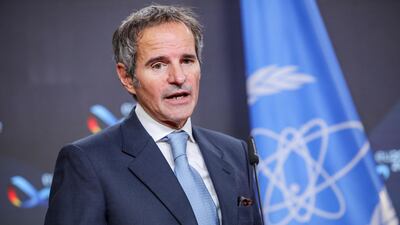
The UN's nuclear watchdog has dismissed Iran's explanations over the presence of nuclear material at an undeclared site in the country as "not credible".
The news comes as observers wait to see whether Joe Biden's victory in the US presidential election will lead to easing of tensions between Iran and western powers.
Despite Iranian authorities providing some information about the site, "the agency informed Iran that it continues to consider Iran's response to be not technically credible," the International Atomic Energy Agency (IAEA) said in a report seen by the Agence France-Presse.
"A full and prompt explanation from Iran regarding the presence of uranium particles of anthropogenic origin … at a location in Iran not declared to the agency is needed," the report said.
While the IAEA has not identified the site in question, diplomatic sources have indicated to AFP that it is in the Turquzabad district of Tehran, previously identified by Israel as an alleged site of secret atomic activity.
A source familiar with the issue said there was no indication the site had been used for processing uranium but that it could have been used for storing it as late as the end of 2018.
Iran's ambassador to the IAEA, Kazem Gharib Abadi, said on Twitter that "any hasty comments should be avoided".
"Interactions are ongoing with a view to finalise the resolution of the matter," he said.
The report did not provide any new information about two separate locations where the IAEA took samples in September and where undeclared nuclear activity may have taken place in the early 2000s.
The analysis of those samples is ongoing.
It however confirmed that Iran's stockpile of enriched uranium is now more than 12 times the limit set in a 2015 deal with world powers, even if the rate at which the stockpile is expanding has slowed since the last report.
The 2015 accord has been progressively unravelling since US President Donald Trump withdrew from the deal in May 2018 and went on to reintroduce crippling economic sanctions on Iran.
In retaliation, Iran has been breaking the limits on its nuclear activity laid down in the deal since May 2019.
In pictures: Nuclear sites in Iran
-

Iranian President Hassan Rouhani, right, and the head of Atomic Energy Organization of Iran Ali Akbar Salehi inspect the nuclear technology on the occasion of Iran National Nuclear Technology Day in Tehran in 2019. EPA -
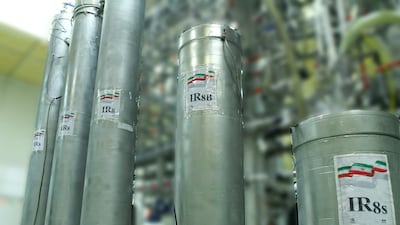
IR-8 centrifuges at Natanz nuclear power plant, some 300 kilometres south of capital Tehran. AFP -
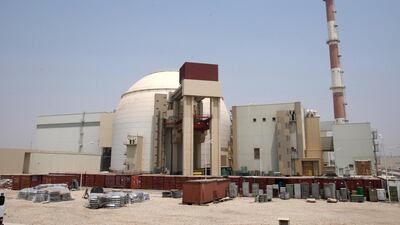
The Iranian nuclear power plant in Bushehr in 2010. EPA -

Salehi speaks with media while visiting Natanz enrichment facility, in central Iran in 2019. Atomic Energy Organization of Iran via AP -
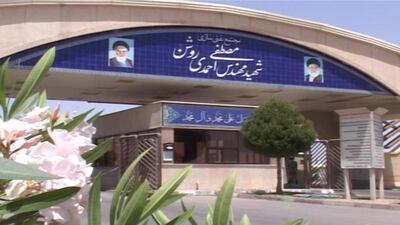
The gate of Natanz nuclear power plant in Natanz , Isfahan province, in 2019. EPA -
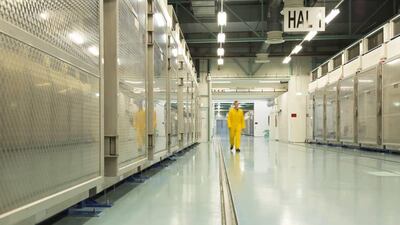
Inside of the Iran's Fordow nuclear facility, in Fordow, Qom province in 2019. EPA -
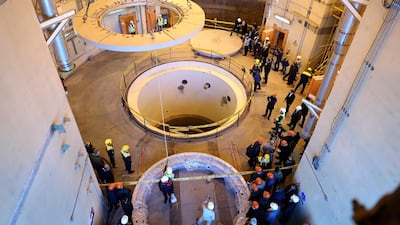
Technicians work at the Arak heavy water reactor's secondary circuit, as officials and media visit the site, near Arak, Iran in 2019. Atomic Energy Organization of Iran via AP -
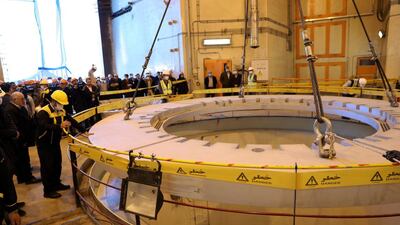
Members of the media and officials tour the water nuclear reactor at Arak in 2019. WANA via Reuters -
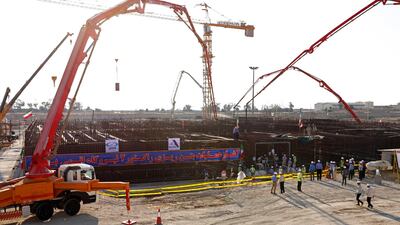
Concrete is poured for the base of the second nuclear power reactor at Bushehr plant in 2019. Atomic Energy Organization of Iran via AP


As well as breaching limits on the stockpile and enrichment level of uranium laid down in the 2015 Joint Comprehensive Plan of Action (JCPOA), Iran has been using more advanced centrifuges than permitted under the deal.
Wednesday's report confirmed that, in line with previous statements by Iranian officials, centrifuges had been installed at an underground part of the Natanz nuclear facility after another part of the site was damaged in a July explosion, which Iran blamed on "sabotage".
The three European powers who are still party to the 2015 deal, namely France, the UK and Germany, have been scrambling to find ways to keep the accord intact.
The election of Mr Trump's Democrat opponent Joe Biden as the next US president has offered some hope the deal could be revived, as Mr Biden has offered Iran a "credible path back to diplomacy".
On Wednesday Iranian President Hassan Rouhani said the country would take "any opportunity" which could "lift the pressure of sanctions from the shoulders of our people".
However, obstacles remain to any relaxation of strained relations.
Iran insists that the US has to lift sanctions imposed by Mr Trump's administration before it will come back into compliance with the JCPOA's limits.
The "maximum pressure" campaign on Iran launched by Mr Trump's administration has intensified Tehran's distrust of the Americans and tensions between the two countries have twice brought them to the brink of war since mid-2019.
Mr Biden will face a tight window of opportunity between his inauguration on January 20 and an Iranian presidential election set for June 18 in which reformists and moderates allied to Mr Rouhani may face a tough challenge from conservatives.
On Friday US Secretary of State Mike Pompeo will start a tour of US allies, including several of Iran's neighbours, during which he is expected to discuss raising further pressure on Tehran in the remaining two months of the Trump administration.

