
Live updates: Follow the latest news on Israel-Gaza
Pro-Palestinian protesters marched through central London on Saturday to call for a ceasefire in the Israel-Gaza war, as far-right counter-protesters clashed with police near the Cenotaph, amid claims they were “emboldened” by the UK's Home Secretary.
Hundreds of thousands of people took to the streets of the British capital on Saturday, which was Armistice Day.
It was the biggest march so far in support of Palestinians and possibly the largest protest since 2003 when an estimated 1.5 million people took to London’s streets against the Iraq war.
Police said that more than 126 people were arrested, most of whom were far-right counter-protesters.
Officers also stopped and searched a breakaway group of around 150 people from the march, who were setting off fireworks and wearing face coverings.
Prime Minister Rishi Sunak condemned “violent, wholly unacceptable” actions by far-right groups and “Hamas sympathisers” on the march, saying “all criminality must be met with the full and swift force of the law”.
He said the ugly scenes in central London on Armistice Day “utterly disrespected” the spirit of remembrance.
Mr Sunak said on Friday he will meet Metropolitan Police Commissioner Sir Mark Rowley in the coming days to hold him “accountable” for dealing with the disturbances.
Nine police officers were injured in the disturbances, including two requiring hospital treatment, Metropolitan Police Assistant Commissioner Matt Twist said in a statement.
Mr Twist said that the Palestine Solidarity Campaign (PSC) march “did not see the sort of physical violence carried out by the right wing”.
However, he added his force recognised the concerns of London’s Jewish community and the effect of hate crimes and anti-Semitic offences.
On X, formerly Twitter, the force said it was attempting to identify five people it had accused of hate crimes.
The Metropolitan Police said officers had faced “aggression” from counter-protesters ahead of a two-minute silence held at the war memorial in Whitehall.
-

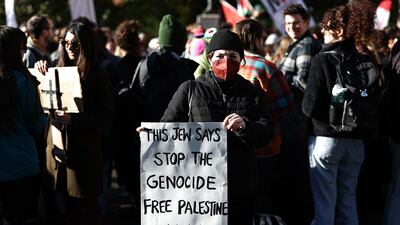
A protester attends a gathering in Belgrave Square, calling for a 'Ceasefire Now', during a demonstration organised by the group Jews For Palestine, in London on Saturday, before a 'National March For Palestine'. AFP -
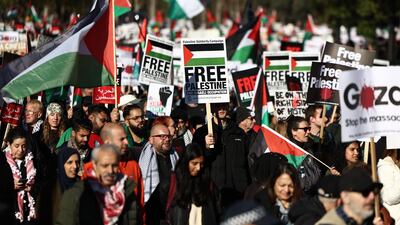
Thousands of pro-Palestinian demonstrators set off in London on Armistice Day in what was one of the largest political marches in British history. AFP -
Britain's Prime Minister Rishi Sunak had described a planned march in London on Saturday - Armistice Day, when Britain honours its war dead - as "provocative and disrespectful" and suggested London's Metropolitan Police ban it. AFP -
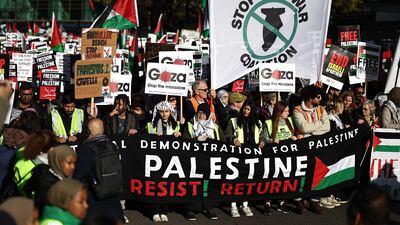
Police said the march in support of Palestinians does not meet the legal threshold for requesting a government order to stop it going ahead. AFP -
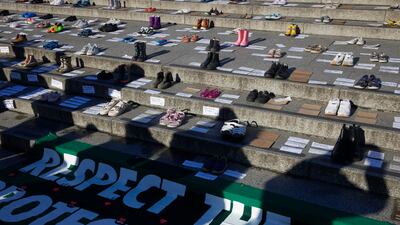
A remembrance for the children who have been killed in Israeli air strikes since the beginning of the Israel-Gaza war at the steps of Trafalgar Square as part of the demonstration. Getty Images -
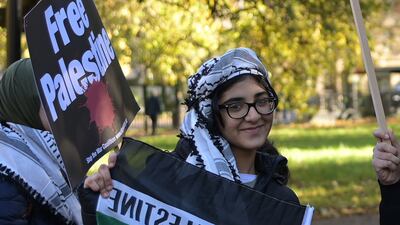
Many women were taking part in the march. EPA -
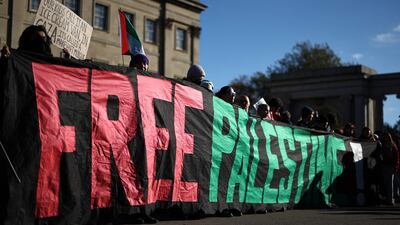
Protesters gather with placards and flags in central London. AFP -

A coalition of groups are behind the march including the Palestine Solidarity Campaign, Friends of Al Aqsa, Stop the War Coalition, Muslim Association of Britain, Palestinian Forum in Britain and Campaign for Nuclear Disarmament. EPA -
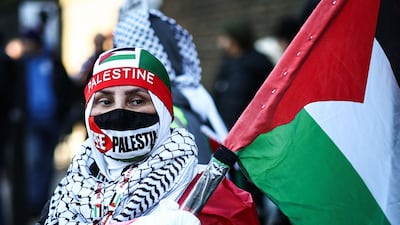
A protestor wearing a face mask and a Palestinian flag takes part in the 'National March For Palestine' in central London. AFP -
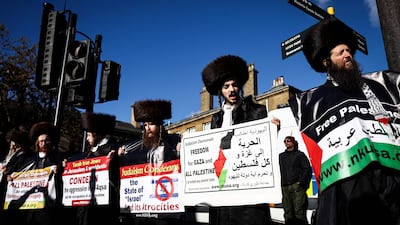
Members of the Ultra-Orthodox Jewish community take part in the 'National March For Palestine' in central London. AFP -
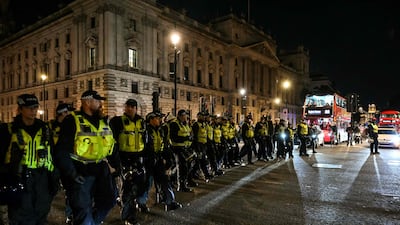
Police officers patrol Parliament Square with far-right counter-protesters nearby -
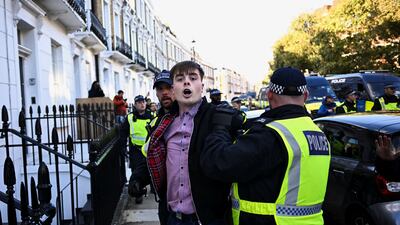
A man is detained by police officers on the day of a protest in solidarity with Palestinians in Gaza in London. Reuters -
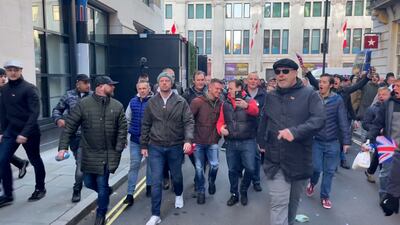
Far-right activist Tommy Robinson with counter-protesters in London's Chinatown. PA


The force said: “While the two minutes' silence was marked respectfully and without incident on Whitehall, officers have faced aggression from counter-protesters who are in the area in significant numbers.”
It later said it had detained a “large group” of counter-protesters near Westminster Bridge who were believed to be part of the group involved in the disorder.
In total, 82 arrests were made in Tachbrook Street. Police said they had made the arrests to prevent a breach of the peace.
Arrests were also made for possession of a knife, possession of a baton, possession of class A drugs and an assault on an emergency worker.
“They’re part of a large group of counter-protesters we have been monitoring who have tried to reach the main protest march. We will continue to take action to avoid the disorder that would likely take place if that happened,” police said in a post on X.
An officer said police were also preventing some people from leaving the White Swan pub on Vauxhall Bridge Road “as they might cause some aggro”.
Pro-Palestine protesters on the main march booed at those kettled inside the pub, where a heavy police presence was in place outside, as they walked by.
About 20 officers, including police on horseback, were separating counter-protesters from the pro-Palestine march, which passed peacefully south.
A group of pro-Palestinian protesters had climbed on to a raised platform on the corner of Vauxhall Bridge, a firework was set off and one was clutching a smoke flare.
Police officers appeared to be preventing a small group of counter-protesters from coming up a flight of stairs on the Pimlico side of the bridge.
Further clashes between people chanting “England 'til I die” and officers took place near Westminster underground station and in Chinatown.
Scottish First Minister Humza Yousaf blamed the Home Secretary, Suella Braverman, for the unrest, saying she had encouraged far-right protesters with her inflammatory rhetoric, branding pro-Palestinian demonstrators “hate marchers”.
She also accused the police of bias for letting the march go ahead on the day commemorating the end of the First World War.
In a post on X, he wrote: “The far right has been emboldened by the Home Secretary. She has spent her week fanning the flames of division. They are now attacking the police on Armistice Day.
“The Home Secretary's position is untenable. She must resign.”
Mayor of London Sadiq Khan said: “The scenes of disorder we witnessed by the far-right at the Cenotaph are a direct result of the Home Secretary's words. The police's job has been made much harder.”
There were no signs of trouble at the start of the march on Saturday, when thousands of people flooded into Hyde Park ahead of the beginning of the protest.
One London marcher told The National her father was a Holocaust survivor who supported the Palestinian cause. Celia Urbach said Philip Gorbach, who lost his entire family in the Holocaust, arrived in London on Kindertransport when he was 14.
She said he would have joined her at the march to support Palestinians if he were still alive.
“He was always ambivalent about the Zionist project, because of course he wanted a homeland for the Jews he knew it meant displacing another people.
“So he could never wholeheartedly support the Zionist project and that’s been my upbringing. There are many, many Jews who feel the same way.”
“He carried a lot of sadness in attempting to solve one problem you create another in a very similar vein. “He felt deeply sad about that. And I do too.”
Johnathan Ferrier, 78, who also took part in the march, said those who died in the world wars would have understood why people were protesting against the Israel-Gaza conflict.
He told The National: “My father’s brother, my uncle, was killed in the First World War, at the age of 18.
“I will be going to our Remembrance service tomorrow. But my uncle would, and all the British who were killed in the First World War, and the Germans, and those killed in the Second World War would have understood and realised how we have to stop this madness. That’s why I am here.

“We have to have a ceasefire. But we also have to have a just solution. And unfortunately the creation of Israel by displacing Palestinians in 1947 was a mistake.
“We need a two or even a three state solution. And we have to work for a peaceful solution.”
Another protester, Farhan Mohamed, 27, said people coming together to support the Palestinian cause “shows what Britain is about”.
“Britain is about the people, and you can’t forget people who are in need of help.
“If the way we help them and going on marches, that’s the littlest we can do. And that’s the only thing we can do. But we do it together.”
He said people should focus on what is happening in Palestine, rather than issues like what Ms Braverman said about the protest.
“It is a very big gathering. You see all sorts of people, and it’s not just Muslims,” he told The National.
“I have seen a couple of Jewish people as well. It’s a way of understanding that people need help and we should come together, put aside our differences and support what’s right.”
Towards the end of the march, pro-Palestinian protesters also staged a sit-in at Waterloo Station with a similar sit-in held briefly at Victoria Station earlier in the afternoon.
The British Transport Police said officers were urging people to disperse after an order was put in place prohibiting assembly at several London railway stations.
Metropolitan Police commissioner Sir Mark Rowley had resisted pressure from politicians, including Prime Minister Rishi Sunak, to try to block the gathering.
He said intelligence surrounding the potential for serious disorder this weekend did not meet the threshold to apply for a ban and insisted he would not act outside the law.
On the eve of the mass protest, the Prime Minister urged those taking part to do so “respectfully and peacefully” and to respect Armistice Day commemorations.
“Remembrance weekend is sacred for us all and should be a moment of unity, of our shared British values and of solemn reflection,” he said.
Protests were, however, banned at several train stations, with orders in place prohibiting assembly at Waterloo, Victoria and Charing Cross between 10am and 11pm on Saturday.
Mr Sunak and Ms Braverman have expressed concern that the protests could spill over into Sunday, when King Charles and the prime ministers of Commonwealth nations will lay wreaths at the national war memorial, known as the Cenotaph.
The commemoration events are “sacred” to Britain and should be a time for unity and “solemn reflection,” Mr Sunak said before Saturday's events got under way.
“It is because of those who fought for this country and for the freedom we cherish that those who wish to protest can do so, but they must do so respectfully and peacefully,” he added.

