


Russian forces are being pushed back from towns around Kyiv by Ukrainian counter-attacks, Britain has said, as President Vladimir Putin’s troops struggle to push towards the capital.
Ukrainian troops have recaptured towns occupied by the Russians and are likely to continue with their pushback towards Hostomel Airport.
The airfield on the outskirts of the capital is a key target for Moscow, which hopes to use the base to fly in extra troops. Invading forces briefly took control of the site at the beginning of the war but the Ukrainians managed to retake it shortly afterwards.
In an intelligence update issued on Friday Britain’s Ministry of Defence said the Russians continue to be blighted by logistical problems.
“Ukrainian counter-attacks, and Russian Forces falling back on overextended supply lines, has allowed Ukraine to reoccupy towns and defensive positions up to 35 kilometres east of Kyiv,” the MoD said.
“Ukrainian Forces are likely to continue to attempt to push Russian Forces back along the north-western axis from Kyiv towards Hostomel airfield.
“In the south of Ukraine Russian forces are still attempting to circumvent Mykolaiv as they look to drive west towards Odesa with their progress being slowed by logistic issues and Ukrainian resistance.”
However further north the Ukrainian city of Chernihiv has in effect been cut off by Russian forces, the regional governor said on Friday.
"The city has been conditionally, operationally surrounded by the enemy," Governor Viacheslav Chaus said on national television, adding that the city was under fire from artillery and warplanes.
Ukrainian President Volodymyr Zelenskyy on Thursday pleaded for more military aid for his troops and volunteers to defend their country. He also said the West's sanctions against Russia had come too late.
He issued a clarion call as world leaders gathered for three summits to discuss the next steps in countering Russia’s month-old invasion. The extraordinary series of summits — hosted by Nato, the G7 industrialised nations and the EU in Brussels — reflected alarm that the conflict shows no sign of ending soon and could even spread beyond Ukraine’s borders.
As Europe faces its greatest crisis in generations, Western leaders continue the search for ways to increase pressure on President Putin while avoiding steps that could lead to a wider war on the continent.
Mr Zelenskkyy, addressing the Nato gathering by video from Kyiv, called for “military assistance without limitations” as Russia is “without limits using its entire arsenal”.
He specifically asked for anti-air and anti-ship weapons, and although Mr Zelenskyy thanked Western nations for support they already have provided, his frustration was clear.
He urged Nato to provide Ukraine with “1 per cent of all your planes, 1 per cent of all your tanks”.
“We can’t just buy those,” Mr Zelenskyy said. “When we will have all this, it will give us, just like you, 100 per cent security.”
US President Joe Biden, who is attending all three summits, said more aid was on its way. “We are committed to identifying additional equipment, including air defence systems, to help Ukraine,” Mr Biden said after the Nato meeting.
He will travel to a Polish town near the border with Ukraine on Friday to meet Ukrainian refugees.
Billions of dollars of military hardware has already been provided. A US official said Western nations were also discussing the possibility of providing anti-ship weapons amid concerns that Russia will launch amphibious assaults along the Black Sea coast.
-
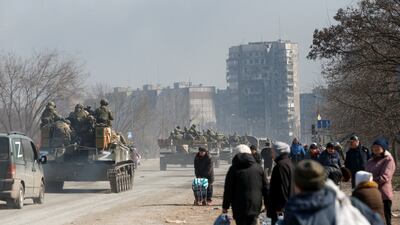
Pro-Russian troops drive armoured vehicles past local residents in the besieged Ukrainian port city of Mariupol. Reuters -
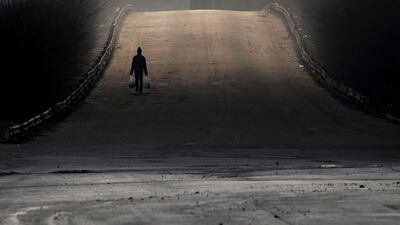
Heavy smoke from a warehouse destroyed by Russian troops casts a shadow on a road outside Kyiv. AP -
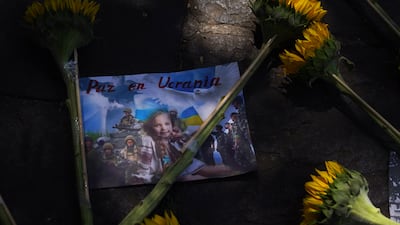
Sunflowers and an image with a message in Spanish that reads 'Peace in Ukraine' placed outside the Russian embassy in Mexico City by demonstrators during a protest against Moscow's invasion of Ukraine. AP -
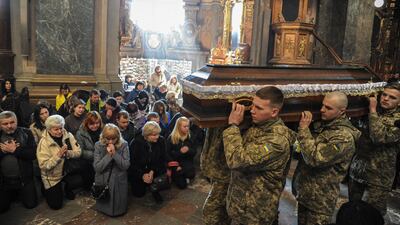
Ukrainians pay their respects during the funeral Senior Lt Igor Fedorchik in Lviv. The Ukrainian officer was killed when Russian forces shelled the town of New Kahovka. EPA -
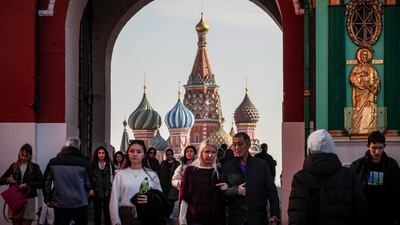
St Basil's Cathedral, as viewed from the Red Square in Moscow. EPA -
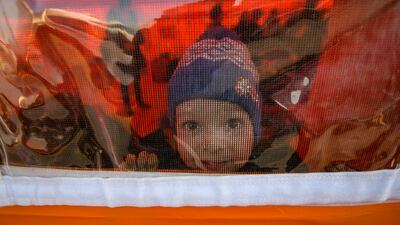
A young Ukrainian refugee looks out of a tent after crossing the border by ferry into Romania on March 24, 2022. AP -
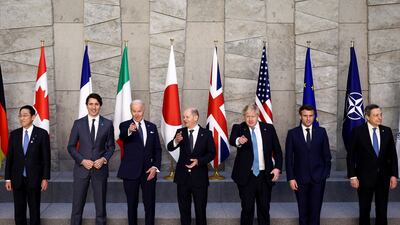
From left, Japanese Prime Minister Fumio Kishida, Canadian Prime Minister Justin Trudeau, US President Joe Biden, German Chancellor Olaf Scholz, British Prime Minister Boris Johnson, French President Emmanuel Macron and Italian Prime Minister Mario Draghi pose for a family photo during the G7 summit in Brussels, Belgium. Reuters -

Smoke billows from a fire on what the Ukrainian Ministry of Defence says is a Russian warship at the port of Berdiansk, Ukraine. Reuters -

Yurii, brother of Ihor Fedorchyk, 38, a soldier killed by Russian shelling in the town of New Kahovka, hugs his mother, Myroslava, as they mourn during his funeral at the Lychakiv cemetery in Lviv, Ukraine. Reuters -
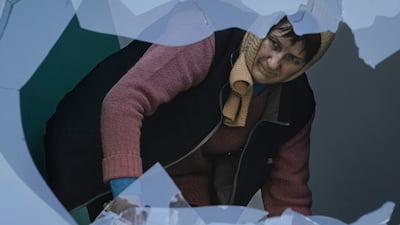
A woman cleans broken glass from a staircase in an apartment building damaged by bombing in Kyiv, Ukraine. AP -
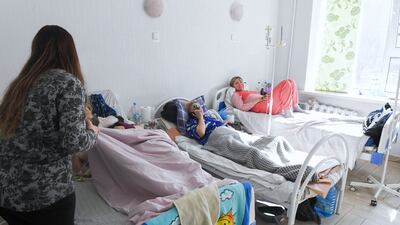
Civilian victims of Russian bombings are treated in a hospital in Kharkiv, Ukraine. EPA -
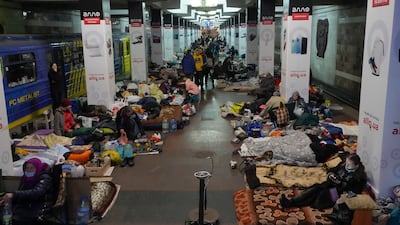
People rest with their belongings in a city subway being used as a bomb shelter in Kharkiv, Ukraine. AP -
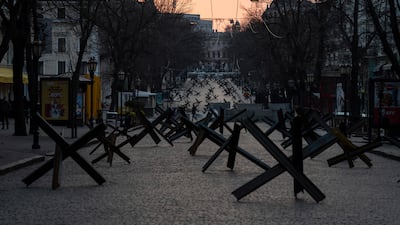
Anti-tank barricades are placed on a street in preparation for a possible Russian offensive in Odesa, Ukraine. AP -
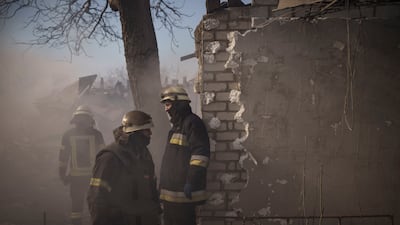
Firefighters work to extinguish a fire at a house destroyed in a Russian attack in Kharkiv, Ukraine. AP -
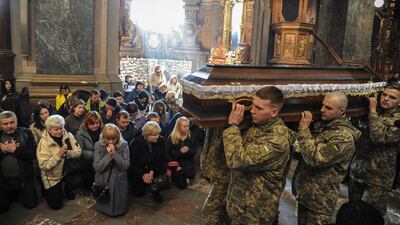
Ukrainian servicemen carry a coffin during a funeral in Lviv, Ukraine. EPA -
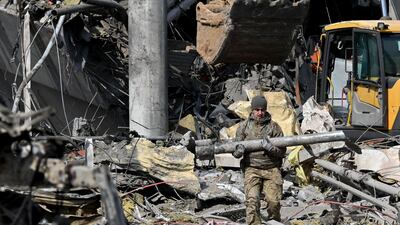
A Ukrainian serviceman carries a fragment of a rocket outside a building in Kyiv that was destroyed by Russian shelling. AFP -
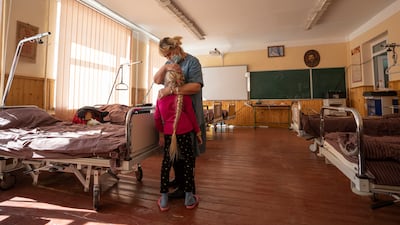
Nadia holds her 10-year-old granddaughter, Zlata Moiseinko, who suffers from a chronic heart condition, as she receives treatment at a schoolhouse that has been converted into a field hospital in Mostyska, western Ukraine. AP -

A neighbour walks on the debris of a burning house destroyed in a Russian attack in Kharkiv, Ukraine. AP


The White House announced that the US will welcome 100,000 Ukrainian refugees and provide an additional $1 billion in food, medicine, water and other supplies.
With Russia facing increasing international isolation, Nato Secretary General Jens Stoltenberg warned China against coming to its rescue. “They should join the rest of the world and clearly condemn the brutal war against Ukraine and not support Russia,” either with economic or military support, he said after the closed-door meeting.
Meanwhile Ukrainian officials in the strategic port city of Mariupol say some 300 people could have died in last week's Russian strike on a theatre where hundreds were sheltering.
"From eyewitnesses, information is emerging that about 300 people died in the Drama Theatre of Mariupol following strikes by a Russian aircraft," Mariupol city council wrote on Telegram.

