The entrance of the American University of Beirut's medical centre in the Lebanese capital Beirut on March 14, 2014. AFP

Lebanon: American University of Beirut forced to let go of up to a quarter of its staff


Sunniva Rose
  • English
  • Arabic

The American University of Beirut will let go of up to 25 per cent of its staff in the face of its worst economic crisis so far, its President Fadlo Khuri has said.

Mr Khuri informed Lebanese President Michel Aoun on Friday that between 22 and 25 per cent of AUB's staff would be dismissed, local daily L'Orient-Le Jour reported on Monday. Mr Khuri told the newspaper that AUB employed 6,500 people.

Jobs will be cut mostly in administrative posts and both AUB and at its hospital, the American University Hospital (AUH), will be targeted, wrote L'Orient-Le Jour. The planned construction of a new hospital will be suspended.

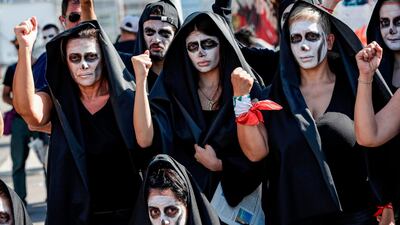
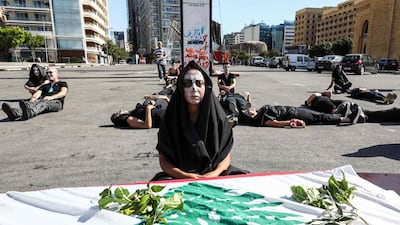
  • Lebanese anti-government protesters take part in a symbolic funeral for the country in the capital Beirut on June 13, 2020, the third consecutive day of demonstrations over a deepening economic crisis. AFP
    Lebanese anti-government protesters take part in a symbolic funeral for the country in the capital Beirut on June 13, 2020, the third consecutive day of demonstrations over a deepening economic crisis. AFP
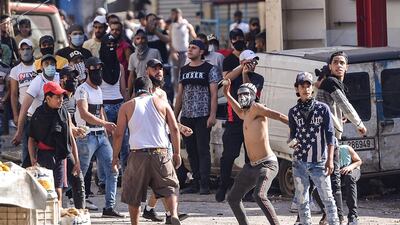
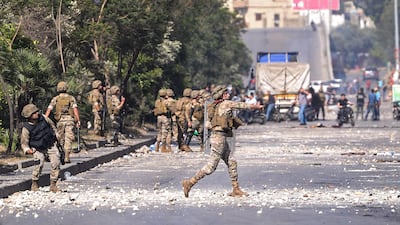
  • Lebanese anti-government protesters throw rocks at soldiers amid clashes in the Bab al-Tabbaneh neighbourhood in the northern port city of Tripoli on the third consecutive day of demonstrations against deepening economic crisis. AFP
    Lebanese anti-government protesters throw rocks at soldiers amid clashes in the Bab al-Tabbaneh neighbourhood in the northern port city of Tripoli on the third consecutive day of demonstrations against deepening economic crisis. AFP
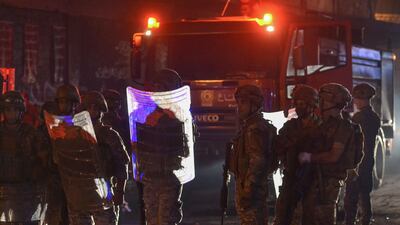
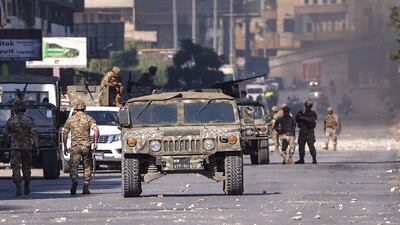
  • Lebanese soldiers deploy by a civil defence firefighting truck during clashes with anti-government protesters in the northern port city of Tripoli amid fresh demonstrations over a spiralling economic crisis. AFP
    Lebanese soldiers deploy by a civil defence firefighting truck during clashes with anti-government protesters in the northern port city of Tripoli amid fresh demonstrations over a spiralling economic crisis. AFP
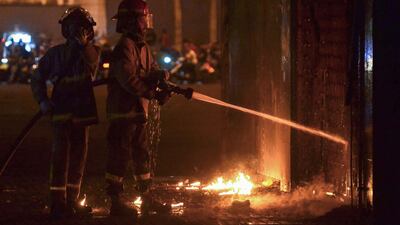
  • Lebanese civil defence firefighters extinguish flames in a shop as anti-government protesters and security forces clash in the northern port city of Tripoli amid fresh demonstrations over a spiralling economic crisis. AFP
    Lebanese civil defence firefighters extinguish flames in a shop as anti-government protesters and security forces clash in the northern port city of Tripoli amid fresh demonstrations over a spiralling economic crisis. AFP
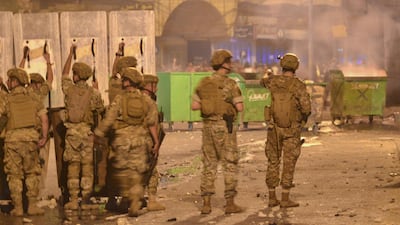
  • Lebanese soldiers with riot gear react during clashes with anti-government protesters in the northern port city of Tripoli amid fresh demonstrations over a spiralling economic crisis. AFP
    Lebanese soldiers with riot gear react during clashes with anti-government protesters in the northern port city of Tripoli amid fresh demonstrations over a spiralling economic crisis. AFP
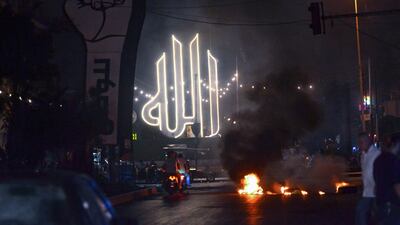
  • Lebanese anti-government protesters block a road with burning tyres in the northern port city of Tripoli amid fresh protests over a spiralling economic crisis. AFP
    Lebanese anti-government protesters block a road with burning tyres in the northern port city of Tripoli amid fresh protests over a spiralling economic crisis. AFP
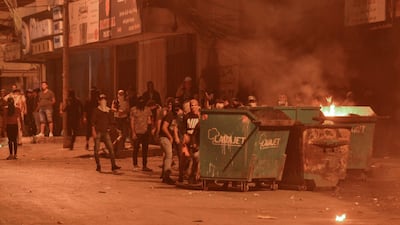
  • Lebanese anti-government protesters clash with security forces in the northern port city of Tripoli amid fresh protests over a spiralling economic crisis. AFP
    Lebanese anti-government protesters clash with security forces in the northern port city of Tripoli amid fresh protests over a spiralling economic crisis. AFP
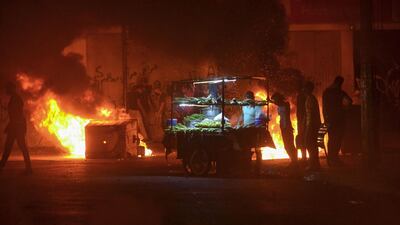
  • Lebanese anti-government protesters buy corn from a street vendor next to burning garbage bins during clashes with security forces in the northern port city of Tripoli amid fresh protests over a spiralling economic crisis. AFP
    Lebanese anti-government protesters buy corn from a street vendor next to burning garbage bins during clashes with security forces in the northern port city of Tripoli amid fresh protests over a spiralling economic crisis. AFP
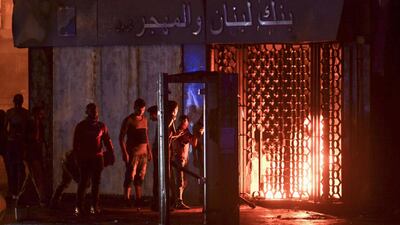
  • Lebanese anti-government protesters take shelter behind a public phone booth as a local bank's branch burns during clashes with security forces in the northern port city of Tripoli amid fresh protests over a spiralling economic crisis. AFP
    Lebanese anti-government protesters take shelter behind a public phone booth as a local bank's branch burns during clashes with security forces in the northern port city of Tripoli amid fresh protests over a spiralling economic crisis. AFP
  • Lebanese anti-government protesters take part in a symbolic funeral for the country in the central area of the capital Beirut on the third consecutive day of demonstrations over a deepening economic crisis. AFP
    Lebanese anti-government protesters take part in a symbolic funeral for the country in the central area of the capital Beirut on the third consecutive day of demonstrations over a deepening economic crisis. AFP
  • Lebanese soldiers deploy during an anti-government protest in the Bab al-Tabbaneh neighbourhood in the northern port city of Tripoli on the third day of demonstrations across the country over deepening economic crisis. AFP
    Lebanese soldiers deploy during an anti-government protest in the Bab al-Tabbaneh neighbourhood in the northern port city of Tripoli on the third day of demonstrations across the country over deepening economic crisis. AFP
  • Lebanese soldiers clash with anti-government protesters in the Bab al-Tabbaneh neighbourhood in the northern port city of Tripoli on the third day of demonstrations across the country against deepening economic crisis. AFP
    Lebanese soldiers clash with anti-government protesters in the Bab al-Tabbaneh neighbourhood in the northern port city of Tripoli on the third day of demonstrations across the country against deepening economic crisis. AFP

On May 5, Mr Khuri wrote an alarming letter saying the University was facing its “greatest crisis since [its] foundation in 1866”. He blamed Lebanon’s “economic meltdown, the Covid-19 pandemic, and the expected global economic depression”.

The university’s revenue for 2020-2021 will be 60 per cent below its target of $249 million. “Most organisations do not survive such rapid and severe drops in revenue,” wrote Mr Khuri.

At the time, staff told The National that the university's situation had been difficult even before Lebanon's economic crisis, which has caused the local currency to crash, reached a boiling point last October, causing massive protests.

Mr Khuri said on Saturday that staff would be asked to accept a reduction of 10 to 15 per cent of their salary. This will be voluntary for those earning up to $150,000/year and compulsory above that amount, reported L’Orient-Le Jour.

In his May 5 letter, Mr Khuri had said that everyone at AUB would be affected by the crisis “from our senior leadership, which will take significant pay reductions, to faculty members who have seen their buying power reduced, to students and their families who are struggling more than ever to pay tuition fees, to our staff who comprise our most financially challenged group”.

Mr Khuri said on Saturday that in 1975, when AUB was in a severe economic crisis during the first year of the Lebanese civil war, then-Prime Minister Rachid Karamé had saved the university from closure with a donation of 18 million Lebanese pounds.

AUB functioned through the 15-year civil war despite the kidnapping or murder of a number of staff, including two presidents.

Mercer, the investment consulting arm of US services company Marsh & McLennan, expects its wealth division to at least double its assets under management (AUM) in the Middle East as wealth in the region continues to grow despite economic headwinds, a company official said.

Mercer Wealth, which globally has $160 billion in AUM, plans to boost its AUM in the region to $2-$3bn in the next 2-3 years from the present $1bn, said Yasir AbuShaban, a Dubai-based principal with Mercer Wealth.

Within the next two to three years, we are looking at reaching $2 to $3 billion as a conservative estimate and we do see an opportunity to do so,” said Mr AbuShaban.

Mercer does not directly make investments, but allocates clients’ money they have discretion to, to professional asset managers. They also provide advice to clients.

“We have buying power. We can negotiate on their (client’s) behalf with asset managers to provide them lower fees than they otherwise would have to get on their own,” he added.

Mercer Wealth’s clients include sovereign wealth funds, family offices, and insurance companies among others.

From its office in Dubai, Mercer also looks after Africa, India and Turkey, where they also see opportunity for growth.

Wealth creation in Middle East and Africa (MEA) grew 8.5 per cent to $8.1 trillion last year from $7.5tn in 2015, higher than last year’s global average of 6 per cent and the second-highest growth in a region after Asia-Pacific which grew 9.9 per cent, according to consultancy Boston Consulting Group (BCG). In the region, where wealth grew just 1.9 per cent in 2015 compared with 2014, a pickup in oil prices has helped in wealth generation.

BCG is forecasting MEA wealth will rise to $12tn by 2021, growing at an annual average of 8 per cent.

Drivers of wealth generation in the region will be split evenly between new wealth creation and growth of performance of existing assets, according to BCG.

Another general trend in the region is clients’ looking for a comprehensive approach to investing, according to Mr AbuShaban.

“Institutional investors or some of the families are seeing a slowdown in the available capital they have to invest and in that sense they are looking at optimizing the way they manage their portfolios and making sure they are not investing haphazardly and different parts of their investment are working together,” said Mr AbuShaban.

Some clients also have a higher appetite for risk, given the low interest-rate environment that does not provide enough yield for some institutional investors. These clients are keen to invest in illiquid assets, such as private equity and infrastructure.

“What we have seen is a desire for higher returns in what has been a low-return environment specifically in various fixed income or bonds,” he said.

“In this environment, we have seen a de facto increase in the risk that clients are taking in things like illiquid investments, private equity investments, infrastructure and private debt, those kind of investments were higher illiquidity results in incrementally higher returns.”

The Abu Dhabi Investment Authority, one of the largest sovereign wealth funds, said in its 2016 report that has gradually increased its exposure in direct private equity and private credit transactions, mainly in Asian markets and especially in China and India. The authority’s private equity department focused on structured equities owing to “their defensive characteristics.”

Key facilities
  • Olympic-size swimming pool with a split bulkhead for multi-use configurations, including water polo and 50m/25m training lanes
  • Premier League-standard football pitch
  • 400m Olympic running track
  • NBA-spec basketball court with auditorium
  • 600-seat auditorium
  • Spaces for historical and cultural exploration
  • An elevated football field that doubles as a helipad
  • Specialist robotics and science laboratories
  • AR and VR-enabled learning centres
  • Disruption Lab and Research Centre for developing entrepreneurial skills
RESULTS

5pm: Wathba Stallions Cup – Maiden (PA) Dh70,000 (Dirt) 1,400m
Winner: Yas Xmnsor, Sean Kirrane (jockey), Khalifa Al Neyadi (trainer)

5.30pm: Falaj Hazza – Handicap (PA) Dh70,000 (D) 1,600m
Winner: Arim W’Rsan, Dane O’Neill, Jaci Wickham

6pm: Al Basrah – Maiden (PA) Dh70,000 (D) 1,800m
Winner: Kalifano De Ghazal, Abdul Aziz Al Balushi, Helal Al Alawi

6.30pm: Oud Al Touba – Handicap (PA) Dh70,000 (D) 1,800m
Winner: Pharitz Oubai, Sean Kirrane, Ibrahim Al Hadhrami

7pm: Sieh bin Amaar – Conditions (PA) Dh80,000 (D) 1,800m
Winner: Oxord, Richard Mullen, Abdalla Al Hammadi

7.30pm: Jebel Hafeet – Conditions (PA) Dh85,000 (D) 2,000m
Winner: AF Ramz, Sean Kirrane, Khalifa Al Neyadi

8pm: Al Saad – Handicap (TB) Dh70,000 (D) 2,000m
Winner: Sea Skimmer, Gabriele Malune, Kareem Ramadan

AUSTRALIA%20SQUAD
%3Cp%3EPat%20Cummins%20(capt)%2C%20Scott%20Boland%2C%20Alex%20Carey%2C%20Cameron%20Green%2C%20Marcus%20Harris%2C%20Josh%20Hazlewood%2C%20Travis%20Head%2C%20Josh%20Inglis%2C%20Usman%20Khawaja%2C%20Marnus%20Labuschagne%2C%20Nathan%20Lyon%2C%20Mitchell%20Marsh%2C%20Todd%20Murphy%2C%20Matthew%20Renshaw%2C%20Steve%20Smith%2C%20Mitchell%20Starc%2C%20David%20Warner%3C%2Fp%3E%0A
Desert Warrior

Starring: Anthony Mackie, Aiysha Hart, Ben Kingsley

Director: Rupert Wyatt

Rating: 3/5

Countries recognising Palestine

France, UK, Canada, Australia, Portugal, Belgium, Malta, Luxembourg, San Marino and Andorra


HEADLINE HERE
  • I would recommend writing out the text in the body 
  • And then copy into this box
  • It can be as long as you link
  • But I recommend you use the bullet point function (see red square)
  • Or try to keep the word count down
  • Be wary of other embeds lengthy fact boxes could crash into 
  • That's about it
Tamkeen's offering
  • Option 1: 70% in year 1, 50% in year 2, 30% in year 3
  • Option 2: 50% across three years
  • Option 3: 30% across five years 
Federer's 19 grand slam titles

Australian Open (5 titles) - 2004 bt Marat Safin; 2006 bt Marcos Baghdatis; 2007 bt Fernando Gonzalez; 2010 bt Andy Murray; 2017 bt Rafael Nadal

French Open (1 title) - 2009 bt Robin Soderling

Wimbledon (8 titles) - 2003 bt Mark Philippoussis; 2004 bt Andy Roddick; 2005 bt Andy Roddick; 2006 bt Rafael Nadal; 2007 bt Rafael Nadal; 2009 bt Andy Roddick; 2012 bt Andy Murray; 2017 bt Marin Cilic

US Open (5 titles) - 2004 bt Lleyton Hewitt; 2005 bt Andre Agassi; 2006 bt Andy Roddick; 2007 bt Novak Djokovic; 2008 bt Andy Murray

Roll of honour: Who won what in 2018/19?

West Asia Premiership: Winners – Bahrain; Runners-up – Dubai Exiles

UAE Premiership: Winners – Abu Dhabi Harlequins; Runners-up  Jebel Ali Dragons

Dubai Rugby Sevens: Winners – Dubai Hurricanes; Runners-up – Abu Dhabi Harlequins

UAE Conference: Winners  Dubai Tigers; Runners-up  Al Ain Amblers

RESULTS

1.45pm: Maiden Dh75,000 1,200m
Winner: Lady Parma, Richard Mullen (jockey), Satish Seemar (trainer).
2.15pm: Maiden Dh75,000 1,200m
Winner: Tabernas, Connor Beasley, Ahmed bin Harmash.
2.45pm: Handicap Dh95,000 1,200m
Winner: Night Castle, Connor Beasley, Satish Seemar.
3.15pm: Handicap Dh120,000 1,400m
Winner: Mystique Moon, Sam Hitchcott, Doug Watson.
3.45pm: Handicap Dh80,000 1,400m
Winner: Mutawakked, Szczepan Mazur, Musabah Al Muhairi.
4.15pm: Handicap Dh90,000 1,800m
Winner: Tafaakhor, Sandro Paiva, Ali Rashid Al Raihe.
4.45pm: Handicap Dh80,000 1,950m
Winner: Cranesbill, Fabrice Veron, Erwan Charpy.

SERIES INFO

Afghanistan v Zimbabwe, Abu Dhabi Sunshine Series

All matches at the Zayed Cricket Stadium, Abu Dhabi

Test series

1st Test: Zimbabwe beat Afghanistan by 10 wickets
2nd Test: Wednesday, 10 March – Sunday, 14 March

Play starts at 9.30am

T20 series

1st T20I: Wednesday, 17 March
2nd T20I: Friday, 19 March
3rd T20I: Saturday, 20 March

TV
Supporters in the UAE can watch the matches on the Rabbithole channel on YouTube