
The chief of staff of the Iranian Armed Forces, Maj Gen Mohammed Bagheri, vowed “severe revenge” on whoever was behind the assassination of the country's top nuclear scientist, a killing that Tehran has already attributed to Israel.
However, it remains an open question as to what an Iranian retaliation over the killing of Mohsen Fakhrizadeh would look like – and when it could occur.
"The consensus is that this is may be not quite in the category – but close to the category – of the killing of Qassem Suleimani, insofar as Iran is probably going to feel compelled to retaliate in some way," Kenneth Katzman, an Iran specialist at the Congressional Research Service in the United States, told The National.
“Fakhrizadeh had a big enough reputation as the architect of the nuclear weapons research component of Iran’s nuclear programme, and certainly as a revered figure in Tehran, so there’s definitely a core support in the regime to do some sort of retaliation, which may not come immediately. It could be delayed.”
-
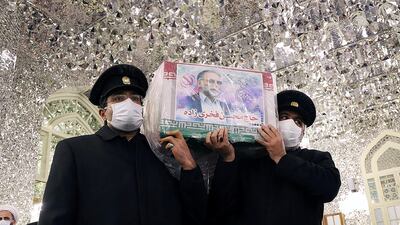
Servants of the holy shrine of Imam Reza carry the coffin of Iranian nuclear scientist Mohsen Fakhrizadeh in Mashhad, Iran. WANA via REUTERS -
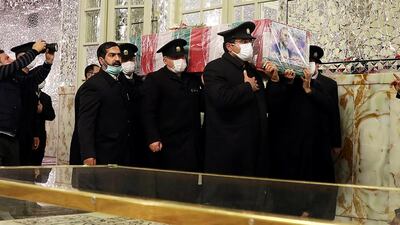
Servants of the holy shrine of Imam Reza carry the coffin of Iranian nuclear scientist Mohsen Fakhrizadeh in Mashhad, Iran. WANA via REUTERS -
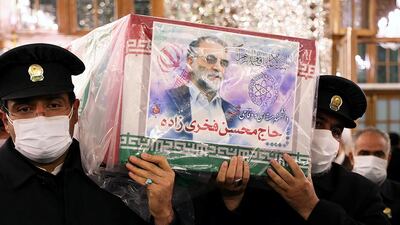
Servants of the holy shrine of Imam Reza carry the coffin of Iranian nuclear scientist Mohsen Fakhrizadeh in Mashhad, Iran. WANA via REUTERS -
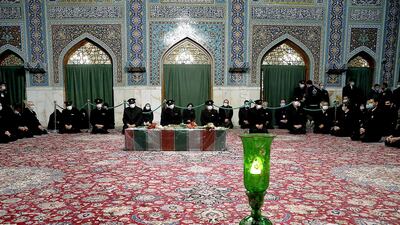
Servants of the holy shrine of Imam Reza sit near the coffin of Iranian nuclear scientist Mohsen Fakhrizadeh in Mashhad, Iran. WANA via REUTERS -
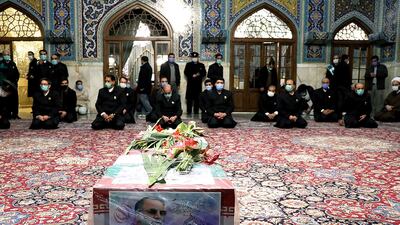
A coffin with an image of Iranian nuclear scientist Mohsen Fakhrizadeh, can be seen among the servants of the holy shrine of Imam Reza in Mashhad. WANA via REUTERS -

A coffin with an image of Iranian nuclear scientist Mohsen Fakhrizadeh, can be seen among the servants of the holy shrine of Imam Reza in Mashhad. WANA via REUTERS -
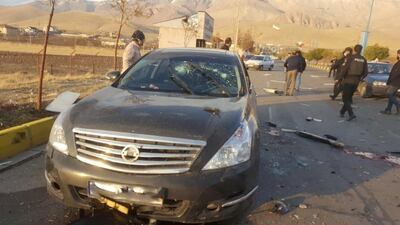
The scene of the attack that killed prominent Iranian scientist Mohsen Fakhrizadeh, outside Tehran. WANA via REUTERS -
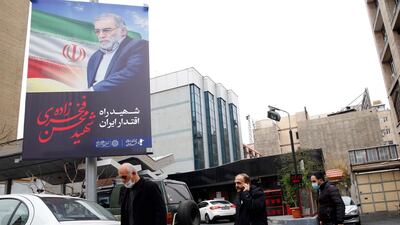
Iranians walk past next to a huge poster of Iranian nuclear scientist Mohsen Fakhrizadeh in a street in Tehran. EPA -
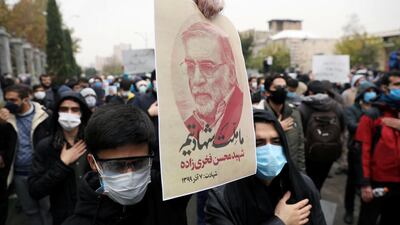
A protester holds a picture of Mohsen Fakhrizadeh, Iran's top nuclear scientist, during a demonstration against his killing in Tehran. WANA via REUTERS -

A protester holds a picture of Mohsen Fakhrizadeh, Iran's top nuclear scientist, during a demonstration against his killing in Tehran. WANA via REUTERS -
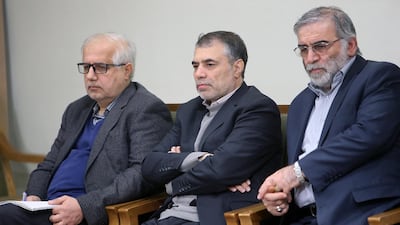
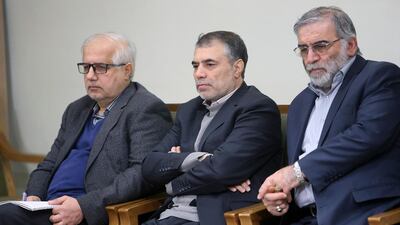
Iranian nuclear scientist Mohsen Fakhrizadeh (R) during a meeting with Iranian supreme leader (unseen) in Tehran on January 23, 2019. EPA/IRANIAN SUPREME LEADER'S OFFICE HO -

Israeli Prime Minister Benjamin Netanyahu points at a screen with an image of Iranian nuclear scientist Mohsen Fakhrizadeh during a news conference at the Defence Ministry of in Tel Aviv on April 30, 2018. Reuters -
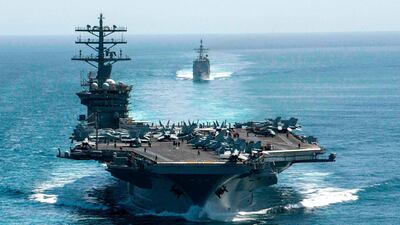
The US Navy’s USS Nimitz aircraft carrier was ordered back to the Arabian Gulf to show capability as it withdraws troops from Afghanistan and Iraq and to deter adversaries moving against the US, US Fifth Fleet said. AFP PHOTO / US NAVY


The response could be reminiscent of Iran’s proxy attacks against US forces in Iraq in the aftermath of President Donald Trump’s January strike on Gen Qassem Suleimani, the leader of the Islamic Revolutionary Guard Corps' Quds Force. Or Tehran could instead opt to play diplomatic hardball with the incoming Joe Biden administration.
The New York Times reported that at least one US intelligence official says Israel was responsible for Fakhrizadeh's assassination, and Israeli Prime Minister Benjamin Netanyahu had previously singled him out by name in a 2018 presentation on Iran's nuclear programme.
But Mr Katzman noted that Iran is unlikely to draw a distinction between US and Israeli culpability for the attack.
“Obviously Iran is going to blame the United States and its allies in some way or another,” he said. “There’s obviously potential for retaliation in all the places Iran is involved in right now.”
Former secretary of state Hillary Clinton strongly denied any American involvement in the 2012 assassination of another Iranian nuclear scientist, which Tehran had blamed on the United States and Israel.
Neither President Trump’s White House nor the State Department would comment on the record on Fakhrizadeh’s killing.
“There’s potential for Iran to strike out against more Iranian dissidents in Europe or even potentially Western targets in Europe,” said Mr Katzman. “There’s potential for Iran to activate its various proxies to ratchet up their activities in the Gulf, obviously. It’s the same universe that we discussed when Suleimani was killed. It’s a very broad universe.”
After the Suleimani strike, Iran launched a missile barrage at sites hosting US forces in Iraq, resulting in traumatic brain injuries for 110 American troops but no deaths, and used its proxy militias to carry out attacks.
"For Suleimani, there was a very moderate retaliation," Robert Einhorn, a senior fellow and non-proliferation specialist at the Brookings Institution, told The National.
Mr Einhorn also noted that Iran has not yet publicly attributed any blame for the sabotage of its Natanz nuclear facility in August and that Tehran has not shown any overt signs of retaliation.
Mr Trump reportedly asked the Pentagon to draw up plans to strike Iran's Natanz nuclear facility earlier this month, but ultimately opted against such a move after his senior advisers dissuaded him, according to The New York Times.
-
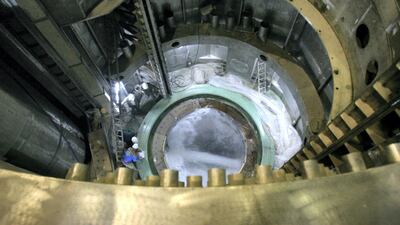
Russian contractors work at the Bushehr nuclear reactor site in 2007. The plant opened four years later. Bloomberg -
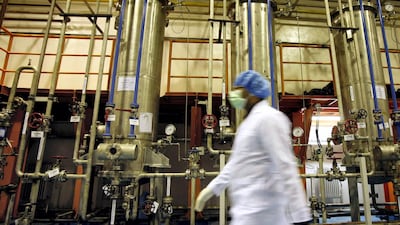
An Iranian technician at the International Atomic Energy Agency inspects the country's Isfahan plant in 2007. Tehran is no longer co-operating with the agency at nuclear sites across the country. EPA -

Workers wait to begin constructing a second reactor at the Bushehr nuclear power plant in 2019. AFP -
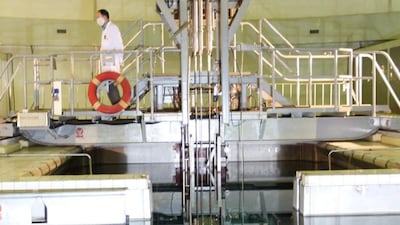
A metal-encased rod with 20 per cent enriched nuclear fuel is inserted into a reactor in Tehran in 2012. AFP -
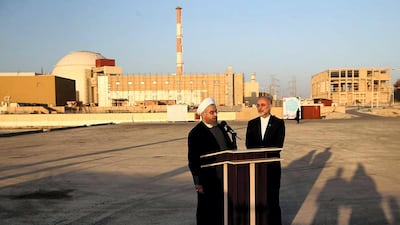
Fomer Iranian President Hassan Rouhani and the country's Atomic Energy Organisation chief Ali Akbar Salehi speak at the Bushehr nuclear site in 2015. AFP -
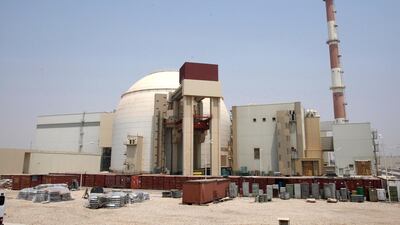
Iran's Bushehr nuclear plant has been restarted. EPA -
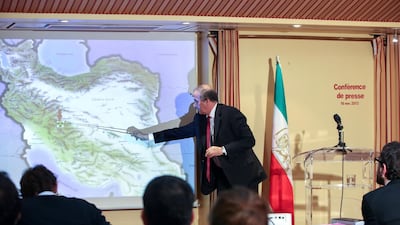
Mehdi Abrichamtchi, chairman of the Peace and Security Committee at the National Council of Resistance of Iran, shows journalists the location of a secret nuclear site in Iran in 2013. AFP -
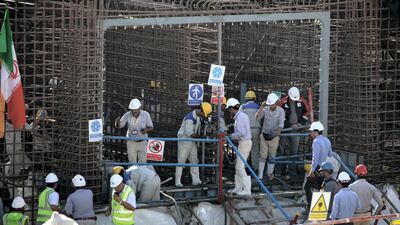
Workers prepare to begin the construction of a second reactor at the Bushehr site. AFP


Earlier this week, the United States also dispatched nuclear-capable B-52H bombers to the Middle East, where they flew through Israeli airspace.
“Hardliners in Iran may see this as an opportunity to reinforce their opposition to engaging with the United States and resurrecting the JCPOA,” said Mr Einhorn, using the formal acronym for the Iran nuclear deal, which Mr Biden has vowed to re-enter, should Tehran return to compliance with the accord.
“On the other hand, there’ll be those in Iran who want to preserve the option to re-engage with the United States and not want to complicate Biden’s efforts to return to compliance. They might want to resist a harsh retaliation so as not to make it more difficult for Biden to go forward with his apparent intention to return to compliance with the JCPOA.”
But Iran could also retaliate at the negotiating table, complicating efforts to revive the nuclear deal, which remains on life support following Mr Trump’s 2018 withdrawal.
“If the United States decides to rejoin the nuclear deal, there would almost certainly have to be negotiations over the additional sanctions imposed and Iranian nuclear facilities built since 2016,” said Mr Katzman. “Iran might raise its demands. They might say, 'Well, we have to get something back for Fakhrizadeh being killed.' I don’t know what they might demand for it, but potentially additional sanctions relief beyond what was promised could be on the table for them to ask for.”
It is also unclear what immediate impact – if any – Fakhrizadeh’s assassination will have on Iran’s nuclear programme.
“It’s been quite a while since they had an active developmental programme, which in many respects ended in 2003, although it is believed that it continued afterwards,” said Mr Einhorn. “And it is widely believed that the Iranians wanted to preserve this cadre of people – nuclear scientists and engineers who would be in a position to resurrect the programme if the supreme leader gave them the greenlight.”
“We know that the Iranians went to great lengths to preserve documentation about their programme. It’s not just documentation. They would want to keep the personnel together and my guess is they kept these people together, some veterans of the old programme and some new recruits.”

