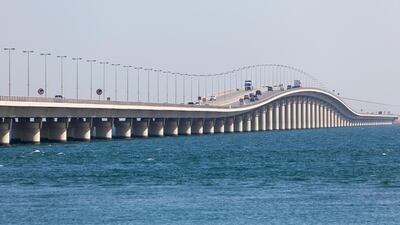
King Fahd Causeway in Bahrain. Alamy

King Fahd Causeway: Covid-19 shutdown upgrades to allow 45% more traffic


  • English
  • Arabic

Faced with the longest closure since the bridge opened in 1986, Bahraini authorities have used the coronavirus travel shutdown to roll out major upgrades to the King Fahd Causeway.

When borders between the GCC states of Bahrain and Saudi Arabia reopen, the thousands who commute across the causeway daily and millions who cross it every year will be sped through new customs gates and e-Payment lanes that authorities say will boost traffic capacity by 45 per cent.

"The precautionary closure of the bridge to private vehicles has acted as a catalyst for long-planned upgrade work, while commercial drivers are still able to pass through each day enabling critical continuity for the logistics sector," Abdul Hakim Al Shammari, Chairman of Commercial Market Committee and Board Member of the Bahrain Chamber of Commerce and Industry (BCCI), said.

Thousands use the 25-kilometre-long bridge linking Bahrain's Al Jasra to Saudi Arabia's Al Khobar every year. Up to 100,000 people usually make the crossing during Eid holidays. However, with borders closed since March 7, there has been no passenger traffic in nearly three months. Lorries and cargo trucks still use the bridge, but extra checks have been brought in.

Usually, work on the bridge has to happen at quiet times of the day around traffic, making the process slow. But planned improvements moved into the fast lane with the bridge empty.

Coronavirus across the Middle East 

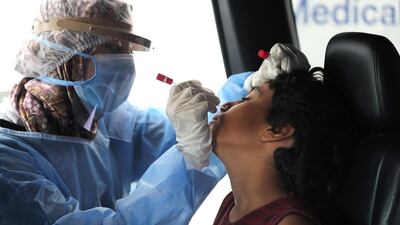
  • A health worker collects a sample at a drive-through coronavirus testing centre at the Ain Shams University in Cairo, Egypt. EPA
    A health worker collects a sample at a drive-through coronavirus testing centre at the Ain Shams University in Cairo, Egypt. EPA
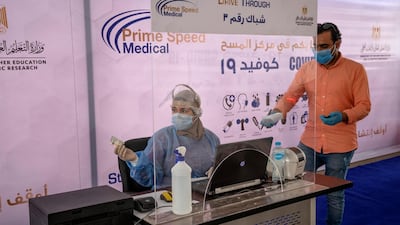
  • A health worker wearing protective gear prepares to take swab samples from people queuing in their cars. AP Photo
    A health worker wearing protective gear prepares to take swab samples from people queuing in their cars. AP Photo
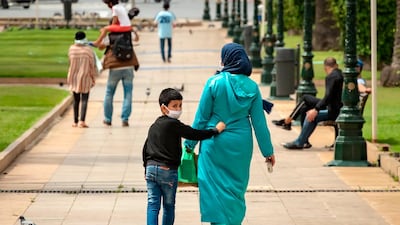
  • A mother walks with her son in the centre of Morocco's capital Rabat amid the ongoing Covid-19 pandemic. AFP
    A mother walks with her son in the centre of Morocco's capital Rabat amid the ongoing Covid-19 pandemic. AFP
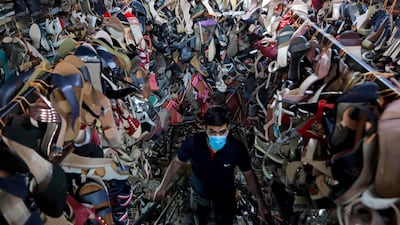
  • A mask-clad owner climbs the stairs of his shoe store in Arbil, the capital of the northern Iraqi Kurdish autonomous region, during the ongoing Covid-19 pandemic. AFP
    A mask-clad owner climbs the stairs of his shoe store in Arbil, the capital of the northern Iraqi Kurdish autonomous region, during the ongoing Covid-19 pandemic. AFP
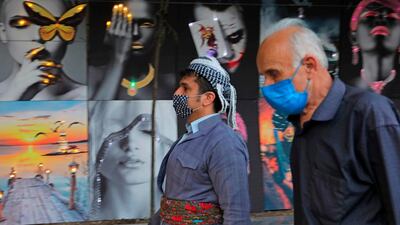
  • Mask-clad men walk past posters in the vicinity of Arbil Citadel in the capital of the northern Iraqi Kurdish autonomous region. AFP
    Mask-clad men walk past posters in the vicinity of Arbil Citadel in the capital of the northern Iraqi Kurdish autonomous region. AFP
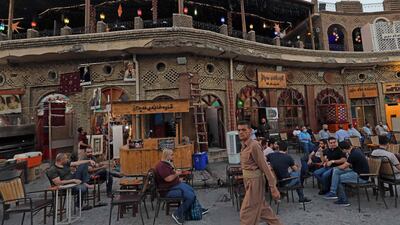
  • Iraqis sit at a coffee shop in front of Arbil Citadel. AFP
    Iraqis sit at a coffee shop in front of Arbil Citadel. AFP
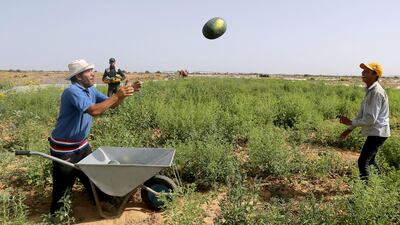
  • A Palestinian worker collects watermelons as farmers complain about export restrictions due to coronavirus. Reuters
    A Palestinian worker collects watermelons as farmers complain about export restrictions due to coronavirus. Reuters
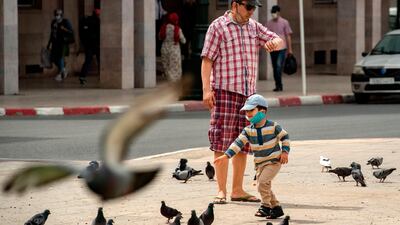
  • A mask-clad boy runs after pigeons near his father in the centre of Morocco's capital Rabat. AFP
    A mask-clad boy runs after pigeons near his father in the centre of Morocco's capital Rabat. AFP

"We look forward to the upcoming re-opening of the causeway with this new infrastructure in place, which will substantially enhance capacity and speed up journeys for the tens of thousands of passengers who cross between Bahrain and Saudi Arabia each day," Mr Al Shammari said.

There is still no word on when the borders will reopen, but both countries have taken steps to ease travel and movement restrictions in recent weeks and domestic flights restarted at the end of May.

Whenever the border restrictions lift, Mr Al Shammari says Bahrain will be waiting.

"We stand ready to welcome visitors from Saudi Arabia to the Kingdom as soon as the causeway reopens," he said.

The Bahrain Causeway Authority that manages the bridge denied this week online reports that it was planning to reopen from June 10.

"The Authority denies the truthfulness of reports attributed to it that the King Fahd Causeway will reopen for some cases, starting June 10," it said on Twitter.

The causeway is a vital route for the small island kingdom. Of the 11.1 million tourists who entered Bahrain last year, 9.7 million – 88 per cent – travelled across the bridge.

"The King Fahd Causeway acts as an essential link between Bahrain and the wider $1.5 trillion Gulf economy for millions of passengers and commercial trucks each year," Al Shammari added.


The Perfect Couple

Starring: Nicole Kidman, Liev Schreiber, Jack Reynor

Creator: Jenna Lamia

Rating: 3/5

World Sevens Series standing after Dubai

1. South Africa
2. New Zealand
3. England
4. Fiji
5. Australia
6. Samoa
7. Kenya
8. Scotland
9. France
10. Spain
11. Argentina
12. Canada
13. Wales
14. Uganda
15. United States
16. Russia

Star%20Wars%3A%20Episode%20I%20%E2%80%93%20The%20Phantom%20Menace
%3Cp%3E%3Cstrong%3EDeveloper%3A%3C%2Fstrong%3E%20Big%20Ape%20Productions%3Cbr%3E%3Cstrong%3EPublisher%3A%3C%2Fstrong%3E%20LucasArts%3Cbr%3E%3Cstrong%3EConsoles%3A%3C%2Fstrong%3E%20PC%2C%20PlayStation%3Cbr%3E%3Cstrong%3ERating%3A%3C%2Fstrong%3E%202%2F5%3C%2Fp%3E%0A
Drishyam 2

Directed by: Jeethu Joseph

Starring: Mohanlal, Meena, Ansiba, Murali Gopy

Rating: 4 stars

Mercer, the investment consulting arm of US services company Marsh & McLennan, expects its wealth division to at least double its assets under management (AUM) in the Middle East as wealth in the region continues to grow despite economic headwinds, a company official said.

Mercer Wealth, which globally has $160 billion in AUM, plans to boost its AUM in the region to $2-$3bn in the next 2-3 years from the present $1bn, said Yasir AbuShaban, a Dubai-based principal with Mercer Wealth.

Within the next two to three years, we are looking at reaching $2 to $3 billion as a conservative estimate and we do see an opportunity to do so,” said Mr AbuShaban.

Mercer does not directly make investments, but allocates clients’ money they have discretion to, to professional asset managers. They also provide advice to clients.

“We have buying power. We can negotiate on their (client’s) behalf with asset managers to provide them lower fees than they otherwise would have to get on their own,” he added.

Mercer Wealth’s clients include sovereign wealth funds, family offices, and insurance companies among others.

From its office in Dubai, Mercer also looks after Africa, India and Turkey, where they also see opportunity for growth.

Wealth creation in Middle East and Africa (MEA) grew 8.5 per cent to $8.1 trillion last year from $7.5tn in 2015, higher than last year’s global average of 6 per cent and the second-highest growth in a region after Asia-Pacific which grew 9.9 per cent, according to consultancy Boston Consulting Group (BCG). In the region, where wealth grew just 1.9 per cent in 2015 compared with 2014, a pickup in oil prices has helped in wealth generation.

BCG is forecasting MEA wealth will rise to $12tn by 2021, growing at an annual average of 8 per cent.

Drivers of wealth generation in the region will be split evenly between new wealth creation and growth of performance of existing assets, according to BCG.

Another general trend in the region is clients’ looking for a comprehensive approach to investing, according to Mr AbuShaban.

“Institutional investors or some of the families are seeing a slowdown in the available capital they have to invest and in that sense they are looking at optimizing the way they manage their portfolios and making sure they are not investing haphazardly and different parts of their investment are working together,” said Mr AbuShaban.

Some clients also have a higher appetite for risk, given the low interest-rate environment that does not provide enough yield for some institutional investors. These clients are keen to invest in illiquid assets, such as private equity and infrastructure.

“What we have seen is a desire for higher returns in what has been a low-return environment specifically in various fixed income or bonds,” he said.

“In this environment, we have seen a de facto increase in the risk that clients are taking in things like illiquid investments, private equity investments, infrastructure and private debt, those kind of investments were higher illiquidity results in incrementally higher returns.”

The Abu Dhabi Investment Authority, one of the largest sovereign wealth funds, said in its 2016 report that has gradually increased its exposure in direct private equity and private credit transactions, mainly in Asian markets and especially in China and India. The authority’s private equity department focused on structured equities owing to “their defensive characteristics.”

Abu Dhabi World Pro 2019 remaining schedule:

Wednesday April 24: Abu Dhabi World Professional Jiu-Jitsu Championship, 11am-6pm

Thursday April 25:  Abu Dhabi World Professional Jiu-Jitsu Championship, 11am-5pm

Friday April 26: Finals, 3-6pm

Saturday April 27: Awards ceremony, 4pm and 8pm

UAE currency: the story behind the money in your pockets
The%20Little%20Mermaid%20
%3Cp%3E%3Cstrong%3EDirector%3A%3C%2Fstrong%3E%20Rob%20Marshall%3Cbr%3E%3Cstrong%3EStars%3A%20%3C%2Fstrong%3EHalle%20Bailey%2C%20Jonah%20Hauer-King%2C%20Melissa%20McCarthy%2C%20Javier%20Bardem%3Cbr%3E%3Cstrong%3ERating%3A%20%3C%2Fstrong%3E2%2F5%3Cbr%3E%3Cbr%3E%3C%2Fp%3E%0A
The White Lotus: Season three

Creator: Mike White

Starring: Walton Goggins, Jason Isaacs, Natasha Rothwell

Rating: 4.5/5