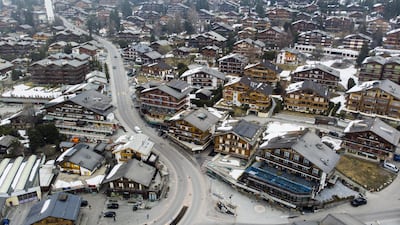
A Swiss police car patrols in a empty street of the ski resort in Verbier, Switzerland. EPA

The ski resort coronavirus hotspot where revellers partied while officials dallied


  • English
  • Arabic

When Swiss authorities closed the nation’s ski runs in mid-March, two days after the World Health Organisation declared a pandemic, the coronavirus was already ripping through the chic resort of Verbier.

A longtime destination of Europe’s jet set for off-piste skiing and apres-ski high life, Verbier’s packed gondola lifts and bars made it the perfect incubator for Covid-19. Even after the lifts closed, vacationers and seasonal workers partied one last time before heading home.

“It’s a perfect opportunity to spread — it’s a virus heaven,” said Corinne Cohen, a doctor at a clinic close to the resort. At one medical practice in Verbier, 80 per cent of patients tested positive for Covid-19.

The Verbier Alpine ski resort in Switzerlan became one of Europe's first hotspots for the virus. Reuters

Dr Cohen and other physicians called for Verbier to be quarantined. The Swiss government demurred, saying that isolating the resort wouldn’t limit the spread of Covid-19.

That decision increased scrutiny of Switzerland’s approach, which was criticised for initially prioritising the economy and individual liberties over containment. Those tensions also illustrate the challenge of co-ordinating a pandemic response across borders with four other major European nations.

While the WHO is based in Geneva, Swiss authorities were slow to embrace its recommendations on contact tracing and isolation, and ramped up testing only in recent weeks.

Medical staff at work outside of a medical centre of the ski resort during the coronavirus disease outbreak in Verbier. EPA

“This is the host country of the WHO and the host country initially did not follow WHO advice,” said Annelies Wilder-Smith, a professor of emerging infectious diseases at the London School of Hygiene and Tropical Medicine who lives in Switzerland.

After Italy became the pandemic’s centre, Switzerland initially kept open the 740-kilometre frontier with its southern neighbour, partly because the Swiss canton of Ticino relies on about 70,000 cross-border Italian workers to power its economy. Now Ticino has Switzerland’s highest infection rate.

When WHO Director General Tedros Adhanom Ghebreyesus called in mid-March for countries to “test, test, test,” Daniel Koch, head of communicable diseases at the Swiss Federal Office of Public Health said such an approach was no longer appropriate for the country.

While most Swiss people were happy with the official response, 42 per cent wanted stronger measures, a poll in March by the Sotomo Research Institute showed.

Countries like Singapore and South Korea invested heavily in strategies to combat epidemics after experiencing the virus outbreaks of SARS in 2003 and MERS in 2015. Others, such as Italy or Switzerland, were caught less prepared, according to Didier Trono, a professor of virology and genetics at the Swiss Federal Institute of Technology in Lausanne. Fears of ruining the economy by overreacting also played a role, as they did in the US and UK.

“Switzerland doesn’t stand out as the bad person in the class,” Mr Trono said. “Generally speaking, highly democratic modes of functioning are also not best suited in these situations, where blitzkrieg-like approaches are needed.”

Still, the Swiss implementation of social distancing has been exemplary, said Ms Wilder-Smith, while the government has incrementally adopted WHO advice. Where the country still lags behind is on capacity for “liberal testing, and more contact tracing,” she said.

Switzerland now has one of the highest per capita testing rates in the world, though the focus remains on risk groups. The government has banned gatherings of more than five people, but the strict lockdowns imposed in neighboring Italy and France aren’t in place.

The epidemic started in many places at the same time in Switzerland, complicating a systematic containment, Mr Trono said. “Now there are far too many fires everywhere, and we’re past being able to contain it here, here and here.”

Surveillance must go beyond Alpine virus hotspots, such as Verbier and the Austrian ski resort of Ischgl, from which tourists spread Covid-19 across Europe. That imperative is running up against pressure from lawmakers and businesses to reopen the Swiss economy as industries from gold refining to tourism suffer.

For now, the government agrees with the WHO that it’s too soon to relax restrictions, which have been extended until April 26.

“As soon as the trend of new infections declines sharply we can say the epidemic wave is declining and will continue to decline,” said Mr Koch, the Swiss government’s coronavirus czar. “But it’s still a little too early to make that call.”

It will also be important over the coming weeks to use antibody tests to determine what fraction of the population has already been exposed, according to Mr Trono.

“Once we have determined whether the presence of antibodies indicates resistance to further infection, we will additionally know who can go back to work without risk to themselves or others,” he said. “That may allow some precision de-confinement.”

As governments look for exit strategies, the WHO is stressing the continuing need for testing, isolation and contact tracing.

“Lockdowns will slow the virus, but they won’t stop it,” Bruce Aylward, senior adviser to the WHO’s director-general, said on Wednesday. “They provide a window to prepare for the post-lockdown reality.”


Miguel Cotto world titles:

WBO Light Welterweight champion - 2004-06
WBA Welterweight champion – 2006-08
WBO Welterweight champion – Feb 2009-Nov 2009
WBA Light Middleweight champion – 2010-12
WBC Middleweight champion – 2014-15
WBO Light Middleweight champion – Aug 2017-Dec 2017

The%20specs%20
%3Cp%3E%3Cstrong%3EEngine%3A%20%3C%2Fstrong%3E2.0-litre%204cyl%20turbo%0D%3Cbr%3E%3Cstrong%3EPower%3A%20%3C%2Fstrong%3E261hp%20at%205%2C500rpm%0D%3Cbr%3E%3Cstrong%3ETorque%3A%20%3C%2Fstrong%3E400Nm%20at%201%2C750-4%2C000rpm%0D%3Cbr%3E%3Cstrong%3ETransmission%3A%20%3C%2Fstrong%3E7-speed%20dual-clutch%20auto%0D%3Cbr%3E%3Cstrong%3EFuel%20consumption%3A%20%3C%2Fstrong%3E10.5L%2F100km%0D%3Cbr%3E%3Cstrong%3EOn%20sale%3A%20%3C%2Fstrong%3ENow%0D%3Cbr%3E%3Cstrong%3EPrice%3A%20%3C%2Fstrong%3EFrom%20Dh129%2C999%20(VX%20Luxury)%3B%20from%20Dh149%2C999%20(VX%20Black%20Gold)%3C%2Fp%3E%0A
Game Changer

Director: Shankar 

Stars: Ram Charan, Kiara Advani, Anjali, S J Suryah, Jayaram

Rating: 2/5

RESULTS

Welterweight

Tohir Zhuraev (TJK) beat Mostafa Radi (PAL)

(Unanimous points decision)

Catchweight 75kg

Anas Siraj Mounir (MAR) beat Leandro Martins (BRA)

(Second round knockout)

Flyweight (female)

Manon Fiorot (FRA) beat Corinne Laframboise (CAN)

(RSC in third round)

Featherweight

Bogdan Kirilenko (UZB) beat Ahmed Al Darmaki

(Disqualification)

Lightweight

Izzedine Al Derabani (JOR) beat Rey Nacionales (PHI)

(Unanimous points)

Featherweight

Yousef Al Housani (UAE) beat Mohamed Fargan (IND)

(TKO first round)

Catchweight 69kg

Jung Han-gook (KOR) beat Max Lima (BRA)

(First round submission by foot-lock)

Catchweight 71kg

Usman Nurmogamedov (RUS) beat Jerry Kvarnstrom (FIN)

(TKO round 1).

Featherweight title (5 rounds)

Lee Do-gyeom (KOR) v Alexandru Chitoran (ROU)

(TKO round 1).

Lightweight title (5 rounds)

Bruno Machado (BRA) beat Mike Santiago (USA)

(RSC round 2).

%3Cp%3E%3Cstrong%3ETHE%20SPECS%3C%2Fstrong%3E%0D%3Cbr%3EEngine%3A%203.5-litre%20V6%0D%3Cbr%3ETransmission%3A%209-speed%20automatc%0D%3Cbr%3EPower%3A%20279hp%0D%3Cbr%3ETorque%3A%20350Nm%0D%3Cbr%3EPrice%3A%20From%20Dh250%2C000%0D%3Cbr%3EOn%20sale%3A%20Now%3C%2Fp%3E%0A
2.0

Director: S Shankar

Producer: Lyca Productions; presented by Dharma Films

Cast: Rajnikanth, Akshay Kumar, Amy Jackson, Sudhanshu Pandey

Rating: 3.5/5 stars

The specs
Engine: 2.0-litre 4-cyl turbo

Power: 201hp at 5,200rpm

Torque: 320Nm at 1,750-4,000rpm

Transmission: 6-speed auto

Fuel consumption: 8.7L/100km

Price: Dh133,900

On sale: now 

The specs
 
Engine: 3.0-litre six-cylinder turbo
Power: 398hp from 5,250rpm
Torque: 580Nm at 1,900-4,800rpm
Transmission: Eight-speed auto
Fuel economy, combined: 6.5L/100km
On sale: December
Price: From Dh330,000 (estimate)

Mercer, the investment consulting arm of US services company Marsh & McLennan, expects its wealth division to at least double its assets under management (AUM) in the Middle East as wealth in the region continues to grow despite economic headwinds, a company official said.

Mercer Wealth, which globally has $160 billion in AUM, plans to boost its AUM in the region to $2-$3bn in the next 2-3 years from the present $1bn, said Yasir AbuShaban, a Dubai-based principal with Mercer Wealth.

Within the next two to three years, we are looking at reaching $2 to $3 billion as a conservative estimate and we do see an opportunity to do so,” said Mr AbuShaban.

Mercer does not directly make investments, but allocates clients’ money they have discretion to, to professional asset managers. They also provide advice to clients.

“We have buying power. We can negotiate on their (client’s) behalf with asset managers to provide them lower fees than they otherwise would have to get on their own,” he added.

Mercer Wealth’s clients include sovereign wealth funds, family offices, and insurance companies among others.

From its office in Dubai, Mercer also looks after Africa, India and Turkey, where they also see opportunity for growth.

Wealth creation in Middle East and Africa (MEA) grew 8.5 per cent to $8.1 trillion last year from $7.5tn in 2015, higher than last year’s global average of 6 per cent and the second-highest growth in a region after Asia-Pacific which grew 9.9 per cent, according to consultancy Boston Consulting Group (BCG). In the region, where wealth grew just 1.9 per cent in 2015 compared with 2014, a pickup in oil prices has helped in wealth generation.

BCG is forecasting MEA wealth will rise to $12tn by 2021, growing at an annual average of 8 per cent.

Drivers of wealth generation in the region will be split evenly between new wealth creation and growth of performance of existing assets, according to BCG.

Another general trend in the region is clients’ looking for a comprehensive approach to investing, according to Mr AbuShaban.

“Institutional investors or some of the families are seeing a slowdown in the available capital they have to invest and in that sense they are looking at optimizing the way they manage their portfolios and making sure they are not investing haphazardly and different parts of their investment are working together,” said Mr AbuShaban.

Some clients also have a higher appetite for risk, given the low interest-rate environment that does not provide enough yield for some institutional investors. These clients are keen to invest in illiquid assets, such as private equity and infrastructure.

“What we have seen is a desire for higher returns in what has been a low-return environment specifically in various fixed income or bonds,” he said.

“In this environment, we have seen a de facto increase in the risk that clients are taking in things like illiquid investments, private equity investments, infrastructure and private debt, those kind of investments were higher illiquidity results in incrementally higher returns.”

The Abu Dhabi Investment Authority, one of the largest sovereign wealth funds, said in its 2016 report that has gradually increased its exposure in direct private equity and private credit transactions, mainly in Asian markets and especially in China and India. The authority’s private equity department focused on structured equities owing to “their defensive characteristics.”

GAC GS8 Specs

Engine: 2.0-litre 4cyl turbo

Power: 248hp at 5,200rpm

Torque: 400Nm at 1,750-4,000rpm

Transmission: 8-speed auto

Fuel consumption: 9.1L/100km

On sale: Now

Price: From Dh149,900

The President's Cake

Director: Hasan Hadi

Starring: Baneen Ahmad Nayyef, Waheed Thabet Khreibat, Sajad Mohamad Qasem 

Rating: 4/5

How has net migration to UK changed?

The figure was broadly flat immediately before the Covid-19 pandemic, standing at 216,000 in the year to June 2018 and 224,000 in the year to June 2019.

It then dropped to an estimated 111,000 in the year to June 2020 when restrictions introduced during the pandemic limited travel and movement.

The total rose to 254,000 in the year to June 2021, followed by steep jumps to 634,000 in the year to June 2022 and 906,000 in the year to June 2023.

The latest available figure of 728,000 for the 12 months to June 2024 suggests levels are starting to decrease.

Global state-owned investor ranking by size

1.

United States

2.

China

3.

UAE

4.

Japan

5

Norway

6.

Canada

7.

Singapore

8.

Australia

9.

Saudi Arabia

10.

South Korea

The specs
  • Engine: 3.9-litre twin-turbo V8
  • Power: 640hp
  • Torque: 760nm
  • On sale: 2026
  • Price: Not announced yet
Why it pays to compare

A comparison of sending Dh20,000 from the UAE using two different routes at the same time - the first direct from a UAE bank to a bank in Germany, and the second from the same UAE bank via an online platform to Germany - found key differences in cost and speed. The transfers were both initiated on January 30.

Route 1: bank transfer

The UAE bank charged Dh152.25 for the Dh20,000 transfer. On top of that, their exchange rate margin added a difference of around Dh415, compared with the mid-market rate.

Total cost: Dh567.25 - around 2.9 per cent of the total amount

Total received: €4,670.30 

Route 2: online platform

The UAE bank’s charge for sending Dh20,000 to a UK dirham-denominated account was Dh2.10. The exchange rate margin cost was Dh60, plus a Dh12 fee.

Total cost: Dh74.10, around 0.4 per cent of the transaction

Total received: €4,756

The UAE bank transfer was far quicker – around two to three working days, while the online platform took around four to five days, but was considerably cheaper. In the online platform transfer, the funds were also exposed to currency risk during the period it took for them to arrive.

UAE currency: the story behind the money in your pockets