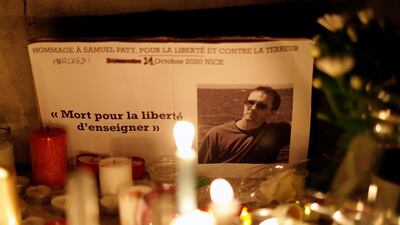

The brutal murder of a French schoolteacher by an 18-year-old Chechen refugee has demonstrated that, despite all the setbacks Islamist extremists have suffered in recent years, the threat of terrorism remains as potent as ever.
After the US-led coalition’s success in destroying the self-styled caliphate established by ISIS in Syria and Iraq, there were hopes that the extremist threat would diminish, particularly in Europe, which had been the target of a number of high-profile attacks.
There has been a reduction in the type of mass casualty attacks witnessed in cities such as Nice and Manchester, the majority of which were later found to have links with groups linked to ISIS. Yet the murder of Samuel Paty, beheaded outside his school in the Paris suburb of Conflans-Sainte-Honorine, shows that their ability to carry out so-called "lone wolf" attacks has not diminished.
Paty was murdered by Abdulakh Anzorov after the schoolteacher showed caricatures of the Prophet Mohammed in a class discussion about freedom of expression. Anzorov, heard shouting “Allahu akbar” as he murdered the 47-year-old teacher, was later shot dead by police.
-
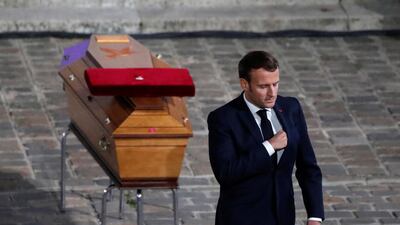
French President Emmanuel Macron leaves after paying his respects by the coffin of slain teacher Samuel Paty in the courtyard of the Sorbonne university during a national memorial event, in Paris, France October 21, 2020. REUTERS -
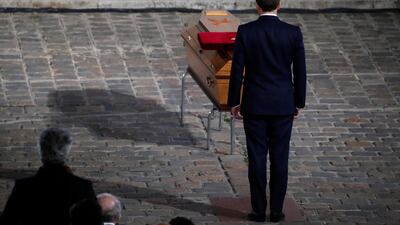
French President Emmanuel Macron pays his respects by the coffin of slain teacher Samuel Paty in the courtyard of the Sorbonne university during a national memorial event, in Paris, France October 21, 2020. REUTERS -
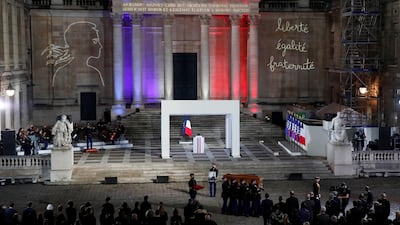
The coffin of slain teacher Samuel Paty is carried away in the courtyard of the Sorbonne university during a national memorial event, in Paris, France October 21, 2020. REUTERS -
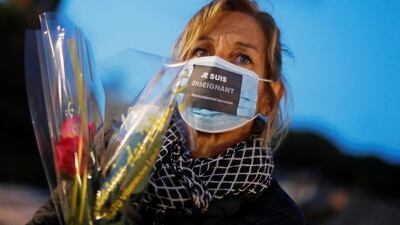
A woman wearing a protective face mask with the words "I'm a teacher" written on it pays homage to Samuel Paty, the French teacher who was beheaded on the streets of the Paris suburb of Conflans-Sainte-Honorine, as part of a national tribute, in Nice, France, October 21, 2020. REUTERS -
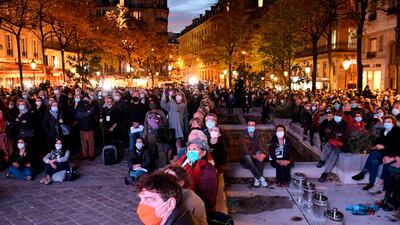
People gather on the Place de la Sorbonne in Paris on October 21, 2020, to watch a live broadcast on a giant screen of a national homage at the Sorbonne University to French teacher Samuel Paty, who was beheaded for showing cartoons of the Prophet Mohamed in his civics class. AFP -
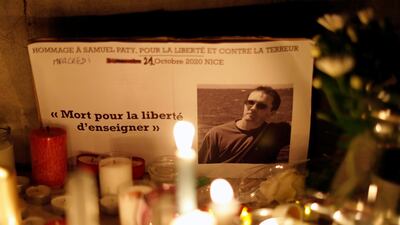
Candles are lit at a makeshift memorial as people gather to pay homage to Samuel Paty. REUTERS -
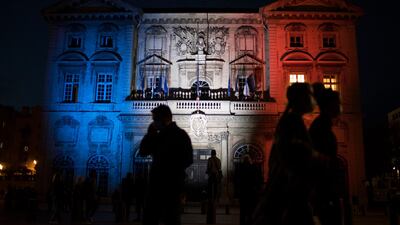
Pedestrians walk past Marseille's town hall lit up in the French Tricolor to honor slain teacher Samuel Paty, Wednesday, October 21, 2020. AP Photo


The caricatures that are said to have provoked the killing first appeared in the French satirical magazine Charlie Hebdo, which was itself the target of a high-profile attack by extremists five years ago, in which 12 people were killed and 11 others injured. The two gunmen who carried out the attack identified themselves as belonging to Al Qaeda in the Arabian Peninsula.
The trial of 14 alleged accomplices of the Charlie Hebdo attackers, who were killed in a shoot-out with French police, is under way in Paris, and the murder of Paty is the second extremist-linked attack to have taken place in France since the trial began.
The nationwide clampdown on extremist activity by the French security authorities in the wake of the Charlie Hebdo attack has limited the ability of militants to conduct large-scale attacks. But the circumstances surrounding Paty's murder shows that ISIS and other groups continue to maintain a global network of supporters.
In the wake of the killing, French investigators have discovered that Anzorov had links with ISIS. A video and images of the gruesome murder recorded by the killer were sent to fellow Russian-speaking ISIS supporters and have been shared by Chechen pro-ISIS accounts on the Telegram messaging service. It has also emerged that Anzorov's half-sister travelled to Syria in 2014 to join ISIS, deepening suspicions of his ties to the terror group. In addition, Anzorov's uncle has told French television that he suspected his nephew had been radicalised by online ISIS propaganda.
Indeed, the role of social media in the events leading up to the schoolteacher’s murder has shed fresh light on the ease with which ISIS and other extremist groups are able to exploit these platforms to maintain links with their supporters.
-
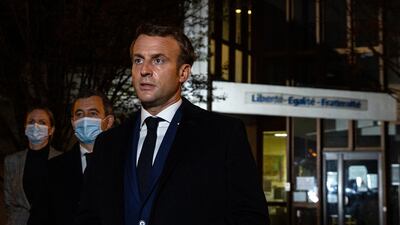
French President Emmanuel Macron, flanked by French Interior Minister Gerald Darmanin, speaks to the press in front of a middle school in Conflans Saint-Honorine. AFP, Pool -
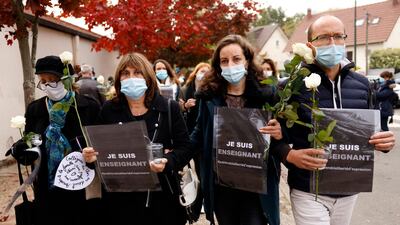
Teachers carrying a sign that reads 'I am a Teacher' lays flowers in front of Bois d'Aulne middle school to pay their respect after a teacher was assassinated in Conflans Sainte-Honorine. EPA -
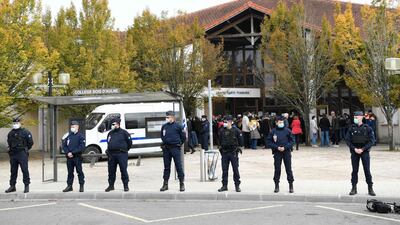
French CRS police officers stand as adults and children gather in front of flowers displayed at the entrance of a middle school in Conflans-Sainte-Honorine, 30kms northwest of Paris, on October 17, 2020, after a teacher was decapitated by an attacker who has been shot dead by policemen. The man suspected of beheading on October 16 ,2020 a French teacher who had shown his students cartoons of the prophet Mohammed was an 18-year-old born in Moscow and originating from Russia's southern region of Chechnya, a judicial source said on October 17. Five more people have been detained over the murder on October 16 ,2020 outside Paris, including the parents of a child at the school where the teacher was working, bringing to nine the total number currently under arrest, said the source, who asked not to be named. The attack happened at around 5 pm (1500 GMT) near a school in Conflans Saint-Honorine, a western suburb of the French capital. The man who was decapitated was a history teacher who had recently shown caricatures of the Prophet Mohammed in class. / AFP / Bertrand GUAY -
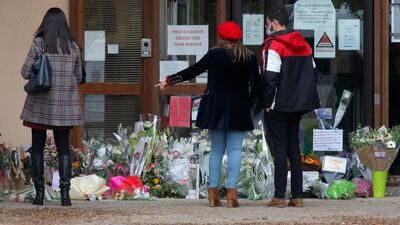
Teachers and the public lay flowers in front of Bois d'Aulne middle school to pay their respect after a teacher was assassinated in Conflans Sainte-Honorine. AP -

Teachers and the public lay flowers in front of Bois d'Aulne middle school to pay their respect after a teacher was assassinated in Conflans Sainte-Honorine. AP -
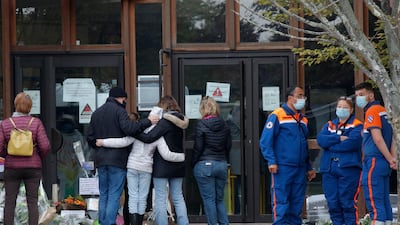
Teachers and the public lay flowers in front of Bois d'Aulne middle school to pay their respect after a teacher was assassinated in Conflans Sainte-Honorine. AP -
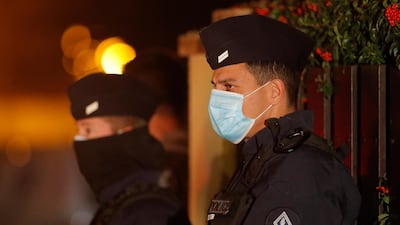
French police officers stand outside a high school after a history teacher who opened a discussion with students on caricatures of Islam's Prophet Muhammad was beheaded. AP -

French police officers stand outside a high school after a history teacher who opened a discussion with students on caricatures of Islam's Prophet Muhammad was beheaded. Getty Images -
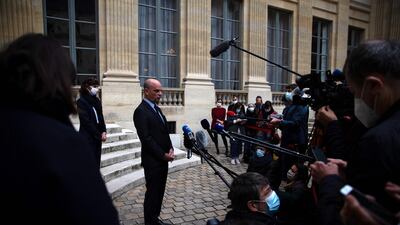
French Education, Youth and Sports Minister Jean-Michel Blanquer speaks to medias in Paris after a teacher was decapitated by an attacker who has been shot dead by policemen. AFP -
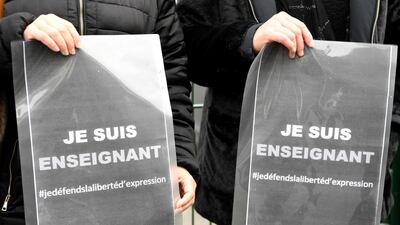
People hold a sign reading 'I am a teacher - Freedom of speech' in front of a middle school in Conflans Saint-Honorine, 30kms northwest of Paris, on October 17, 2020, after a teacher was decapitated by an attacker who has been shot dead by policemen. The man suspected of beheading on October 16 ,2020 a French teacher who had shown his students cartoons of the prophet Mohammed was an 18-year-old born in Moscow and originating from Russia's southern region of Chechnya, a judicial source said on October 17. Five more people have been detained over the murder on October 16 ,2020 outside Paris, including the parents of a child at the school where the teacher was working, bringing to nine the total number currently under arrest, said the source, who asked not to be named. The attack happened at around 5 pm (1500 GMT) near a school in Conflans Saint-Honorine, a western suburb of the French capital. The man who was decapitated was a history teacher who had recently shown caricatures of the Prophet Mohammed in class. / AFP / Bertrand GUAY


In this instance, the parent of a Muslim girl who had attended the class in which Paty had shown the offending cartoon took to social media to criticise the teacher’s conduct, accusing him of Islamophobia. And it was in response to this that Anzorov decided to act.
Nor is this the only recent example where extremists have been found using social media platforms to promote violence. Earlier this week, an ISIS supporter was convicted by a British court of encouraging terrorism by posting a video on social media urging like-minded associates to attack one of London’s most famous arts venues.
Shehroz Iqbal, 29, posted the footage on a 22-strong WhatsApp group named “From Dark to Light” that featured the Southbank Centre, a complex of theatres and arts venues in central London. In another internet-related incident, British authorities have charged Florian Flegel, a 22-year-old German citizen, with terrorism offences after he allegedly shared ISIS propaganda videos – including beheadings – online.
The ease with which extremist groups and their supporters continue to exploit the internet remains a major cause of concern for European security officials, who are coming under increasing pressure to impose more effective restrictions on social media platforms.
The tech giants Google and Apple, for example, are being called upon to remove a Muslim Brotherhood-sponsored app that has consistently ranked in the top 100 download charts in their stores across multiple European countries. This follows warnings that the Euro Fatwa app, which claims to advise European Muslims on how to adhere to the regulations and manners of Islam, has the potential to act as a gateway for extremism.
The internet is not the only area where European security officials need to improve their vigilance.
The fact that French President Emmanuel Macron has now found it necessary to ban a pro-Hamas group that has been implicated in Paty's murder, as well as closing a Paris mosque that denounced the schoolteacher, shows that extremists are still maintaining their operations in Europe in spite of the tougher measures security officials have imposed over the past two decades.
And so long as they are able to maintain a presence in Europe, their ability to carry out atrocities similar to the brutal murder of Paty will remain undiminished.
Con Coughlin is a defence and foreign affairs columnist for The National

