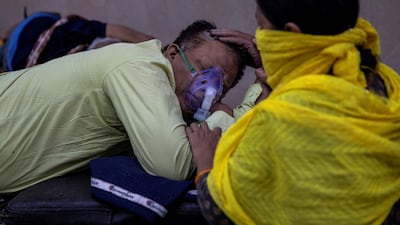
India’s second Covid-19 wave is devastating, with more than new 200,000 coronavirus cases recorded each day. Reuters

India caught off guard by Britain’s 'surprise' travel ban decision


  • English
  • Arabic

India was surprised by the UK’s decision to impose a travel ban on the country despite surging infections and scientific concern over a new variant of the virus.

Britain on Monday added the subcontinent to its red list of travel ban countries after confirmed cases of the Indian variant in the UK rose to 103.

Health Secretary Matt Hancock said the “difficult but vital decision” would take effect from 4am London time on Friday.

Returning British citizens will have to pay to quarantine for 10 days in a government-approved hotel, while others will be refused entry.

The move came hours after Prime Minister Boris Johnson cancelled his planned trip to India next week, where he had hoped to boost ties between the nations as part of his post-Brexit trade vision.

Nalin Kohli, spokesman for Indian Prime Minister Narendra Modi’s Bharatiya Janata Party, said the travel ban came as a surprise, given the “lack of data” to suggest the Indian variant was more dangerous than previous strains.

"The UK is in its sovereign rights to do as it sees fit, but it will cause a lot of inconvenience to people who are travelling," he told the BBC Radio 4 Today programme on Tuesday.

“It came as a surprise news item so I don’t know if there's an explanation because there’s nothing in the public space.”

An estimated 900 people arrive in the UK each day from India, with five flights landing on Monday.

There is likely to be a rush of travellers booking flights to Britain before hotel quarantine measures take effect.

According to Skyscanner, there are no direct flights available between New Delhi and London Heathrow Airport on Tuesday or Wednesday.

Prof Sir Mark Walport, former chief scientific adviser for England, said the decision to place India on the red list was taken too late.

"These decisions are almost inevitably taken a bit too late in truth, but what's absolutely clear is that this variant is more transmissible in India," he said.

:You can see that it's becoming the dominant variant and the other concern about it is that it has a second change in the spike protein which may mean that it's able to be a bit more effective at escaping an immune response, either a natural one or vaccine-induced one, so there's good reasons for wanting to keep it out of the country if at all possible."

Education Secretary Gavin Williamson defended the government’s decision to wait until the end of the week for the changes to take effect, and said it was “standard practice to give a short window”.

“The government continuously reviews the data … sadly India is one of those countries that have to be added,” he told Sky News. “We have to remain vigilant against new variants – that’s why we have to place India on the red list.”

India is recording more than 200,000 new cases per day, and the health system is said to be crumbling under the weight of new infections, with Covid-19 patients housed in sleeper trains converted into clinics.

Britain’s main opposition Labour party said the government should have acted sooner.

“It’s not good enough to try and shut the door after the horse has bolted, by adding countries on to a red list when it is too late,” Shadow Home Secretary Nick Thomas-Symonds said.

Mr Johnson's scaled-down trip to India was due to take place next week but the tour has been scrapped.

"In the light of the current coronavirus situation, prime minister Boris Johnson will not be able to travel to India next week," a joint statement from the British and Indian government said.

"Instead, prime ministers [Narendra] Modi and Johnson will speak later this month to agree and launch their ambitious plans for the future partnership between the UK and India.

"They will remain in regular contact beyond this, and look forward to meeting in person later this year."

India's devastating Covid-19 wave - in pictures

  • A woman takes care of her husband who has Covid-19 as they wait outside the casualty ward at Guru Teg Bahadur Hospital, in New Delhi, India. Reuters
    A woman takes care of her husband who has Covid-19 as they wait outside the casualty ward at Guru Teg Bahadur Hospital, in New Delhi, India. Reuters
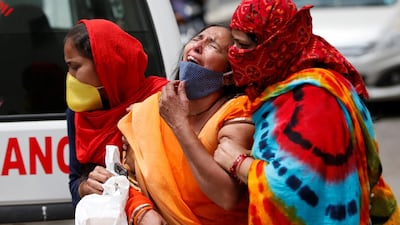
  • Family members mourn after a man is declared dead amid a surge in coronavirus cases in India. Reuters
    Family members mourn after a man is declared dead amid a surge in coronavirus cases in India. Reuters
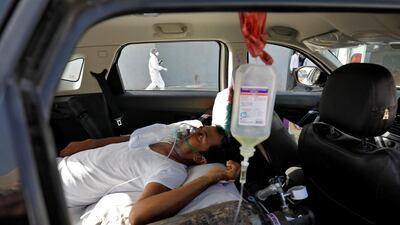
  • A patient with breathing problems is seen inside a car while waiting to enter a hospital for treatment, amid the spread of the coronavirus in Ahmedabad, India. Reuters
    A patient with breathing problems is seen inside a car while waiting to enter a hospital for treatment, amid the spread of the coronavirus in Ahmedabad, India. Reuters
  • India’s second Covid-19 wave is devastating, with more than new 200,000 coronavirus cases recorded each day. Reuters
    India’s second Covid-19 wave is devastating, with more than new 200,000 coronavirus cases recorded each day. Reuters
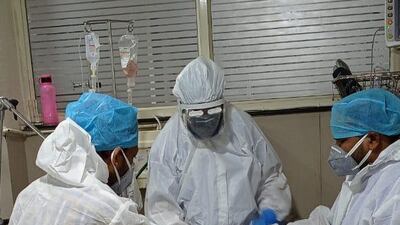
  • Dr Rajesh Bhagchandani, centre, a director at Apex hospital in Bhopal city, intubates a patient. He feels helpless that the hospital, which is now reserved for critically ill Covid-19 patients, cannot accommodate more people who require oxygen. Dr Rajesh Bhagchandani
    Dr Rajesh Bhagchandani, centre, a director at Apex hospital in Bhopal city, intubates a patient. He feels helpless that the hospital, which is now reserved for critically ill Covid-19 patients, cannot accommodate more people who require oxygen. Dr Rajesh Bhagchandani
  • Dr Himanshu Dewan, director of critical care at QRG hospital in Faridabad, a town near India’s capital New Delhi, says the number of deaths will climb because patients do not have access to treatment. Dr Himanshu Dewan
    Dr Himanshu Dewan, director of critical care at QRG hospital in Faridabad, a town near India’s capital New Delhi, says the number of deaths will climb because patients do not have access to treatment. Dr Himanshu Dewan
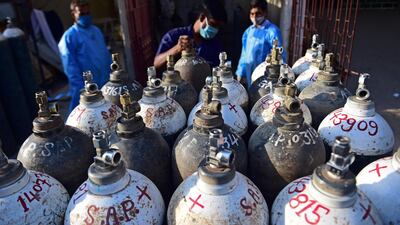
  • A health worker arranges oxygen cylinders that are being used for Covid-19 coronavirus patients at a private hospital in Allahabad. AFP
    A health worker arranges oxygen cylinders that are being used for Covid-19 coronavirus patients at a private hospital in Allahabad. AFP
  • Dr Himanshu Dewan, director of critical care at QRG hospital in Faridabad, a town near India’s capital New Delhi, is acutely aware a patient could die on the road if turned by hospitals that cannot admit more Covid-19 cases . Courtesy: Dr Himanshu Dewan
    Dr Himanshu Dewan, director of critical care at QRG hospital in Faridabad, a town near India’s capital New Delhi, is acutely aware a patient could die on the road if turned by hospitals that cannot admit more Covid-19 cases . Courtesy: Dr Himanshu Dewan
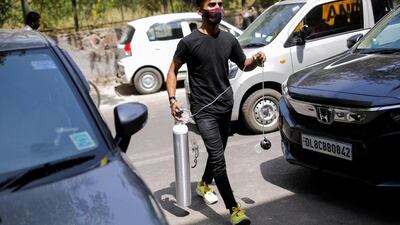
  • A man carries an empty oxygen cylinder to get it refilled at a private refilling station, for his relative who is suffering from the coronavirus disease, in New Delhi. Reuters
    A man carries an empty oxygen cylinder to get it refilled at a private refilling station, for his relative who is suffering from the coronavirus disease, in New Delhi. Reuters
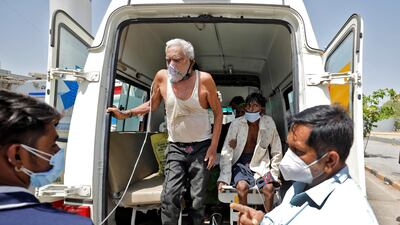
  • Patients with breathing problems are seen inside an ambulance waiting to enter a Covid-19 hospital for treatment in Ahmedabad. Reuters
    Patients with breathing problems are seen inside an ambulance waiting to enter a Covid-19 hospital for treatment in Ahmedabad. Reuters
  • A health worker collects a nasal swab sample from a woman in Amritsar. AFP
    A health worker collects a nasal swab sample from a woman in Amritsar. AFP
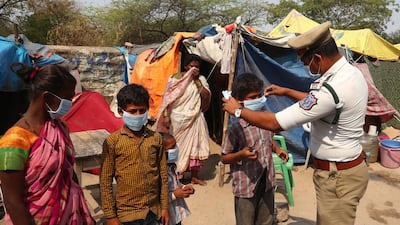
  • An Indian police officer distributes face masks in Hyderabad. AP Photo
    An Indian police officer distributes face masks in Hyderabad. AP Photo
  • A health worker administers the Covidshield vaccine at a government hospital in Hyderabad. AP Photo
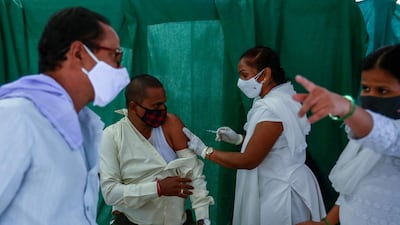
    A health worker administers the Covidshield vaccine at a government hospital in Hyderabad. AP Photo
  • People wearing masks wait to test for Covid-19 at a hospital in Hyderabad. AP Photo
    People wearing masks wait to test for Covid-19 at a hospital in Hyderabad. AP Photo
  • A health worker takes a mouth swab sample at a hospital in Hyderabad. AP Photo
    A health worker takes a mouth swab sample at a hospital in Hyderabad. AP Photo
  • Nuns wait to take a test for Covid-19 at a test center in Kolkata, Eastern India. EPA
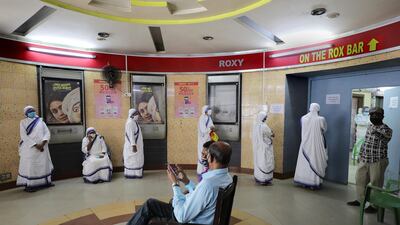
    Nuns wait to take a test for Covid-19 at a test center in Kolkata, Eastern India. EPA

The Delhi region announced a week-long lockdown on Monday. Fewer than 100 critical care beds were available in the city of New Delhi, with a population of more than 20 million people, Chief Minister Arvind Kejriwal said.

UK health authorities said the Indian strain was a “variant under investigation” but this could progress to a “variant of concern” if it is discovered to spread more easily or undermine vaccines.

Prof Danny Altmann from Imperial College London said that new variants should be treated with caution as vulnerable people could be “caught out” if the strain was able to evade immunity.

“We are still vulnerable, and some people in our population are still vulnerable – what I mean by that is the Indian variant, for example, certainly has a mutation like the ones that evade the best neutralising antibodies,” he said.

“If you have a population where at least half of us have had zero or one dose of vaccine, some won’t have made a very good response to the vaccine, because perhaps they are very old or obese or unwell.

“We still have a very large vulnerable population who can still be caught out by variants like this.”

Mr Johnson's visit to India was regarded as an exciting opportunity to upgrade UK-India relations after a series of false starts.

Walter Ladwig, a political scientist and South Asia expert at King’s College London, said there was an appetite on the Indian side for a transformation of bilateral links.

"We're now seeing very clear signals, very obvious signals from the Modi government that they are interested in upgrading relations with the UK," he told The National.

“They see the UK as being one among many states that can play an important role with respect to India and the Indo-Pacific.”

More on coronavirus: 

COMPANY PROFILE
Name: Akeed

Based: Muscat

Launch year: 2018

Number of employees: 40

Sector: Online food delivery

Funding: Raised $3.2m since inception 

Tips for used car buyers
  • Choose cars with GCC specifications
  • Get a service history for cars less than five years old
  • Don’t go cheap on the inspection
  • Check for oil leaks
  • Do a Google search on the standard problems for your car model
  • Do your due diligence. Get a transfer of ownership done at an official RTA centre
  • Check the vehicle’s condition. You don’t want to buy a car that’s a good deal but ends up costing you Dh10,000 in repairs every month
  • Validate warranty and service contracts with the relevant agency and and make sure they are valid when ownership is transferred
  • If you are planning to sell the car soon, buy one with a good resale value. The two most popular cars in the UAE are black or white in colour and other colours are harder to sell

Tarek Kabrit, chief executive of Seez, and Imad Hammad, chief executive and co-founder of CarSwitch.com

GAC GS8 Specs

Engine: 2.0-litre 4cyl turbo

Power: 248hp at 5,200rpm

Torque: 400Nm at 1,750-4,000rpm

Transmission: 8-speed auto

Fuel consumption: 9.1L/100km

On sale: Now

Price: From Dh149,900

RESULTS FOR STAGE 4

Stage 4 Dubai to Hatta, 197 km, Road race.

Overall leader Primoz Roglic SLO (Team Jumbo - Visma)

Stage winners: 1. Caleb Ewan AUS (Lotto - Soudal) 2. Matteo Moschetti ITA (Trek - Segafredo) 3. Primoz Roglic SLO (Team Jumbo - Visma)

Who's who in Yemen conflict

Houthis: Iran-backed rebels who occupy Sanaa and run unrecognised government

Yemeni government: Exiled government in Aden led by eight-member Presidential Leadership Council

Southern Transitional Council: Faction in Yemeni government that seeks autonomy for the south

Habrish 'rebels': Tribal-backed forces feuding with STC over control of oil in government territory

AI traffic lights to ease congestion at seven points to Sheikh Zayed bin Sultan Street

The seven points are:

Shakhbout bin Sultan Street

Dhafeer Street

Hadbat Al Ghubainah Street (outbound)

Salama bint Butti Street

Al Dhafra Street

Rabdan Street

Umm Yifina Street exit (inbound)

Springsteen: Deliver Me from Nowhere

Director: Scott Cooper

Starring: Jeremy Allen White, Odessa Young, Jeremy Strong

Rating: 4/5

Five expert hiking tips
    Always check the weather forecast before setting off Make sure you have plenty of water Set off early to avoid sudden weather changes in the afternoon Wear appropriate clothing and footwear Take your litter home with you
Profile box

Company name: baraka
Started: July 2020
Founders: Feras Jalbout and Kunal Taneja
Based: Dubai and Bahrain
Sector: FinTech
Initial investment: $150,000
Current staff: 12
Stage: Pre-seed capital raising of $1 million
Investors: Class 5 Global, FJ Labs, IMO Ventures, The Community Fund, VentureSouq, Fox Ventures, Dr Abdulla Elyas (private investment)

The burning issue

The internal combustion engine is facing a watershed moment – major manufacturer Volvo is to stop producing petroleum-powered vehicles by 2021 and countries in Europe, including the UK, have vowed to ban their sale before 2040. The National takes a look at the story of one of the most successful technologies of the last 100 years and how it has impacted life in the UAE.

Read part three: the age of the electric vehicle begins

Read part two: how climate change drove the race for an alternative 

Read part one: how cars came to the UAE

If%20you%20go
%3Cp%3EThere%20are%20regular%20flights%20from%20Dubai%20to%20Kathmandu.%20Fares%20with%20Air%20Arabia%20and%20flydubai%20start%20at%20Dh1%2C265.%3Cbr%3EIn%20Kathmandu%2C%20rooms%20at%20the%20Oasis%20Kathmandu%20Hotel%20start%20at%20Dh195%20and%20Dh120%20at%20Hotel%20Ganesh%20Himal.%3Cbr%3EThird%20Rock%20Adventures%20offers%20professionally%20run%20group%20and%20individual%20treks%20and%20tours%20using%20highly%20experienced%20guides%20throughout%20Nepal%2C%20Bhutan%20and%20other%20parts%20of%20the%20Himalayas.%3C%2Fp%3E%0A
Types of policy

Term life insurance: this is the cheapest and most-popular form of life cover. You pay a regular monthly premium for a pre-agreed period, typically anything between five and 25 years, or possibly longer. If you die within that time, the policy will pay a cash lump sum, which is typically tax-free even outside the UAE. If you die after the policy ends, you do not get anything in return. There is no cash-in value at any time. Once you stop paying premiums, cover stops.

Whole-of-life insurance: as its name suggests, this type of life cover is designed to run for the rest of your life. You pay regular monthly premiums and in return, get a guaranteed cash lump sum whenever you die. As a result, premiums are typically much higher than one term life insurance, although they do not usually increase with age. In some cases, you have to keep up premiums for as long as you live, although there may be a cut-off period, say, at age 80 but it can go as high as 95. There are penalties if you don’t last the course and you may get a lot less than you paid in.

Critical illness cover: this pays a cash lump sum if you suffer from a serious illness such as cancer, heart disease or stroke. Some policies cover as many as 50 different illnesses, although cancer triggers by far the most claims. The payout is designed to cover major financial responsibilities such as a mortgage or children’s education fees if you fall ill and are unable to work. It is cost effective to combine it with life insurance, with the policy paying out once if you either die or suffer a serious illness.

Income protection: this pays a replacement income if you fall ill and are unable to continue working. On the best policies, this will continue either until you recover, or reach retirement age. Unlike critical illness cover, policies will typically pay out for stress and musculoskeletal problems such as back trouble.