
Doctors in France have described what they said was the first confirmed case of a newborn infected in the womb with Covid-19 by the mother.
The baby boy, born in March, suffered brain swelling and neurological symptoms linked to Covid-19 in adults, but has since recovered, they reported Tuesday in the journal Nature Communications.
Earlier research had pointed to the likely transmission of the virus from mother to foetus, but the study offers the first solid evidence, said senior author Daniele De Luca, a doctor at Antoine Beclere Hospital near Paris.
"We have shown that the transmission from the mother to the foetus across the placenta is possible during the last weeks of pregnancy," he said.
-

A cadet candidate stands behind a plastic screen as he gets instructions on his arrival at the U.S. Military Academy, in West Point, N.Y. The Army is welcoming more than 1,200 candidates from every state. Candidates will be COVID-19 tested immediately upon arrival, wear masks, and practice social distancing. AP Photo -

EMT’s cleanse their materials outside Memorial West Hospital where coronavirus disease (COVID-19) patients are treated, in Pembroke Pines, Florida, U.S. REUTERS -
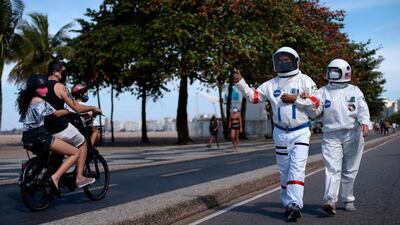
Brazilian accountant Tercio Galdino, 66, gives the thumb up to people riding a motorcycle as he and his wife Alicea Galdino walk along Leme beach in protective suits, in Rio de Janeiro, Brazil. Tercio, who has a chronic lung disease, made the protective suits (looking like astronauts gear) at home using suits used by health professionals. He says that, in addition to giving him protection against the new coronavirus, they also wear them for fun, as he has huge interest in astronomy. AFP -
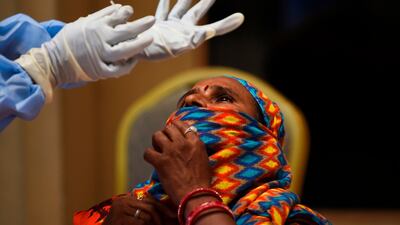
A health worker prepares to take a swab sample from a passenger for a rapid antigen tests (RAT) for the COVID-19 coronavirus at Ranip Bust Terminus in Ahmedabad. AFP -
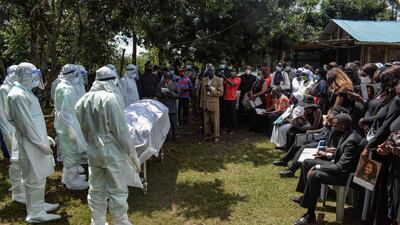
Members of Bungoma County Isolation Team in personal protection equipment (PPE) stand by the coffin of Dr. Doreen Lugaliki, 39, the first Kenyan doctor who died of the COVID-19 coronavirus in Nairobi, during her funeral in Ndalu, western Kenya. AFP -
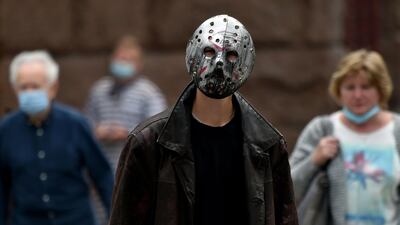
A man wearing an iron mask walks among people wearing surgical masks in the center of the Ukrainian capital of Kiev. AFP -
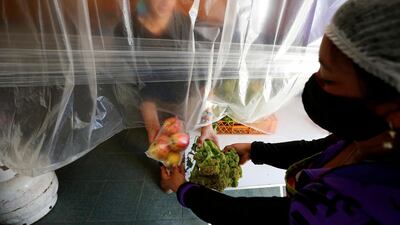
A volunteer delivers food rations at a so-called 'Olla comun', a communal kitchen set up to provide hot food for those with dwindling incomes or nothing, on a hill named "Mariposas" (butterflies), during the spread of the coronavirus disease (COVID-19), in Valparaiso, Chile. REUTERS -

A man fills a bottle with oil perfume along a wholesale market as the spread of the coronavirus disease (COVID-19) continues, in Karachi, Pakistan. REUTERS -

A man reads as he lies in a field where circles were painted to help visitors maintain social distancing at Ibirapuera Park after it was reopened as the city eases the restrictions imposed to control the spread of the coronavirus disease (COVID-19), in Sao Paulo, Brazil. REUTERS -

A man rests in an almost empty area in the City of London financial district, following the outbreak of the coronavirus disease (COVID-19) in London, Britain. REUTERS -

Children wearing masks to curb the spread of the coronavirus sit on a bench in Beijing, China. China reported only a handful of new cases of the virus, all of them brought from outside the country, as domestic community infections fall to near zero. AP Photo -

Elderly women wearing masks to curb the spread of the coronavirus chat as they sit on the sideway with their dogs in Beijing, China. China reported only a handful of new virus cases, all of them brought from outside the country, as domestic community infections fall to near zero. AP Photo


Last week, researchers in Italy said that data on 31 pregnant women hospitalised with Covid-19 "strongly suggested" that the virus could be passed on to unborn infants.
A JAMA study in March reporting on a similar number of pregnant Covid-19 patients came to a similar conclusion, but evidence remained circumstantial.
"You need to analyse maternal blood, amniotic fluid, the newborn's blood, the placenta, etcetera," Dr De Luca said by phone.
"Getting all of these samples during a pandemic with emergencies everywhere has not been easy. This is why it has been suspected but never demonstrated."
Dr De Luca and his team pulled together this data for the case of a pregnant woman in her twenties admitted to his hospital in early March.
Because the baby was delivered by caesarean section, all of the potential sources and reservoirs of the virus remained intact.
The concentration of SARS-CoV-2, the technical name given to the virus, was highest in the placenta, the researchers found.
"From there it passed through the umbilical cord to the baby, where it develops," De Luca said. "That is the pathway of transmission."
The baby began to develop severe symptoms 24 hours after birth, including severe rigidity of the body, damage to white matter in the brain, and extreme irritability.
But before doctors could settle on a course of treatment, the symptoms began to recede. Within three weeks, the newborn had almost fully recovered on his own.
Three months later, his mother is also without symptoms.
"The bad news is that this actually happened, and can happen," Dr De Luca said. "The good news is that it is rare, very rare, compared to the global population."
Among the thousands of babies born to mothers with coronavirus, no more than one or two per cent have tested positive for the virus, and even fewer show serious symptoms, said Marian Knight, a professor of maternal and child population health at the University of Oxford who was not involved in the research.
"The most important message for pregnant women remains to avoid infection through paying attention to hand washing and social distancing measures," she said.
Others said the case study shed light on how the virus passes from mother to child.
"This report adds knowledge to a possible mechanism of transfer to the baby, via the placenta," commented Andrew Shennan, a professor of obstetrics at King's College London.
"But women can remain reassured that pregnancy is not a significant risk factor for them or their babies with Covid-19."

