
Follow the latest updates on Afghanistan here
Senior Taliban leader Abdul Ghani Baradar has returned to Afghanistan, where many expect him to head the country's new government following the sudden collapse of the western-backed administration.
Baradar arrived in the southern province of Kandahar on Tuesday as part of a delegation of top Taliban officials, a spokesman for the group, Mohammad Naeem, tweeted.
He has lived in Doha, Qatar in recent years and led the Taliban in talks that resulted in last year's US withdrawal deal with former president Donald Trump's administration.
Pictures shared on Taliban social media accounts showed crowds waving the Taliban's white flag as they waited for Baradar in the country’s second-biggest city and fireworks being lit to celebrate his return.
The Taliban began an onslaught as US troops withdrew from Afghanistan after 20 years, and the western-backed government collapsed, with former president Ashraf Ghani fleeing over the weekend.
Chaotic scenes at Kabul airport saw thousands of Afghans worried about Taliban reprisals crowd the runways and attempt to cling onto US planes leaving the tarmac.
Overnight on Monday, nine US Air Force C-17 transport planes arrived with equipment and about 1,000 troops, and seven C-17s took off with 700-800 civilian evacuees, including 165 Americans, Army Maj. Gen. William Taylor told a Pentagon news conference.
The total included Afghans who have applied for Special Immigrant Visas and third-country nationals, he said.
Pentagon spokesman John Kirby added the US was in contact with the Taliban "multiple times a day," and planned to end its evacuation by August 31.
Mr Kirby said there have been no hostile actions by the Taliban, and that several hundred members of the now-defeated Afghan army are at the airport assisting in the evacuation.
Jake Sullivan, President Joe Biden's national security adviser, said the Taliban had guaranteed "safe passage" of civilians to the airport.
"We believe this can go until the 31st [of August]. We are talking to them about what the exact timetable is for how this will all play out," Mr Sullivan said.
Western powers are now weighing when - or if - they will recognise the Taliban as the Afghanistan's legitimate new government.
Taliban spokesman Zabihullah Mujahid made assurances to the international community on human rights, women's rights and the freedom of the media at a press conference in Kabul.
Speaking from the capital’s Government Media and Information Centre, Mujahid said women would be equal within society but their rights will be guaranteed only within the framework of Islam and Sharia.
"Our women are Muslim [and] they will be happy to live within the Sharia framework."
During their rule of Afghanistan, from 1996 until the US invasion in 2001, the Taliban imposed brutal controls on women including preventing them from travelling and working, enforced wearing of the burqa and banning education.
Taliban courts handed out extreme punishments including chopping off the hands of thieves and stoning to death women accused of adultery.
Activists have already reported the closure of girls’ schools in Kabul and images of women on billboards and shop windows have been painted over in some areas since the group began its swift seizure of territory last week.
Mujahid also reiterated the Taliban's previous promises to give amnesty to Afghans who previously worked with foreign governments or the previous Afghan government.
He said all aid workers, embassies and other foreign groups would be safe in Afghanistan, and the country would not become a hotbed for terrorist activity.
The UN said it would need to see action behind the promises.
"We will need to see what actually happens and I think we will need to see action on the ground in terms of promises kept," UN spokesman Stephane Dujarric told reporters in New York.
The UAE stressed the need for "stability and security" in Afghanistan and said it was closely monitoring developments.
The Ministry of Foreign Affairs and International Co-operation said it hoped all parties in Afghanistan would work towards this goal.
"The Ministry of Foreign Affairs and International Co-operation expressed its hope that Afghan parties will exert all efforts to establish security and achieve stability and development in Afghanistan in a manner that fulfils the hopes and aspirations of its brotherly people," Tuesday's statement read.
UAE Presidential Adviser Dr Anwar Gargash praised the conciliatory tone of the Taliban spokesman despite the uncertain situation on the ground, writing that, “the statements of the Taliban spokesman today were encouraging.
"Countries are not built with revenge, but through amnesty, through dialogue and tolerance, and acceptance of the role and work of women, and through good relations to achieve prosperity.”
Dr Gargash added: "We hope Afghans can turn the page of suffering to have peace and prosperity".
Also on Tuesday, the Taliban began meeting representatives of other countries to shore up international recognition for their new regime.
Russia’s ambassador to Afghanistan, Dmitry Zhirnov, said he held a "constructive" meeting with a Taliban official in Kabul on Tuesday.
The ambassador said the Taliban were “restoring order in the city” and had succeeded.
He said the meeting was purely technical given that there was still no central authority in Kabul, but only a “de facto senior Taliban” member.
Russia's foreign minister Sergei Lavrov said the Taliban had sent a "positive signal" by showing a "readiness to respect the opinion of others".
Earlier on Tuesday, Qatari Foreign Minister Sheikh Mohammed bin Abdulrahman met Baradar in Doha to discuss the latest political developments, before the Taliban leader travelled to Kabul.
The two sides discussed a “comprehensive political settlement and a peaceful transfer of power, with the importance of preserving the gains made by the Afghan people,” a statement from Qatar’s News Agency read
Internally, senior Taliban leader Amir Khan Muttaqi, who is believed to be in the Afghan capital, was expected to hold talks with Kabul’s leaders, including Abdullah Abdullah, who once headed the country’s negotiating council, and former president Hamid Karzai.
But Afghanistan’s former vice president made a move to declare he would be assuming the role of “caretaker president”.
“According to the explicit provisions of the Constitution of the Islamic Republic of Afghanistan, in case of absence, escape or death of the president, the first vice president will be the acting president,” Amrullah Saleh wrote. He assured Afghans that, contrary to rumours, he was still inside the country.
“I am legally and legitimately in charge of this position/chair. I am consulting with all the leaders of the country to strengthen this position,” he said.
Mr Saleh went underground after the fall of the Afghan capital on August 15, and it was believed he had left the country along with Mr Ghani.
But Mr Saleh dismissed the rumours in an earlier Twitter post.
-

An Afghan policeman keeps watch during a ceremony to hand over security control in the rugged mountains of the Panjshir valley. AFP -
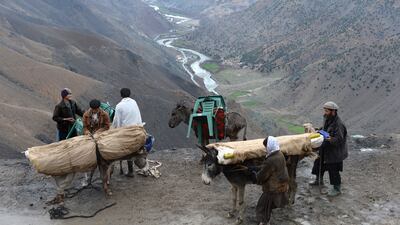
Donkeys are loaded with goods in the Panjshir valley. AFP -
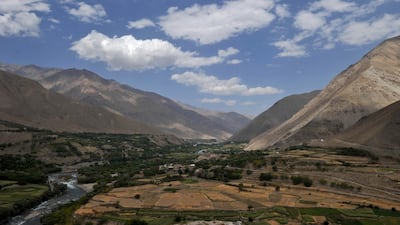
A general view of the valley as seen from Ahmad Shah Massoud's grave. The warlord was nicknamed the Lion of Panjshir for his exploits in resisting Soviet forces. AP Photos -

Panjshir is surrounded by mountains and is hard to reach. Reuters -
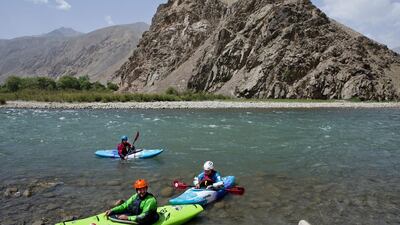
Foreign tourists kayak along the Panjshir River, north of the Afghan capital, Kabul. They are unlikely to be in Afghanistan now. AP Photos -

Abandoned Soviet artillery in Panjshir, left behind after the occupation from 1979 to 1989 and the subsequent fallout. Reuters -
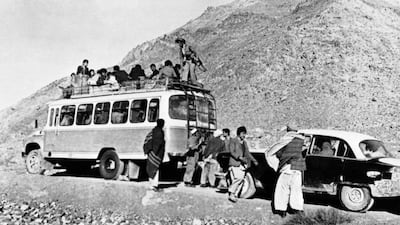
Afghan insurgents search for pro-Soviet regime and party officials among bus passengers in the Panjshir valley, the scene of fierce fighting in January 1981. AP Photo -
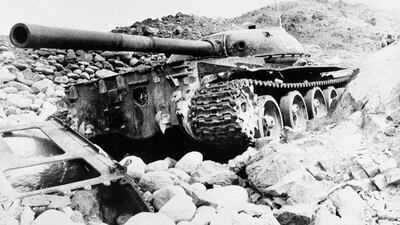
This 1981 picture by an Iranian freelance photographer shows a Russian T-62 Commando tank destroyed in Panjshir valley. Afghan Mujahideen rebels said it was hit by a mine. AP Photo


“I will never, ever [and] under no circumstances bow to [the] Talib terrorists,” he said.
It is believed he is in Panjshir, the only province that is not under Taliban control.
A source close to Mr Saleh confirmed that resistance was being mobilised against the Taliban.
“A lot of people are joining in, and we believe in the capacity to fight back and retake the country and reinstate the democratic government of Islamic Republic of Afghanistan,” they said.

