
Global coronavirus hotspot South Africa is seeing a “huge discrepancy” between confirmed Covid-19 deaths and much higher excess deaths from natural causes, while Africa’s top health official says the coronavirus is spreading there “like wildfire”.
A new report by the South African Medical Research Council, released late on Wednesday, shows more than 17,000 excess deaths in South Africa from May 6 to July 14 as compared to data from the past two years, while confirmed Covid-19 deaths are 5,940.
"The numbers have shown a relentless increase — by the second week of July, there were 59 per cent more deaths from natural causes than would have been expected,” the report says.
The council’s president, Glenda Gray, said in a statement the excess deaths could be attributed to Covid-19 as well as to other widespread diseases such as HIV and tuberculosis while many health resources are redirected toward the pandemic.
Meanwhile, some South Africans are thought to be avoiding health facilities as fears of the new virus spread and public hospitals are overwhelmed.
“In all countries with Covid-19, we are seeing this,” Health Minister Zweli Mkhize said of the report.
_______________
Coronavirus around the world
-

A volunteer health worker of the NGO Bharatiya Jain Sanghatana wearing personal protective equipment (PPE) using a smart helmet equipped with a thermo-scan sensor checks the body temperature of residents in Mumbai. AFP -

Staff members of a restaurant in Johannesburg demonstrate against the Covid-19 coronavirus lockdown regulations. AFP -

Lines of ambulances used during Covid-19 emergencies stand parked on the roadside in Bangalore. AFP -

Funeral assistant, Bradley Georges, 26 walks to a funeral at one of Miami's largest funeral homes. AFP -

Models present creations from Dior's Cruise 2021 collection during a live-streamed runway show without an audience at Piazza del Duomo, in Lecce, Italy. Reuters -

Ifeoma Eh, a candidate from Nigeria who has applied for US citizenship, stands with others during naturalisation ceremony in New York City. Reuters -
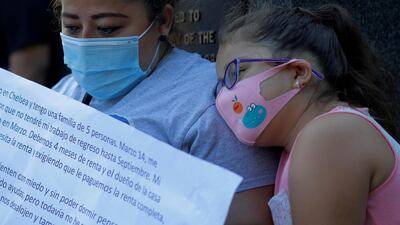
Sandra Cruz sits with her daughter Gabriella after telling her family’s story about losing her job because of the coronavirus outbreak in the US. Reuters -
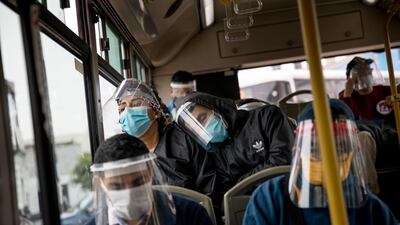
Commuters wearing protective face masks and face shields travel on a public bus in Lima, Peru. AP -
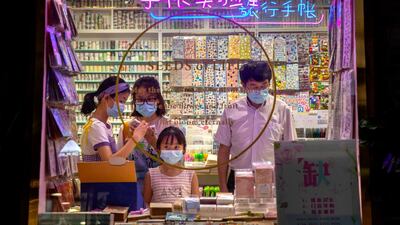
People wearing face masks to protect themselves against the coronavirus visit a store on a shopping street in Beijing. AP -
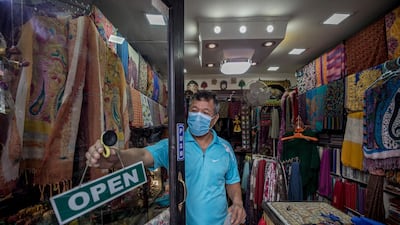
A man wears a mask as he opens a shop at Thamel, a major tourist hub, in Kathmandu. EPA -

A health worker collects blood samples from a patient recently recovered from Covid-19 in Srinagar, India. EPA


_______________
South Africa now has the world's fifth-largest caseload. It makes up more than half the confirmed cases on the African continent with its total expected to surpass 400,000 by the end of Thursday.
Africa’s 54 countries now have more than 750,000 cases.
South Africa is “very concerning”, the director of the Africa Centres for Disease Control and Prevention, John Nkengasong, told reporters on Thursday.
And now other African countries are becoming a problem, notably Kenya, where Mr Nkengasong said cases have “taken off very, very quickly”. East Africa’s commercial hub now has more than 14,000 confirmed cases.
Local transmission of the virus has begun in many countries across the continent, and once it is seeded in vulnerable communities such as slums it “spreads like wildfire, which is what we’re seeing in South Africa now”, he said.
The true number of cases in Africa is unknown, as shown by the new report in South Africa, the continent’s most developed country.
Testing remains limited by shortages of supplies, with just 7.2 million tests conducted on a continent of 1.3 billion people. Data collection is incomplete as some people are dying at home or before being tested. Few African countries were equipped to widely track deaths even before the pandemic.
“Community deaths, we just don’t know how countries are capturing that,” Mr Nkengasong said.
Africa’s case fatality rate in this pandemic remains relatively low at just over 2 per cent, but that measure is weakened if authorities do not know the real number of deaths.
As cases climb, the Africa CDC director said a “universal masking of the continent is very important at this critical stage” as some officials in South Africa and elsewhere warn against pandemic fatigue.
Many countries across Africa locked down quickly as the pandemic raced across Europe and the United States, delaying its spread at home. But economic pressures have forced most governments to loosen restrictions, though South Africa this month returned to a ban on alcohol sales to help free up precious hospital beds.
“The continent still, as a whole, has a chance to fight back in a successful manner,” Mr Nkengasong said, pointing out that 37 countries still have reported less than 5,000 cases.
But those on the front lines have been hit hard. The World Health Organisation said on Thursday that more than 10,000 health workers have been infected in its African region, which is largely sub-Saharan Africa.
WHO Africa chief Matshidiso Moeti said she was unable to say how many workers have died as efforts to improve data collection continue.

