


The palm is a common member of the flora of the UAE and throughout the Arab world, an ancient and powerful symbol of nations, cultures and religions. This week’s Arabic word of the week is nakhla, which translates as palm tree.
In 2019, the palm tree was recognised by Unesco and added to its list of Intangible Cultural Heritage. The nomination to recognise and protect the palm tree came from 14 Arab countries, Bahrain, Egypt, Iraq, Jordan, Kuwait, Mauritania, Morocco, Oman, Palestinian Territories, Saudi Arabia, Sudan, Tunisia, the UAE and Yemen.

This shows the importance of the palm tree across the Arab world, traditionally symbolising prosperity and historically having been used as a resource by many in the region.
Although nakhla means palm tree, the verb form of the word, nakhala, means to sift through or to strain thoroughly. While not officially confirmed, a connection between the meaning of the verb can be connected to the unique properties and history of the palm tree in the region.
Often seen as the tree of the desert, palms also symbolise an oasis in an arid landscape, providing shade from the sun and sweet fruit in the form of dates. Historically, palm trees have been used in the construction of homes, their leaves for thatching and cladding structures, dwellings or household items as far back as 4,000 BC in the ancient region of Mesopotamia, or modern day Iraq.
Given that traditionally every part of the palm tree — from its trunk to leaves and fruit — have been used, the origins of the verb form of nakhla can be interpreted as using the best of any substance.
The date palm tree is also associated with fertility in the Arab world, since trees are either male or female, with the latter bearing dates. There are more than 2,600 species of palm trees that grow in warm, sub-tropical and tropical climates along with more than 200 varieties of dates.
Palm trees have also been referenced in all the Abrahamic religions, Christianity, Judaism and in Islam, where it continues to have a strong cultural presence.
While palm trees are ancient and have been great sources of inspiration in Arabic proverbs and poetry, today, palm trees are also seen as symbols of paradise, associated with beaches and tropical islands.
One of the most popular celebrations of the palm tree as a symbol for the Arab region is the UAE’s design for Palm Jumeirah in Dubai, the tree-shaped artificial island.
Renowned Iraqi singer Nazem Al Ghazali popularised the traditional folklore song Foug El Nakhal, which translates to Above the Palm Trees, in the 1950s. The song’s lyrics describe a man admiring an unattainable and beautiful woman “above the palm trees”.
The song has been re-recorded in varying styles and genres over the years due to its simple lyrics and the Arab world’s fondness for palm trees.
Scroll through the gallery below to see The National's pick of Arabic words of the week
-
Hob is the Arabic word for love, but can be used in many contexts -

The Arabic word helu translates, in English, to sweet -
Nashef is the Arabic word for dry, but has many connotations, depending on the context in which you use it -
The Arabic word hurriyeh translates to freedom in English -
The Arabic word tayeb can mean delicious or good, depending on the context -
The Arabic word mustaqbal is best expressed as future in English -
Waqaa, the Arabic word for fall, can signify a loss of power, stature, health or grace -
Hudood means borders in English -
The Arabic word rooh translates to spirit or soul in English -

The Arabic word ain means eye in English -
Waraq, the Arabic word of the week means paper in English -
Bahr, the Arabic for sea, has a poetic lilt -
Kareem means generous in English -
Bab means door in English -
Eid means holiday or festival -

Najm means star for the night sky and cosmos, but also has plenty of other meanings, including ambition or fame -
Alwan, the Arabic word for colours, has many shades of meaning -

Akel can refer to home-cooked meals, embezzlement, fire and rust -

Jamal is the Arabic word for beauty, be it literal or figurative -

Herfe translates to profession or craft -

Tabiaa translates to nature and can frame landscapes and portraits -

Sehha is the Arabic word for health -

Ijaza is Arabic for holiday and shines in summer but is not stress-free -

Aamal is the Arabic word for work -
Al dahr translates to time -

Qalb is a word for heart, with poetic roots -
Lugha in Arabic translates to language in English -
Insaan means human being -
Na'eeman is an idiomatic expression used when someone has had a shower or bath, a haircut or had their beard trimmed -
The Arabic word for life touches on eternity, death and accomplishment -

Qamar is the Arabic for moon -

The Arabic word for strength or power is quwwa -

Burj is Arabic for tower -
The Arabic word for sun is shams -
Sabr in English can translate to patience -
Hayba is the Arabic word for prestige -
The Arabic term al shay'e translates as 'the thing' in English -

The Arabic word for road is tareeq -
The Arabic word for read has mystical and scholarly connotations -
Istikan is the Arabic word for a type of tea cup -
The Arabic word hanan means affection in English -
The Arabic word atlal means ruins in English -

Kura is the Arabic word for ball, in all its forms -
Janaah in Arabic means wing in English -
The Arabic word sana translates to year in English -
Qasida is the Arabic for poem, not poetry -
Ameer, the Arabic word for prince, which influenced another English title -
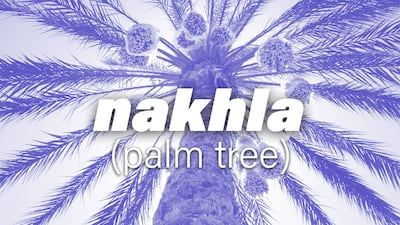
Nakhla translates to palm tree in English -
Al samt is the Arabic for silence -

Kalimaat translates to words in English -

Markaz is Arabic for centre -
Beshara is the Arabic word for good news -
Bayt is the Arabic for house or home -

Fann is the Arabic word for art, and can be either a verb or an adjective -
Isim, which means name, is made up of three letters, alif, seen and meem -
Dunya is the Arabic word for world -
Nazaafah translates to cleanliness in English -
Many traditions revolve around drinking coffee, including weddings, funerals and business meetings -
Fajr is the Arabic word for dawn -
Maghrib is the Arabic word for sunset -

The Arabic language is filled with idioms, quotes and colloquial quips involving the mirror -
Raei is the Arabic word for opinion -

Wa'ed is a multifaceted word for 'promise', as well as a female name -
Qussa is the Arabic word for story -
Sadaaka is the Arabic word for friendship -
Akhbaar is the Arabic word for news -
Rasem is made up of the three Arabic letters Rah, Seen and Meem. While it can simply mean a drawing or a sketch it’s also a malleable word whose definition can change depending on context and dialect – particularly between colloquial and classical Arabic. -

As well as finishing a task, khatem denotes a deeper sense of finality -
Commonly translated to blessed, mubarak is used as a popular greeting on auspicious days -
The Arabic word for lighthouse is also a term that has become closely associated with Islam -

Siyaam, the Arabic word for fasting is also connected to silence -

Tawbah, the Arabic word for repentance, is also connected to Ramadan -
Safar, the Arabic Word for travel can also refer to sunny days, a brighter-blazing fire or exile. The National



