
Abdullah Nasser, 30, vividly remembers the day when an air strike reduced his family home in Aleppo to rubble.
In the summer of 2014, the journalist and his family went to spend the night at his sister’s home.
“I was on vacation from university in Damascus and went to visit my family in Aleppo."
He describes the situation as being a lucky one for him and his family.
“We went to my sister’s house for a sleepover – just to hang out.
“It was June or July, and a battle broke out in our neighbourhood. It was a catastrophe."
One by one, the buildings in the area began to collapse.

“The neighbours told us we were lucky not to have been there. They kept escaping from building to building.”
This week marks 10 years since pro-democracy demonstrations began in Syria.
Inspired by similar events in the region, citizens were calling for reforms and took to the streets. In retaliation, the government of President Bashar Al Assad responded with deadly force, igniting further demands for change and ultimately leading to a civil war which still drags on.
As the situation worsened, the death toll mounted. More than 500,000 people are now believed to be dead or missing.
The UN children's agency Unicef reported that 12,000 children have been killed or wounded during the conflict.

On top of the destruction of his home and most of his belongings, Mr Nasser said his biggest loss was his family memories.
“The problem with losing a house is not about what you have in the house. The saddest moment is to remember that you have lost all your photo albums and memories. This is really hard for anyone.”
After the incident, his mother rented a house in Aleppo. His siblings, who were all married, already lived in their own houses.
Mr Nasser returned to his studies in Damascus, but continued to visit Aleppo regularly.
“During my last three visits, I knew that I would be moving out of Syria soon and I wanted to capture every memory,” he said.
“So I kept taking photos of random buildings and people – just strangers doing their own thing.”
Mr Nasser finally made the decision to leave Syria just as he was due to marry his fiancé.
The economic situation was bad, and he could not see himself raising a family there, he said.
Four days after the ceremony he moved with his wife, Kenda Ali, to the UAE on February 1, 2020.
Although he frequently travelled to Europe for media workshops, Mr Nasser said his preference was to move to the Emirates.
“I’ve been to the Netherlands and France, but the added value in the UAE is that you have a better opportunity to work.
"As an Arab multimedia journalist, it is not easy to find a job when you travel far from the Arab region.”
Even so, it was not easy for Mr Nasser to find a job in the UAE either.
He spent three months in Dubai searching for work, before moving to the capital where his sister-in-law lives.
“I started networking and making friends, sending my resume here and there, until I found this job.”
Mr Nasser now works as a graphic designer at a media production company.
Everyday sounds can remind him of the trauma back home.
Sitting at the cafe outside his office in Abu Dhabi's Twofour54 complex, he paused and smiled every time a plane flew over.
“For a Syrian person, all these aircraft and jets moving around sounds so familiar to me and my Syrian friends,” he said.
“We used to hear this sound a lot in Syria. Not from normal airplanes though, from fighter jets.”
Mr Nasser would like to go back to visit as soon as possible, especially after the birth of his first child two months ago – a girl named Taj.
“I plan to take my baby girl. We are working on her documents. My wife always tells me we must take her to see the family.”
Although Mr Nasser misses his family and friends at home, he said it would still be difficult to move his life back to Syria.
“Do I want to go back to Syria permanently? Yes – it is my country. I hope it gets better and I go back. I want to live in my country, my neighbourhood, with my friends.
"It wasn’t easy to say goodbye.”
-
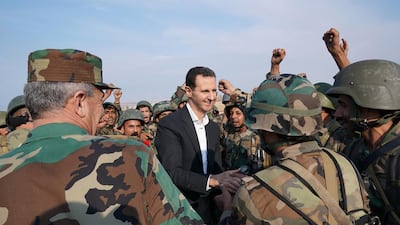
Syrian soldiers are seen cheering President Bashar Al Assad during his visit to Al Habit on the southern edges of the Idlib province, in a picture released on October 22, 2019. AFP / Syrian Presidency Facebook page -
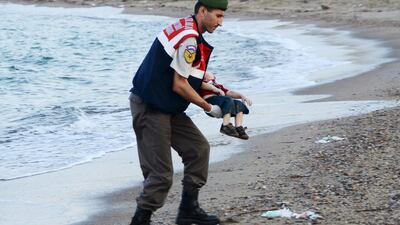
A Turkish gendarme retrieves the body of Syrian refugee Alan Kurdi from a beach in Turkey. Reuters -
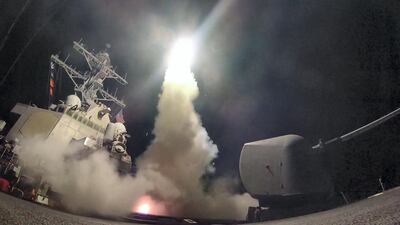
The guided-missile destroyer 'USS Porter' conducts strikes while in the Mediterranean Sea, on April 7, 2017. AFP / US NAVY -
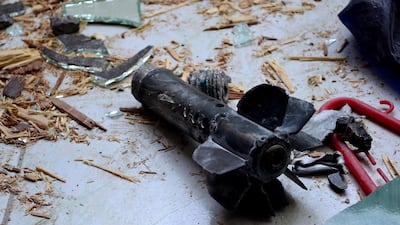
A handout picture released by the official Syrian Arab News Agency on October 31, 2013, shows the remains of a mortar after an alleged mortar attack by rebel fighters on the Damascus mixed Christian-Druze suburb of Jaramana. AFP / Sana -
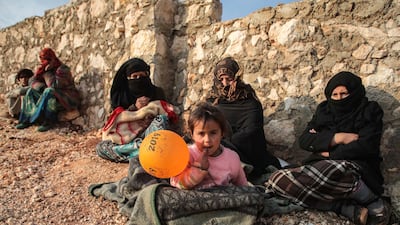
Displaced Syrians from the south of Idlib province sit out in the open in the countryside west of the town of Dana in the north-west Syrian region on December 23, 2019. AFP -
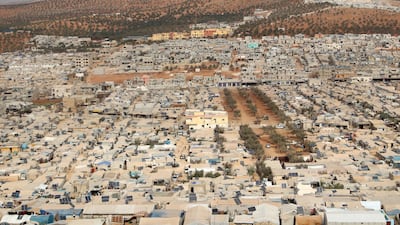
This picture shows a general view of an overcrowded displacement camp near the village of Qah near the Turkish border in Syria's north-west Idlib province, on October 28, 2020, during the coronavirus pandemic crisis. AFP -
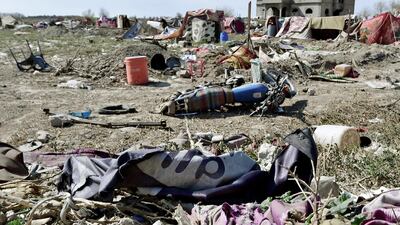
A picture taken on March 23, 2019, shows the last ISIS bastion in the eastern Syrian village of Baghuz after the defeat of the group. The Kurdish-led forces pronounced the end of ISIS regime on March 23, 2019, after flushing out the diehard militants from their very last bastion in eastern Syria. AFP -
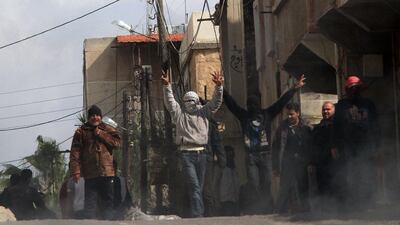
Anti-government activists gesture as they gather on the streets of Daraa, 100 kilometres south of the capital Damascus, on March 23, 2011. AFP -
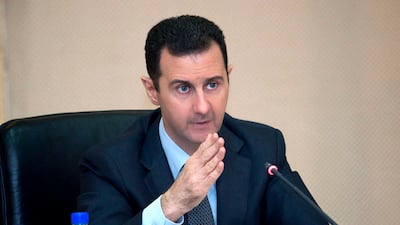
Syria's President Bashar Al Assad heading a cabinet meeting in the presidential palace in Damascus in 2013. Sana / AFP -
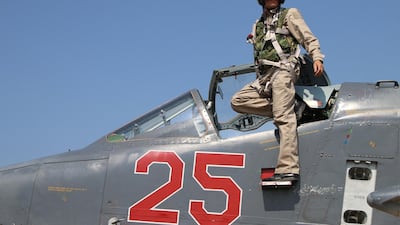
A picture taken on October 3, 2015 shows a Russian army pilot leaving the cockpit of a Russian Sukhoi Su-25 ground attack aircraft at the Hmeimim airbase in the Syrian province of Latakia. AFP -
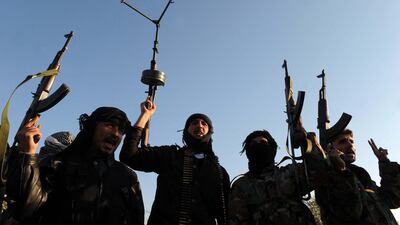
Members of the Free Syrian Army raise their weapons during a patrol in Idlib in north-west Syria on February 18, 2012. AFP -
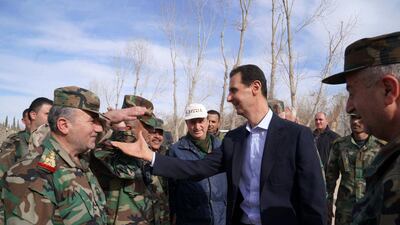
Syrian President Bashar Al Assad is shown shaking hands with government troops in Eastern Ghouta, in the leader's first trip to the former rebel enclave outside Damascus in years, in this handout picture released by the Syrian Presidency on March 18, 2018. Syrian Presidency Facebook page / AFP -
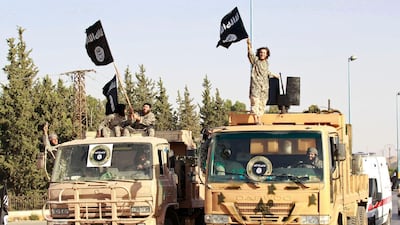
Militant fighters wave flags as they take part in a military parade along the streets of Syria's northern Raqqa province, on June 30, 2014. Reuters



