Abu Dhabi removes PCR test rules for entry from other emirates


Rory Reynolds
  • English
  • Arabic

Related: Abu Dhabi drops need for wristband trackers for arriving passengers

Abu Dhabi authorities will no longer require people to get tested for coronavirus before they enter the capital from other emirates, the government said on Saturday.

The move comes into effect on Sunday.

Officials said the decision was made after the recent drop in cases in Abu Dhabi. As of last week, just 0.2 per cent of people tested were found to have the coronavirus. Since July 2, 2020, anyone driving into Abu Dhabi has had to show police at the border they have had a recent PCR test and are negative for the virus.

Nationwide, cases have dropped significantly, to as few as 500 a day. Last week, the government said 80 per cent of the population were fully vaccinated.

"The decision follows the announcement of a decreased Covid-19 infection rate in the emirate of 0.2 per cent of total tests and the activation of the green pass system to enter some public places," Abu Dhabi's Government Media Office said.

"The committee will continue to monitor infection rates and urges all citizens, residents and visitors to continue adhering to precautionary measures to protect public health and safety, maintain successes and advance the nation’s sustainable recovery."

In a separate announcement, the Abu Dhabi Emergency, Crisis and Disasters Committee said people entering the capital from abroad, including arrivals at the airport, will no longer need to wear an electronic wristband during home quarantine. Positive cases must still wear a wristband.

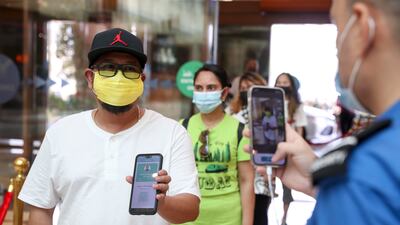
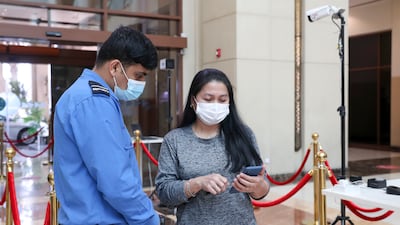
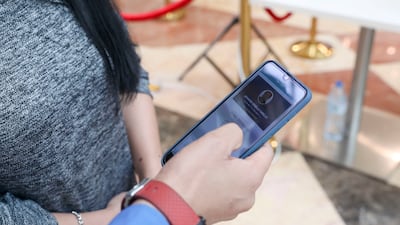
  • The UAE's Al Hosn app acts as a health pass to secure entry to public buildings, malls, education facilities, restaurants and venues in Abu Dhabi. All photos by Khushnam Bhandari / The National
    The UAE's Al Hosn app acts as a health pass to secure entry to public buildings, malls, education facilities, restaurants and venues in Abu Dhabi. All photos by Khushnam Bhandari / The National
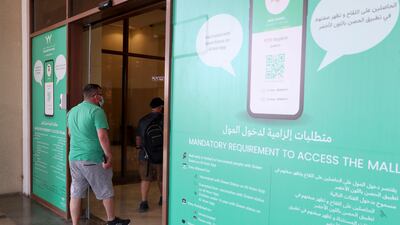
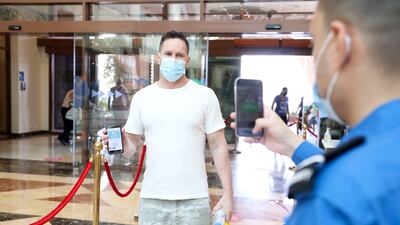
  • Signs at Khalidiyah Mall inform customers about the current 'green pass' entry rules. People are required to have the 'green status' on the Al Hosn app to enter many public places.
    Signs at Khalidiyah Mall inform customers about the current 'green pass' entry rules. People are required to have the 'green status' on the Al Hosn app to enter many public places.
  • People who are fully vaccinated against coronavirus remain green as long as they have a PCR test once every 30 days.
    People who are fully vaccinated against coronavirus remain green as long as they have a PCR test once every 30 days.
  • People who are unvaccinated must be tested every three days to remain green.
    People who are unvaccinated must be tested every three days to remain green.
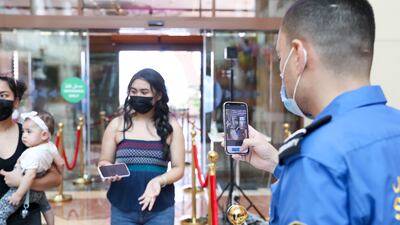
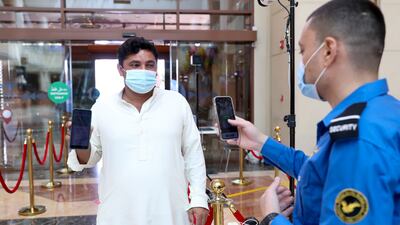
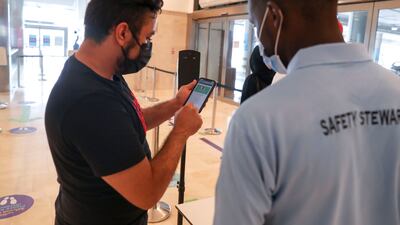
  • People will be required to show their vaccination status before entering public buildings.
    People will be required to show their vaccination status before entering public buildings.
  • This 'green status' system is only in place in Abu Dhabi.
    This 'green status' system is only in place in Abu Dhabi.
  • To maintain vaccinated status on the Al Hosn app, a third booster dose must be taken six months after the second dose has been administered.
    To maintain vaccinated status on the Al Hosn app, a third booster dose must be taken six months after the second dose has been administered.
  • The new rules apply to citizens, residents and tourists.
    The new rules apply to citizens, residents and tourists.
  • Signs at the entrance to Yas Mall in Abu Dhabi inform people to show proof of vaccination upon entry.
    Signs at the entrance to Yas Mall in Abu Dhabi inform people to show proof of vaccination upon entry.
  • A widespread media campaign informed members of the public about the new requirements.
    A widespread media campaign informed members of the public about the new requirements.

"The committee has approved continued strict adherence to home quarantine procedures and required testing schedules based on personal responsibility, as well as monitoring by healthcare systems to ensure compliance with precautionary measures. Violators will be reported to the Attorney-General," it added.

Green pass needed to enter public places in Abu Dhabi

Although people entering Abu Dhabi from Dubai no longer need to show a test result, they are still required to have the 'green status' on the Al Hosn app to enter many public places.

Security staff at public buildings, malls, restaurants and venues will check that entrants have a green pass.

People who are fully vaccinated against coronavirus remain green as long as they have a PCR test once every 30 days.


The%20specs
%3Cp%3E%3Cstrong%3EEngine%3A%3C%2Fstrong%3E%206.4-litre%20V8%0D%3Cbr%3E%3Cstrong%3ETransmission%3A%20%3C%2Fstrong%3E8-speed%20auto%0D%3Cbr%3E%3Cstrong%3EPower%3A%20%3C%2Fstrong%3E470bhp%0D%3Cbr%3E%3Cstrong%3ETorque%3A%20%3C%2Fstrong%3E637Nm%0D%3Cbr%3E%3Cstrong%3EPrice%3A%20%3C%2Fstrong%3EDh375%2C900%20(estimate)%0D%3Cbr%3E%3Cstrong%3EOn%20sale%3A%3C%2Fstrong%3E%20now%3C%2Fp%3E%0A
How Islam's view of posthumous transplant surgery changed

Transplants from the deceased have been carried out in hospitals across the globe for decades, but in some countries in the Middle East, including the UAE, the practise was banned until relatively recently.

Opinion has been divided as to whether organ donations from a deceased person is permissible in Islam.

The body is viewed as sacred, during and after death, thus prohibiting cremation and tattoos.

One school of thought viewed the removal of organs after death as equally impermissible.

That view has largely changed, and among scholars and indeed many in society, to be seen as permissible to save another life.

The biog

Favourite films: Casablanca and Lawrence of Arabia

Favourite books: Start with Why by Simon Sinek and Good to be Great by Jim Collins

Favourite dish: Grilled fish

Inspiration: Sheikh Zayed's visionary leadership taught me to embrace new challenges.

Mercer, the investment consulting arm of US services company Marsh & McLennan, expects its wealth division to at least double its assets under management (AUM) in the Middle East as wealth in the region continues to grow despite economic headwinds, a company official said.

Mercer Wealth, which globally has $160 billion in AUM, plans to boost its AUM in the region to $2-$3bn in the next 2-3 years from the present $1bn, said Yasir AbuShaban, a Dubai-based principal with Mercer Wealth.

Within the next two to three years, we are looking at reaching $2 to $3 billion as a conservative estimate and we do see an opportunity to do so,” said Mr AbuShaban.

Mercer does not directly make investments, but allocates clients’ money they have discretion to, to professional asset managers. They also provide advice to clients.

“We have buying power. We can negotiate on their (client’s) behalf with asset managers to provide them lower fees than they otherwise would have to get on their own,” he added.

Mercer Wealth’s clients include sovereign wealth funds, family offices, and insurance companies among others.

From its office in Dubai, Mercer also looks after Africa, India and Turkey, where they also see opportunity for growth.

Wealth creation in Middle East and Africa (MEA) grew 8.5 per cent to $8.1 trillion last year from $7.5tn in 2015, higher than last year’s global average of 6 per cent and the second-highest growth in a region after Asia-Pacific which grew 9.9 per cent, according to consultancy Boston Consulting Group (BCG). In the region, where wealth grew just 1.9 per cent in 2015 compared with 2014, a pickup in oil prices has helped in wealth generation.

BCG is forecasting MEA wealth will rise to $12tn by 2021, growing at an annual average of 8 per cent.

Drivers of wealth generation in the region will be split evenly between new wealth creation and growth of performance of existing assets, according to BCG.

Another general trend in the region is clients’ looking for a comprehensive approach to investing, according to Mr AbuShaban.

“Institutional investors or some of the families are seeing a slowdown in the available capital they have to invest and in that sense they are looking at optimizing the way they manage their portfolios and making sure they are not investing haphazardly and different parts of their investment are working together,” said Mr AbuShaban.

Some clients also have a higher appetite for risk, given the low interest-rate environment that does not provide enough yield for some institutional investors. These clients are keen to invest in illiquid assets, such as private equity and infrastructure.

“What we have seen is a desire for higher returns in what has been a low-return environment specifically in various fixed income or bonds,” he said.

“In this environment, we have seen a de facto increase in the risk that clients are taking in things like illiquid investments, private equity investments, infrastructure and private debt, those kind of investments were higher illiquidity results in incrementally higher returns.”

The Abu Dhabi Investment Authority, one of the largest sovereign wealth funds, said in its 2016 report that has gradually increased its exposure in direct private equity and private credit transactions, mainly in Asian markets and especially in China and India. The authority’s private equity department focused on structured equities owing to “their defensive characteristics.”

SPEC SHEET

Display: 10.9" Liquid Retina IPS, 2360 x 1640, 264ppi, wide colour, True Tone, Apple Pencil support

Chip: Apple M1, 8-core CPU, 8-core GPU, 16-core Neural Engine

Memory: 64/256GB storage; 8GB RAM

Main camera: 12MP wide, f/1.8, Smart HDR

Video: 4K @ 25/25/30/60fps, full HD @ 25/30/60fps, slo-mo @ 120/240fps

Front camera: 12MP ultra-wide, f/2.4, Smart HDR, Centre Stage; full HD @ 25/30/60fps

Audio: Stereo speakers

Biometrics: Touch ID

I/O: USB-C, smart connector (for folio/keyboard)

Battery: Up to 10 hours on Wi-Fi; up to 9 hours on cellular

Finish: Space grey, starlight, pink, purple, blue

Price: Wi-Fi – Dh2,499 (64GB) / Dh3,099 (256GB); cellular – Dh3,099 (64GB) / Dh3,699 (256GB)

No.6 Collaborations Project

Ed Sheeran (Atlantic)

Three trading apps to try

Sharad Nair recommends three investment apps for UAE residents:

  • For beginners or people who want to start investing with limited capital, Mr Nair suggests eToro. “The low fees and low minimum balance requirements make the platform more accessible,” he says. “The user interface is straightforward to understand and operate, while its social element may help ease beginners into the idea of investing money by looking to a virtual community.”
  • If you’re an experienced investor, and have $10,000 or more to invest, consider Saxo Bank. “Saxo Bank offers a more comprehensive trading platform with advanced features and insight for more experienced users. It offers a more personalised approach to opening and operating an account on their platform,” he says.
  • Finally, StashAway could work for those who want a hands-off approach to their investing. “It removes one of the biggest challenges for novice traders: picking the securities in their portfolio,” Mr Nair says. “A goal-based approach or view towards investing can help motivate residents who may usually shy away from investment platforms.”
Iftar programme at the Sheikh Mohammed Centre for Cultural Understanding

Established in 1998, the Sheikh Mohammed Centre for Cultural Understanding was created with a vision to teach residents about the traditions and customs of the UAE. Its motto is ‘open doors, open minds’. All year-round, visitors can sign up for a traditional Emirati breakfast, lunch or dinner meal, as well as a range of walking tours, including ones to sites such as the Jumeirah Mosque or Al Fahidi Historical Neighbourhood.

Every year during Ramadan, an iftar programme is rolled out. This allows guests to break their fast with the centre’s presenters, visit a nearby mosque and observe their guides while they pray. These events last for about two hours and are open to the public, or can be booked for a private event.

Until the end of Ramadan, the iftar events take place from 7pm until 9pm, from Saturday to Thursday. Advanced booking is required.

For more details, email openminds@cultures.ae or visit www.cultures.ae


Tamkeen's offering
  • Option 1: 70% in year 1, 50% in year 2, 30% in year 3
  • Option 2: 50% across three years
  • Option 3: 30% across five years 
THE SPECS

Engine: 1.5-litre turbocharged four-cylinder

Transmission: Constant Variable (CVT)

Power: 141bhp 

Torque: 250Nm 

Price: Dh64,500

On sale: Now

CABINET%20OF%20CURIOSITIES%20EPISODE%201%3A%20LOT%2036
%3Cp%3E%3Cstrong%3EDirector%3A%20%3C%2Fstrong%3EGuillermo%20del%20Toro%3Cbr%3E%3Cstrong%3EStars%3A%3C%2Fstrong%3E%20Tim%20Blake%20Nelson%2C%20Sebastian%20Roche%2C%20Elpidia%20Carrillo%3Cbr%3ERating%3A%204%2F5%3C%2Fp%3E%0A
TEACHERS' PAY - WHAT YOU NEED TO KNOW

Pay varies significantly depending on the school, its rating and the curriculum. Here's a rough guide as of January 2021:

- top end schools tend to pay Dh16,000-17,000 a month - plus a monthly housing allowance of up to Dh6,000. These tend to be British curriculum schools rated 'outstanding' or 'very good', followed by American schools

- average salary across curriculums and skill levels is about Dh10,000, recruiters say

- it is becoming more common for schools to provide accommodation, sometimes in an apartment block with other teachers, rather than hand teachers a cash housing allowance

- some strong performing schools have cut back on salaries since the pandemic began, sometimes offering Dh16,000 including the housing allowance, which reflects the slump in rental costs, and sheer demand for jobs

- maths and science teachers are most in demand and some schools will pay up to Dh3,000 more than other teachers in recognition of their technical skills

- at the other end of the market, teachers in some Indian schools, where fees are lower and competition among applicants is intense, can be paid as low as Dh3,000 per month

- in Indian schools, it has also become common for teachers to share residential accommodation, living in a block with colleagues

COMPANY%20PROFILE
%3Cp%3E%3Cstrong%3ECompany%20name%3A%3C%2Fstrong%3E%203S%20Money%3Cbr%3E%3Cstrong%3EStarted%3A%3C%2Fstrong%3E%202018%3Cbr%3E%3Cstrong%3EBased%3A%3C%2Fstrong%3E%20London%3Cbr%3E%3Cstrong%3EFounders%3A%3C%2Fstrong%3E%20Ivan%20Zhiznevsky%2C%20Eugene%20Dugaev%20and%20Andrei%20Dikouchine%3Cbr%3E%3Cstrong%3ESector%3A%3C%2Fstrong%3E%20FinTech%3Cbr%3E%3Cstrong%3EInvestment%20stage%3A%3C%2Fstrong%3E%20%245.6%20million%20raised%20in%20total%3C%2Fp%3E%0A
Dengue%20fever%20symptoms
%3Cp%3EHigh%20fever%20(40%C2%B0C%2F104%C2%B0F)%3Cbr%3ESevere%20headache%3Cbr%3EPain%20behind%20the%20eyes%3Cbr%3EMuscle%20and%20joint%20pains%3Cbr%3ENausea%3Cbr%3EVomiting%3Cbr%3ESwollen%20glands%3Cbr%3ERash%26nbsp%3B%3C%2Fp%3E%0A
Results

2.15pm: Maiden (PA) Dh40,000 1,700m; Winner: AF Arrab, Antonio Fresu (jockey), Ernst Oertel (trainer).

2.45pm: Maiden (PA) Dh40,000 1,700m; Winner: AF Mahaleel, Antonio Fresu, Ernst Oertel.

3.15pm: Sheikh Ahmed bin Rashid Al Maktoum handicap (TB) Dh200,000 2,000m; Winner: Dolmen, Richard Mullen, Satish Seemar.

3.45pm: Handicap (PA) Dh40,000 1,200m; Winner: Amang Alawda, Sandro Paiva, Bakhit Al Ketbi.

4.15pm: The Crown Prince of Sharjah Cup Prestige (PA) Dh200,000 1,200m; Winner: AF Alwajel, Tadhg O’Shea, Ernst Oertel.

4.45pm: Handicap (PA) Dh40,000 2,000m; Winner: Al Jazi, Jesus Rosales, Eric Lemartinel.

Updated: September 19, 2021, 12:38 PM