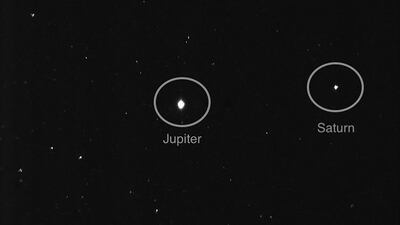

A rare celestial event will be visible to the naked eye in the UAE and around the world on Monday – the appearance of a Christmas Star.
The phenomenon is caused by the near alignment of planets Saturn and Jupiter and has not appeared in the night skies for nearly 800 years. The next such event will be in 2080.
Sky gazers in the UAE will have two hours on December 21 to spot the Christmas Star, said Dubai Astronomy Group. It will appear from sunset (5.40pm) until 7.49pm.
In the nativity story, the Christmas Star, also known as the Star of Bethlehem, led three wise men to the infant Jesus.
US space agency Nasa described the visibility of the planetary conjunction as "merely a coincidence" based on the planets' orbits and tilt of the Earth.
“Conjunctions like this could happen on any day of the year, depending on where the planets are in their orbits,” said Henry Throop, astronomer in the Planetary Science Division at Nasa headquarters in Washington.
“The date of the conjunction is determined by the positions of Jupiter, Saturn, and the Earth in their paths around the Sun, while the date of the solstice is determined by the tilt of Earth’s axis.
“The solstice is the longest night of the year, so this rare coincidence will give people a great chance to go outside and see the solar system.”
Saturn and Jupiter came this close 400 years ago, but it is the first time they will align in the night time.
The closest alignment will appear just a 10th of a degree apart and will last a few days.
“You can imagine the solar system to be a racetrack, with each of the planets as a runner in their own lane and the Earth towards the centre of the stadium,” Mr Throop said.
“From our vantage point, we’ll be able to be to see Jupiter on the inside lane, approaching Saturn all month and finally overtaking it on December 21.”
Dubai Astronomy Group will hold a paid event – Dh30 a person – for the observation of the celestial event using telescopes at Thuraya Astronomy Centre in Mushrif Park. The event starts after sunset.
It will be visible to the naked eye if observed away from light pollution.
But with the use of telescopes, Jupiter’s four large moons – Io, Europa, Ganymede and Callisto – may also be visible.
A live stream by the University of Exeter and Exeter Science Centre will be available online.
Geminids meteor shower in UAE - in pictures
-
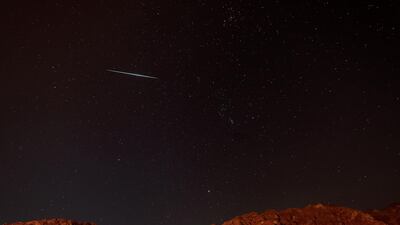
A Geminids meteor shower lit up UAE skies on December 13, 2020. Chris Whiteoak / The National -
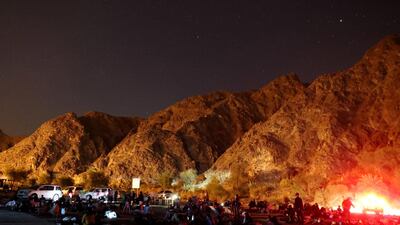
About 200 people turned up at Wadi Shawka in Ras Al Khaimah to watch the celestial event as part of a gathering organised by the Dubai Astronomy Group. Chris Whiteoak / The National -
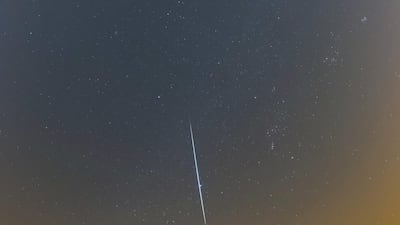
The Geminid meteor shower in Mleiha, Sharjah. Prabhu Astrophotography for The National -
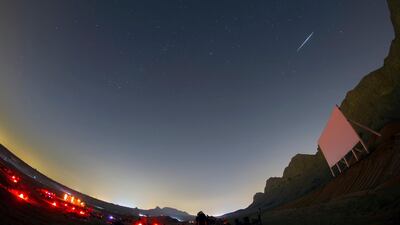
Another shot of the Geminid meteor shower from Mleiha, Sharjah. Prabhu Astrophotography for The National -
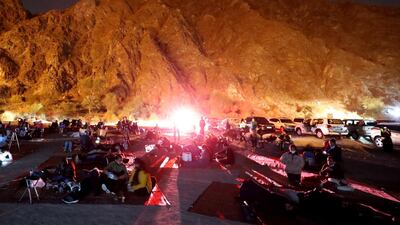
The showers were the most visible ones of the year in the UAE and were at their peak from 10pm to 2am. Chris Whiteoak / The National -
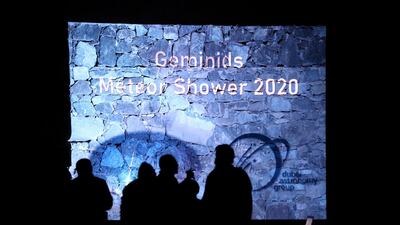
Clear skies and no Moon interference enhanced the experience. Chris Whiteoak / The National -
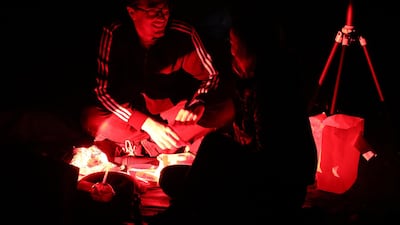
Those who watched away from light pollution were wowed by the large number of 'shooting stars'. Chris Whiteoak / The National -
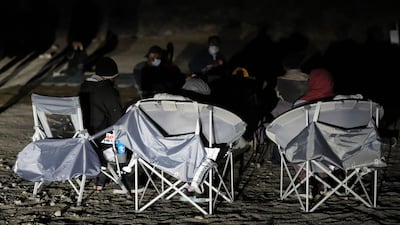
People of all ages attended the gathering. Chris Whiteoak / The National -

Members of the Dubai Astronomy Group gave presentations and educated guests on the celestial event. Chris Whiteoak / The National -
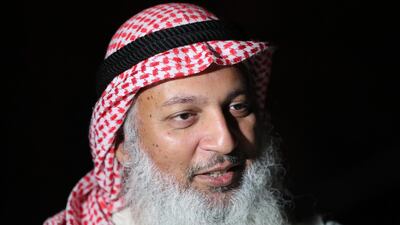
Hasan Al Hariri, chief executive of the Dubai Astronomy Group. Chris Whiteoak / The National -
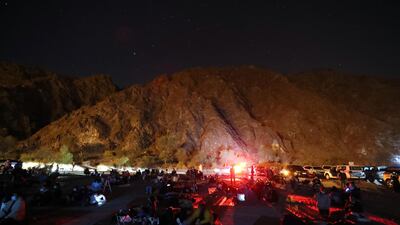
The showers were visible to the naked eye, but telescopes were available to see the 'shooting stars' up close and observe other planets. Chris Whiteoak / The National



