Pope Francis sits with the judges of the Zayed Award for Human Fraternity at the Vatican. Courtesy: Zayed Award for Human Fraternity
Pope Francis pictured with Adama Dieng, former UN special adviser on the prevention of genocide
The pontiff with Jusuf Kalla, who was vice president of Indonesia, the world's largest Muslim nation, in 2004–2009 and 2014–2019
The Judging Committee for the #ZayedAward for Human Fraternity was received by His Holiness the Pope, following its first launch for open submissions in its second edition. During the meeting, Pope Francis called on members to identify individuals who can continue their humanitarian efforts after winning the award, highlighting its purpose is to both celebrate the recipients’ achievements but also motivate them to continue to serve humanity.
Pope Francis welcomes Michaelle Jean, former governor-general of Canada, to the Vatican
Pope Francis pictured with Judge Mohamed Abdel Salam, secretary-general of the Higher Committee for Human Fraternity and a representative of the Grand Imam of Al-Azhar
Pope Francis met the judges of an award set up to recognise people and organisations who strive for human progress.
During a meeting in Rome, the pontiff thanked the judging committee of the Zayed Award for Human Fraternity, which was established after the Pope's historic visit to Abu Dhabi last year.
The honour was named after Sheikh Zayed, the Founding Father of the UAE, whose "values of humility, humanitarianism and respect epitomise the enduring ideals it seeks to celebrate".
Pope Francis and Ahmed El Tayeb, Grand Imam of Al Azhar, were the first recipients last year, after they signed the Document on Human Fraternity in the Emirati capital on February 4.
Pope Francis thanked the judges and called on them to identify people who can continue their humanitarian efforts after winning the award, which comes with $1 million in prize money.
I have shared bread with my brother, the Grand Imam Al Tayeb, and I want you to help humankind, with the committee, to share bread
“I have shared bread with my brother, the Grand Imam El Tayeb, and I want you to help humankind, with the committee, to share bread," he said at the meeting.
"I will pray for you and I hope you that you will pray for me."
This is the first year the Zayed Award is open for nominations, which can be made by senior members of government, former heads of state, supreme court judges, UN leaders, leading academic and cultural figures, heads of NGOs and the Higher Committee for Human Fraternity itself.
The judging committee comprises five members, as well as the secretary general of the higher committee, Judge Mohamed Abdel Salam, a highly regarded Egyptian lawyer and senior representative of the Grand Imam of Al Azhar.
The full panel is comprised:
Catherine Samba-Panza, former president of the Central African Republic
Muhammad Jusuf Kalla, former vice president of Indonesia
Michaelle Jean, former governor-general of Canada
Cardinal Dominique Mamberti, prefect of the Supreme Tribunal of the Apostolic Signatura, the Catholic Church's highest judicial authority
Adama Dieng, former UN special adviser on the prevention of genocide
Mohamed Abdel Salam, secretary general of the Higher Committee for Human Fraternity
"Our world is suffering and this award will help recognise people and institutions and bring everyone together to advance humanity and peace," he said.
“The award is an opportunity to recognise people around the world who are deeply committed to initiatives that bring people together and promote peaceful co-existence.
“The judging committee will consider people or entities any where in the world who are leading by example.”
The nomination process for the 2021 award opened on October 19 and will close on December 1. The recipient or recipients will be announced on February 4, 2021.
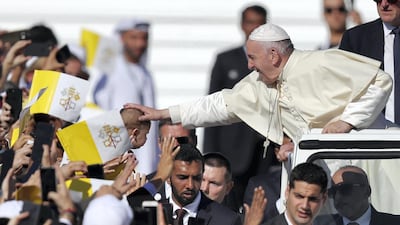
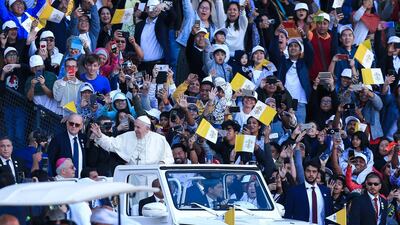
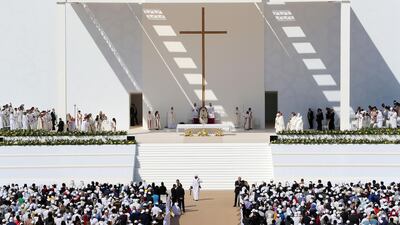
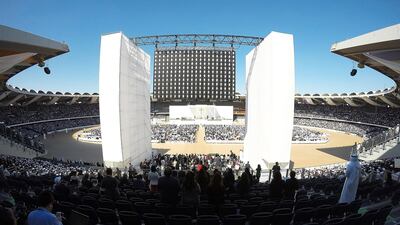
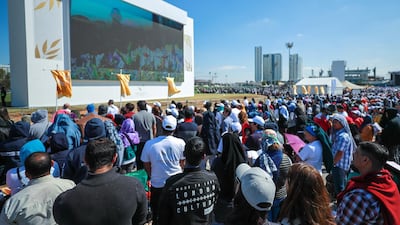
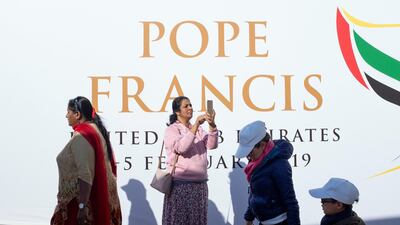
Pope Francis visit to Abu Dhabi, February 5, 2019 - in pictures
Pope Francis blesses a child. Chris Whiteoak / The National
Pope Francis arrives at the Zayed Sports City in Abu Dhabi for Mass in February 2019. Victor Besa / The National
Pope Francis greets the worshippers. Reem Mohammed / The National
Pope Francis celebrates Mass. Chris Whiteoak / The National
Pope Francis celebrates Mass. Pawan Singh / The National
Catholics attend Pope Francis's Mass. Reem Mohammed / The National
Worshippers strengthen their faith at the Mass of Pope Francis. Victor Besa / The National
People seen during Mass inside the stadium. Pawan Singh / The National
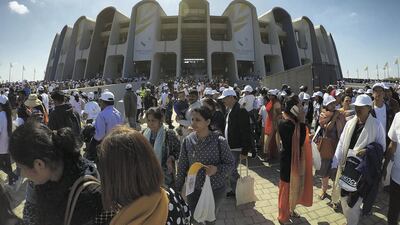
Catholics attend the first Mass carried out by a Pope on the Arabian Peninsula. Reem Mohammed / The National
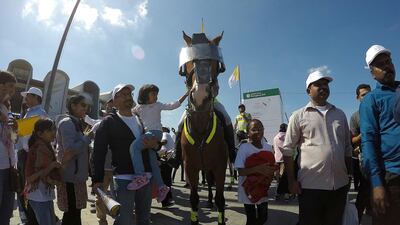
People taking their photos with a police horse after Mass. Pawan Singh / The National
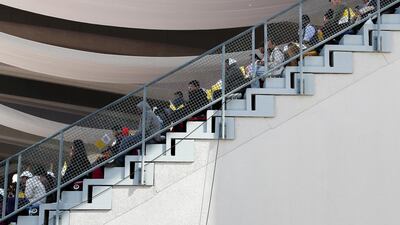
People come out of the stadium after Mass. Pawan Singh / The National
The crowd leaves after the end of Mass. Chris Whiteoak / The National
Araminta Robertson, of the Financially Mint blog, shares her financial advice for university leavers:
1. Build digital or technical skills: After graduation, people can find it extremely hard to find jobs. From programming to digital marketing, your early twenties are for building skills. Future employers will want people with tech skills.
2. Side hustle: At 16, I lived in a village and started teaching online, as well as doing work as a virtual assistant and marketer. There are six skills you can use online: translation; teaching; programming; digital marketing; design and writing. If you master two, you’ll always be able to make money.
3. Networking: Knowing how to make connections is extremely useful. Use LinkedIn to find people who have the job you want, connect and ask to meet for coffee. Ask how they did it and if they know anyone who can help you. I secured quite a few clients this way.
4. Pay yourself first: The minute you receive any income, put about 15 per cent aside into a savings account you won’t touch, to go towards your emergency fund or to start investing. I do 20 per cent. It helped me start saving immediately.
PROFILE OF HALAN
Started: November 2017
Founders: Mounir Nakhla, Ahmed Mohsen and Mohamed Aboulnaga
Based: Cairo, Egypt
Sector: transport and logistics
Size: 150 employees
Investment: approximately $8 million
Investors include: Singapore’s Battery Road Digital Holdings, Egypt’s Algebra Ventures, Uber co-founder and former CTO Oscar Salazar
Mercer, the investment consulting arm of US services company Marsh & McLennan, expects its wealth division to at least double its assets under management (AUM) in the Middle East as wealth in the region continues to grow despite economic headwinds, a company official said.
Mercer Wealth, which globally has $160 billion in AUM, plans to boost its AUM in the region to $2-$3bn in the next 2-3 years from the present $1bn, said Yasir AbuShaban, a Dubai-based principal with Mercer Wealth.
“Within the next two to three years, we are looking at reaching $2 to $3 billion as a conservative estimate and we do see an opportunity to do so,” said Mr AbuShaban.
Mercer does not directly make investments, but allocates clients’ money they have discretion to, to professional asset managers. They also provide advice to clients.
“We have buying power. We can negotiate on their (client’s) behalf with asset managers to provide them lower fees than they otherwise would have to get on their own,” he added.
Mercer Wealth’s clients include sovereign wealth funds, family offices, and insurance companies among others.
From its office in Dubai, Mercer also looks after Africa, India and Turkey, where they also see opportunity for growth.
Wealth creation in Middle East and Africa (MEA) grew 8.5 per cent to $8.1 trillion last year from $7.5tn in 2015, higher than last year’s global average of 6 per cent and the second-highest growth in a region after Asia-Pacific which grew 9.9 per cent, according to consultancy Boston Consulting Group (BCG). In the region, where wealth grew just 1.9 per cent in 2015 compared with 2014, a pickup in oil prices has helped in wealth generation.
BCG is forecasting MEA wealth will rise to $12tn by 2021, growing at an annual average of 8 per cent.
Drivers of wealth generation in the region will be split evenly between new wealth creation and growth of performance of existing assets, according to BCG.
Another general trend in the region is clients’ looking for a comprehensive approach to investing, according to Mr AbuShaban.
“Institutional investors or some of the families are seeing a slowdown in the available capital they have to invest and in that sense they are looking at optimizing the way they manage their portfolios and making sure they are not investing haphazardly and different parts of their investment are working together,” said Mr AbuShaban.
Some clients also have a higher appetite for risk, given the low interest-rate environment that does not provide enough yield for some institutional investors. These clients are keen to invest in illiquid assets, such as private equity and infrastructure.
“What we have seen is a desire for higher returns in what has been a low-return environment specifically in various fixed income or bonds,” he said.
“In this environment, we have seen a de facto increase in the risk that clients are taking in things like illiquid investments, private equity investments, infrastructure and private debt, those kind of investments were higher illiquidity results in incrementally higher returns.”
The Abu Dhabi Investment Authority, one of the largest sovereign wealth funds, said in its 2016 report that has gradually increased its exposure in direct private equity and private credit transactions, mainly in Asian markets and especially in China and India. The authority’s private equity department focused on structured equities owing to “their defensive characteristics.”