


On the day he was nominated as Prime Minister, Mustafa Al Kadhimi told the people of Iraq in a televised address that the country's sovereignty "is a red line".
Mr Al Kadhimi, who is viewed as a reformer, has vowed to restore the state's authority, undermined by widespread corruption and the rule of militias supported by Iran. "I said it and I will say it again: Iraqi sovereignty is not up for debate," he said.
Yet since the onset of demonstrations last October, the question of sovereignty has, indeed, taken centre stage in Iraq as a subject of national debate. The protesters demanded better living conditions, an end to corruption and for Iran to stay out of Iraqi affairs.
-
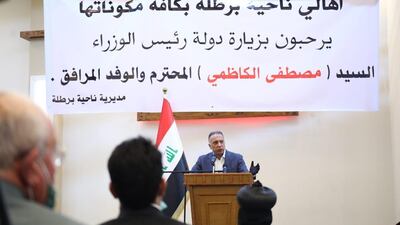
Iraqi Prime Minister Mustafa Al Kadhimi during his visit to the Nineveh province. -
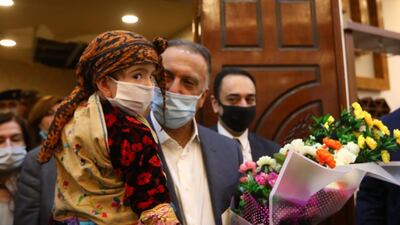
Prime Minister Mustafa Al Kadhimi during his visit to the Nineveh province. -
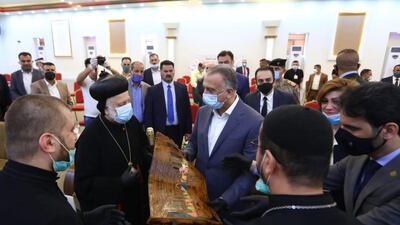
Prime Minister Mustafa Al Kadhimi during his visit to the Nineveh province. -
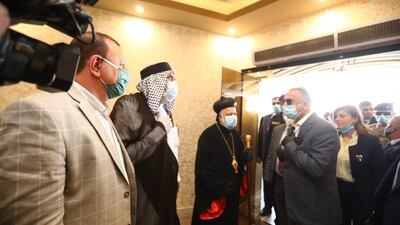
Prime Minister Mustafa Al Kadhimi during his visit to the Nineveh province. -
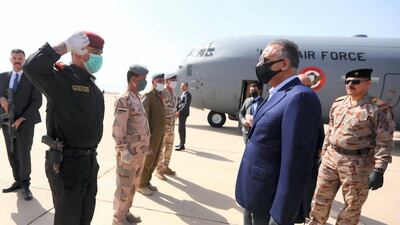
Prime MInister Mustafa Al Kadhimi arrives in Mosul. Iraqi PM Media Office HO -
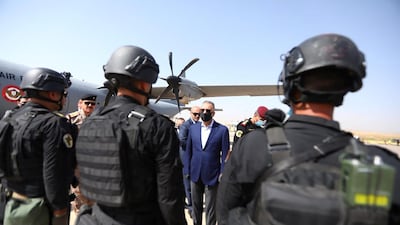
Prime Minister Mustafa Al Kadhimi in Mosul last month. The PM's Media Office -

Prime Minister Mustafa Al Kadhimi arrives in Mosul. Iraqi PM Media Office HO -
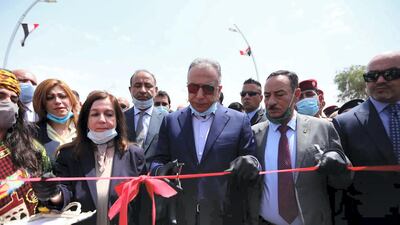
Prime Minister Mustafa Al Kadhimi officially opens the Al Hurriya or Freedom Bridge crossing the Tigris river to Mosul's old city. Iraqi PM Media Office HO -
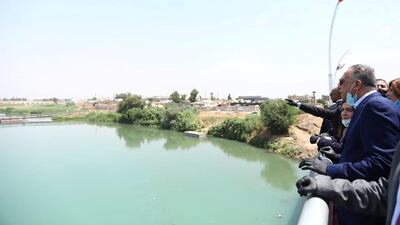
Prime Minister Mustafa Al Kadhimi officially opens the Al Hurriya or Freedom Bridge crossing the Tigris river to Mosul's old city. Iraqi PM Media Office HO -
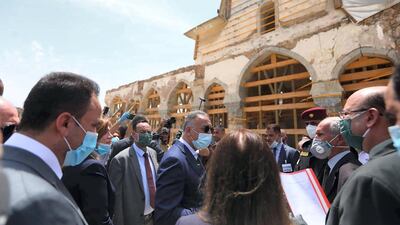
Prime Minister Mustafa Al Kadhimi tours Al Nuri Mosque, destroyed by ISIS and being rebuilt with assistance from the UAE. Iraqi PM Media Office HO -
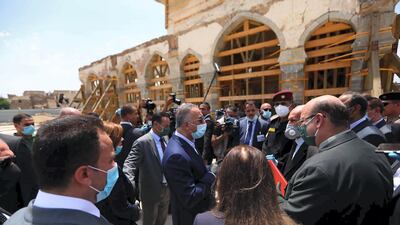
Prime Minister Mustafa Al Kadhimi tours Al Nuri Mosque, destroyed by ISIS and being rebuilt with assistance from the UAE. Iraqi PM Media Office HO -
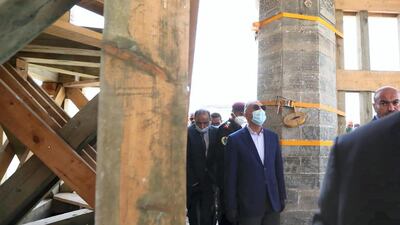
Prime Minister Mustafa Al Kadhimi tours Al Nuri Mosque, destroyed by ISIS and being rebuilt with assistance from the UAE. Iraqi PM Media Office HO -
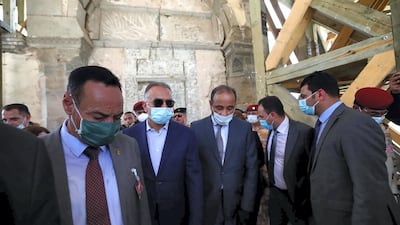
Prime Minister Mustafa Al Kadhimi tours Al Nuri Mosque, destroyed by ISIS and being rebuilt with assistance from the UAE. Iraqi PM Media Office HO -

Prime Minister Mustafa Al Kadhimi tours Mosul Museum during a visit to the city six years after ISIS captured it. Iraqi PM Media Office HO -
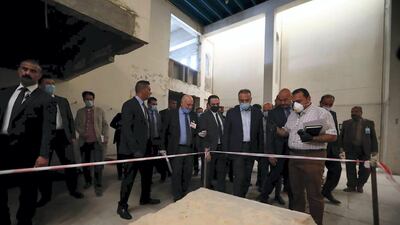
Prime Minister Mustafa Al Kadhimi tours Mosul six years after ISIS captured the city. Iraqi PM Media Office HO -

Prime Minister Mustafa Al Kadhimi tours Mosul Museum during a visit to the city six years after ISIS captured it. Iraqi PM Media Office HO -
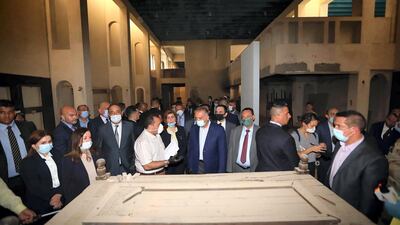
Prime Minister Mustafa Al Kadhimi tours Mosul Museum during a visit to the city six years after ISIS captured it. Iraqi PM Media Office HO -
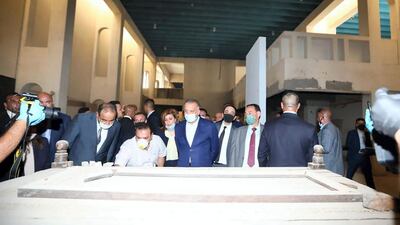
Prime Minister Mustafa Al Kadhimi tours Mosul Museum during a visit to the city six years after ISIS captured it. Iraqi PM Media Office HO -
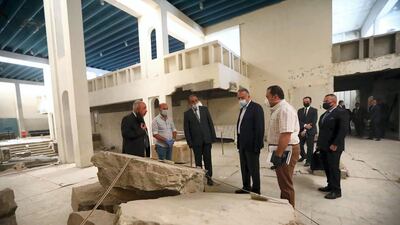
Prime Minister Mustafa Al Kadhimi tours Mosul Museum during a visit to the city six years after ISIS captured it. Iraqi PM Media Office HO -
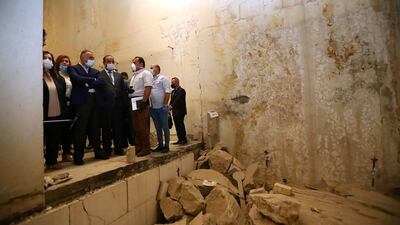
Prime Minister Mustafa Al Kadhimi tours Mosul Museum during a visit to the city six years after ISIS captured it. Iraqi PM Media Office HO -

Prime Minister Mustafa Al Kadhimi tours Mosul Museum during a visit to the city six years after ISIS captured it. Iraqi PM Media Office HO -
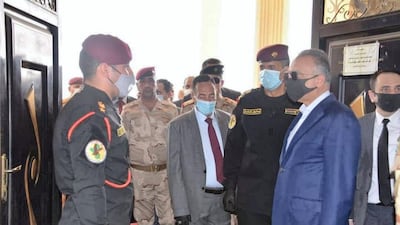
PM Mustafa Al Kadhimi and Lieutenant General Abdul Wahab Al Saadi, the head of the Iraqi Counter-Terrorism Service, meet with Najim Jubouri, Governor of Mosul. Iraqi PM Media Office HO -
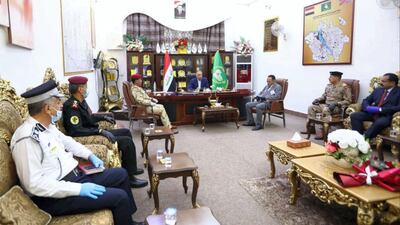
Prime Minister Mustafa Al Kadhimi meets military and security heads after arriving in Mosul six years after ISIS captured the city. Iraqi PM Media Office HO -

Prime Minister Mustafa Al Kadhimi meets military and security heads after arriving in Mosul six years after ISIS captured the city. Iraqi PM Media Office HO -
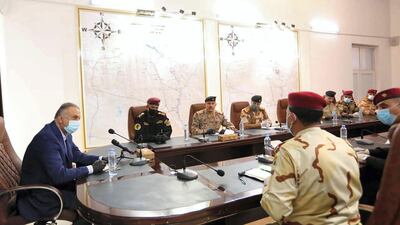
Prime Minister Mustafa Al Kadhimi meets military and security heads after arriving in Mosul six years after ISIS captured the city. Iraqi PM Media Office HO -
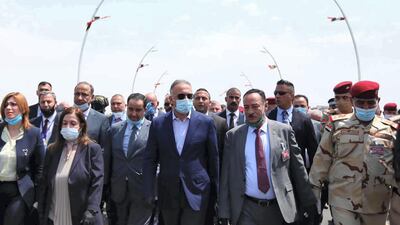
Prime Minister Mustafa Al Kadhimi walks beside Najm Al Jabouri, the city's governor and the general who led the battle against ISIS in 2017. Iraqi PM Media Office HO -
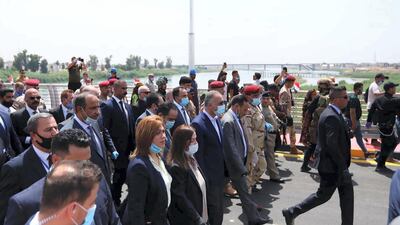
Prime Minister Mustafa Al Kadhimi officially opens the Al Hurriya or Freedom Bridge crossing the Tigris river to Mosul's old city. Iraqi PM Media Office HO -
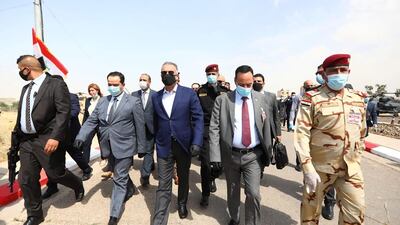
Prime Minister Mustafa Al Kadhimi officially opens the Al Hurriya or Freedom Bridge crossing the Tigris river to Mosul's old city. Iraqi PM Media Office HO -
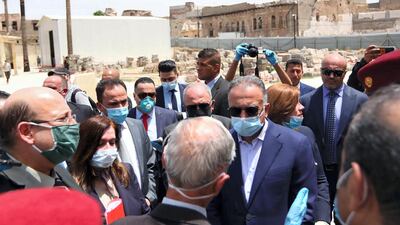
Prime Minister Mustafa Al Kadhimi officially opens the Al Hurriya or Freedom Bridge crossing the Tigris river to Mosul's old city. Iraqi PM Media Office HO


Their rallying cry was “we want a nation", a slogan that embodies the aspirations of an entire generation.
Mr Al Kadhimi has said nation building is his goal too. He has ordered investigations into the killings of more than 700 peaceful protesters, a crackdown widely believed to be the doing of the security apparatus and the militias. He has also reached out to Iraq's Arab neighbours, with his most trusted ally in the cabinet, Finance Minister Ali Allawi, visiting Saudi Arabia and Kuwait on his first official trip abroad.
But the premier has faced immense challenges. After having arrested members of Kataib Hezbollah, a powerful militia, security forces had to set them free. Two weeks later, Husham Al Hashimi, a critic of Iranian-backed militias and well-known analyst advocating for protecting Iraq's sovereignty was killed. Kataib Hezbollah had sent him death threats prior to his murder, Hashimi's friends said.
Mr Al Kadhimi faces a tough balancing act at home and on the international scene. To be taken seriously, he must prove he is capable of reining in Iran’s proxies and managing a neighbour that has shown disregard for Iraqi lives with its support of violent, non-state groups.
But Mr Al Kadhimi is playing a weak hand, and it is pivotal for him not to appear to be taking sides and drive home the message that he represents Iraq as a whole. This week he was scheduled to visit Tehran and Riyadh on his first official trips abroad. His Riyadh visit was due to come first but it has been rescheduled after King Salman fell ill.
One-thousand kilometers away from Baghdad, politicians in Beirut face a dilemma of a similar nature.
During the past few weeks, Maronite Patriarch Bechara Boutros Al Rahi, the spiritual leader of Lebanon’s largest Christian sect, has called for Lebanon to adopt a neutral stance in politics with the aim of staying out of regional conflicts and preserving its sovereignty.
His statements come at a time when Hezbollah has been calling for Lebanese to abandon hope of receiving help from Arab or western allies and "go eastwards". The group has presented Iran and China as potential providers of a miracle solution to Lebanon's crises.

Mr Al Rahi’s remarks sparked a debate over what it could mean for Lebanon to truly live up to the role envisaged by its founders, as a multi-religious state bridging the gap between the Arab and western worlds. The economic boom that followed helped Lebanon earn the moniker “Switzerland of the Middle East".
In the early days of Lebanese independence, the country's foreign policy was best described by the motto "not West nor East". At the time, this meant rejecting both unification with Syria and the French mandate. This policy, which allowed for Lebanon to become independent in 1943, has now become taboo. Supporters of Hezbollah have called the Patriarch a "traitor" and launched an online campaign targeting him on Twitter. One Shiite cleric even suggested that Christians "brought" Israel to Lebanon. What could have been a constructive debate has instead been used to stir sectarian sentiment and deflect from the responsibility of political leaders in Lebanon's spiralling economic crisis.
It is no coincidence that debates around sovereignty and neutrality are being had in these two countries, at around the same time. Iraq and Lebanon have yet to find a working model that fits the aspirations of their people.
-
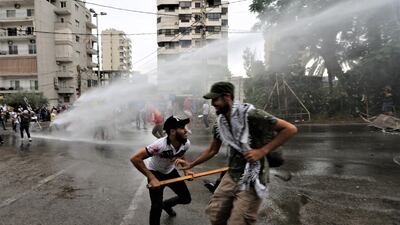
Protesters face water cannon from riot police during a demonstration organised by supporters of Hezbollah, Lebanese communist party, and other Lebanese national parties at the US embassy against US interference in Lebanon's affairs, in Awkar area north-east Beirut, Lebanon. EPA -
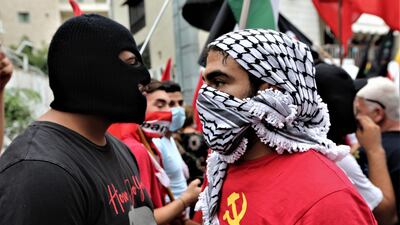
Protesters backed by Hezbollah, the Lebanese communist party and others during a demonstration against the United States' interference in Lebanon's affairs, near the US embassy in Awkar area, Beirut, Lebanon. EPA -
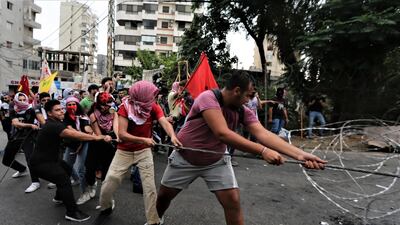
Protesters try to remove barbed wire during a demonstration by supporters of Hezbollah, Lebanese communist party, and other Lebanese national parties during a demonstration at the US embassy against US interference in Lebanon's affairs, in Awkar area north-east Beirut, Lebanon. EPA -
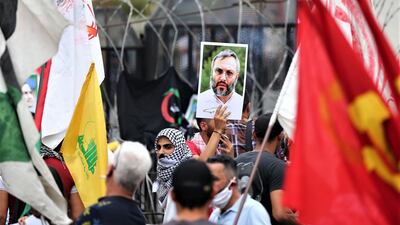
Protesters carry a picture of Hezbollah commander Imad Moughnyeh during a demonstration by supporters of Hezbollah, Lebanese communist party, and other Lebanese national parties at the US embassy against US interference in Lebanon's affairs, in Awkar area northeast Beirut, Lebanon. EPA -
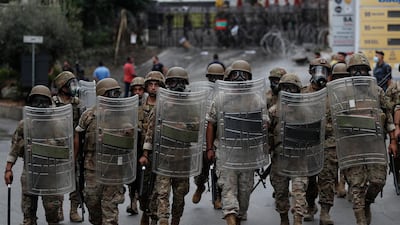
Lebanese army soldiers in riot gear arrive to the scene where supporters of Hezbollah and communist groups protest against US interference in Lebanon's affairs, near the American embassy, in Aukar north-east of Beirut, Lebanon. AP Photo -
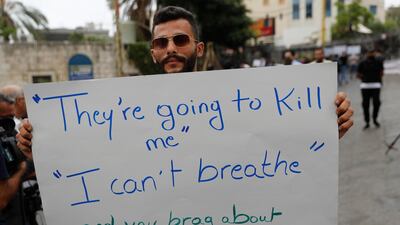
A Hezbollah supporter holds a placard during a protest against US interference in Lebanon's affairs, near the American embassy, in Aukar north-east of Beirut, Lebanon. AP Photo -
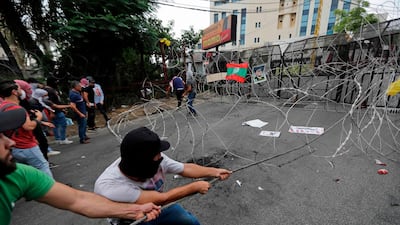
Protesters pull barbed-wire fence off a street during an anti-US demonstration near the American embassy in Awkar, north-east Beirut. AFP -
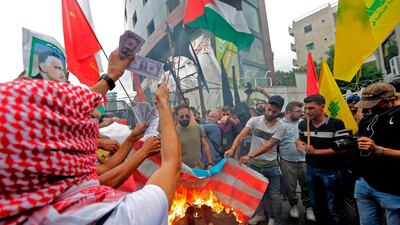
Protesters during an anti-US demonstration near the American embassy in Awkar, north-east of Lebanon's capital Beirut. AFP -
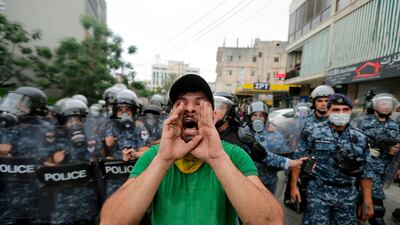
A protester chants slogans as he is flanked by Lebanese police during an anti-US demonstration outside the American embassy in Awkar, north-east of the capital Beirut. AFP -
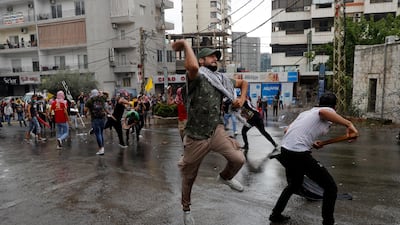
Hezbollah supporters and communist groups throw stones at riot police during a protest against US interference in Lebanon's affairs, near the American embassy in Aukar, north-east of Beirut, Lebanon. AP Photo


These similarities are rooted in history and demographics. Beirut and Baghdad have both undergone decades of war and witnessed anti-government protests nine months ago. The two nations are at the edge of the Levant, linking the Arab world to other cultures. Iraq is only one of two Arab countries with a majority Shiite population, but the country holds great religious and historical significance to all Muslims. Iraq is also the only Arab country that shares a land border with Iran.
Lebanon, meanwhile, has a population that is roughly divided into equal parts Shiite, Sunni and Christian. Its sizable Christian population and long-standing relations with France and the US have opened up the country to western culture, making it the Arab world's gateway to Europe and America. Beirut and Baghdad's positions could have given them a chance of linking different cultures and acting as mediators in regional conflicts. But it has too often been the opposite, with foreign-backed sectarian allegiances overtaking national interests.
In Iraq as in Lebanon, the October demonstrations were were anti-sectarian. Each sect rebelled against its own leaders in Lebanon, and Iraq's southern Shiite heartland stood up to Tehran and its proxies. But nine months on, the two nations have found themselves forced to pick sides once more.
During his visit to Iran, Mr Al Kadhimi met with President Hassan Rouhani and emphasised that relations between the two nations should be "based on the principle of non-interference in internal affairs". While Mr Rouhani welcomed closer economic co-operation with Iraq, on the same day, Supreme Leader Ayatollah Ali Khamenei vowed to take revenge for Qassem Suleimani's killing. The late leader of the Islamic Revolutionary Guard Corps' elite Al Quds Force, which co-ordinates proxies, was killed by a US drone attack in Baghdad. Tehran's double language is a thinly veiled warning to the new Prime Minister.
Despite its many setbacks, Baghdad still holds some leverage over Tehran. Mr Rouhani hopes to increase bilateral trade with Baghdad from $12 billion to $20bn per year. The regime is running out of options to remedy a growing economic crisis, compounded by increased US sanctions and the economic impact of the coronavirus pandemic. Mr Al Kadhimi has also received positive signals from Arab neighbours.

Switzerland, the world's oldest neutral country and one to which Lebanon, in its glory days, was often compared, has maintained its position only because its neighbours recognised its neutrality during the Congress of Vienna in 1815. Geneva was able to preserve neutrality, even throughout the Second World War, by strengthening the state while its cantons enjoyed wide autonomy. The Swiss maintained an army geared toward defence, and they continue to hold mandatory military service to this day.
Prior to neutrality, the Swiss economy was centred around providing mercenaries for other European nations at war, a model in some ways similar to that of Lebanese and Iraqi militia members, guided by Tehran to intervene in Syria and, for Hezbollah, in Yemen. In Lebanon as in Iraq, sovereignty rests on the ability of decision makers to impose the rule of law – and on Tehran’s willingness to respect the state’s authority.
Aya Iskandarani is a staff comment writer at The National

