


One sure-fire prediction for 2021 is that Covid-19 will be the biggest health story of the year.
What is worryingly far from clear is how much closer we will be to ending the pandemic a year from now.
But as vaccines start to come on line, the signs are that the answer will lie in decisions made not by scientists or politicians, but each one of us.
Here we look at what the year ahead could hold for us.
An epidemic of errors
Last December, when doctors in Wuhan, central China, first reported cases of a mysterious respiratory illness caused a new virus, the official response was denial – followed by reprimands for spreading false rumours.
Beyond China, the outbreak initially sparked little concern. Inoculated through years of reports of viruses flaring up and fading away again, Covid-19 was put into the same box as Sars, Mers and swine-flu: nasty pieces of work if you get them - which you almost certainly won’t.
That complacency vanished last January, as outbreaks emerged around the world and China put 60 million of its citizens under lockdown.
But as governments turned to the global research community for answers, complacency mutated into the belief that by “following the science” the virus would quickly be brought under control. As they put their countries under lockdown politicians – notably British Prime Minister Boris Johnson – talked of turning the tide against the virus within a few months.
But of all the insights about Covid-19 gleaned in 2020, the most critical has been that this virus metes out severe punishment to the complacent and careless.
This is what lies behind the stark reality that 2021 will begin with a pandemic that has already claimed over 1.7 million lives – and is still accelerating. How next year ends will depend on how well we avoid the complacency and carelessness of the past 12 months.
The need for speed
The emergence of a new, apparently far more infectious, variant of the original Covid-19 virus provides the first test of whether lessons have been learned. One of the most disastrous blunders was made in the very early days of the pandemic: a failure to recognise the need for speed.
Epidemics spread with exponential speed, with case-numbers increasing not like 1, 2, 3, 4 etc, but as 1, 2, 4, 8 – or even faster. Scientists capture this rate of spread by estimating how long it takes for the case numbers to double. Getting this figure wrong by even a few days leads can lead to disastrous delays in tackling the virus.
This does more than just give the virus more time to infect people, however. The mathematics of exponential growth shows the impact of the delay is permanently locked into the statistics. Experts have estimated that by getting the doubling time wrong by just two days, the resulting delay in the UK lockdown in March led to tens of thousands of unnecessary deaths.
Ever since, the UK government’s scientific advisors have been desperate to avoid making the same mistake. As soon as data on the spread of the new form of the Covid-19 virus became available, they began lobbying Mr Johnson to impose strict controls on most of South-East England over Christmas, regardless of the political or economic cost.
Testing times
While the swift reaction of the UK and other countries to the new variant is encouraging, the form of the response is less so. Within days of declaring the Covid-19 pandemic, the WHO said the key to extinguishing the virus was to "test, test, test".
Implementing that simple mantra remains anything but simple, however. Many countries still lack sufficient testing kits, even in the final days of 2020. But even when they are available, a trickier problem has emerged: how to interpret the outcome.
Experts stressed that all the tests have false-negative and false-positive rates – that is, a probability of wrongly giving the all-clear to those carrying the virus, or vice versa.
The so-called gold standard PCR test is regarded as having the lowest error rate, but it is expensive and slow. This led to greater use of faster, cheaper but less reliable tests.
-
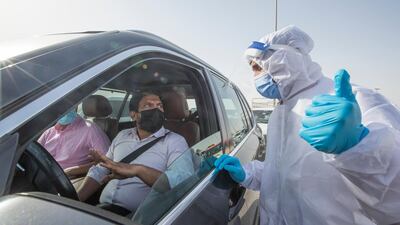
Medical staff speak to drivers before they take a prick of blood from their finger that can rapidly be scanned for signs of the virus. All photos by Leslie Pableo for The National -
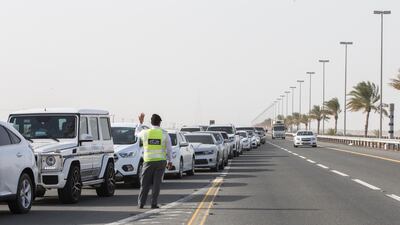
Police direct a long line of vehicles waiting for the rapid test at the Dubai-Abu Dhabi border -
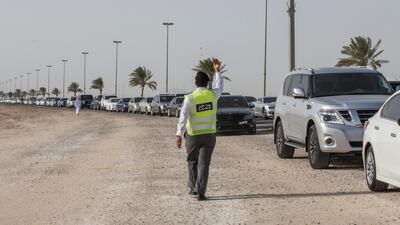
Many commuters are expected to use the quick Dh50 to enter Abu Dhabi instead of undergoing a PCR nasal swab test, which costs about Dh150 in a private clinic -
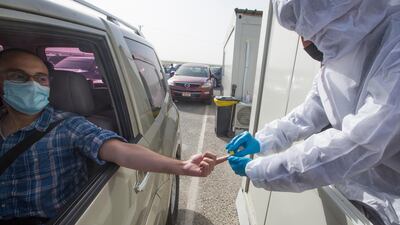
A medic takes a drop of blood from a commuter -
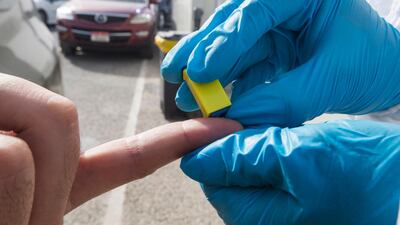
A medic takes a drop of blood from a commuter -
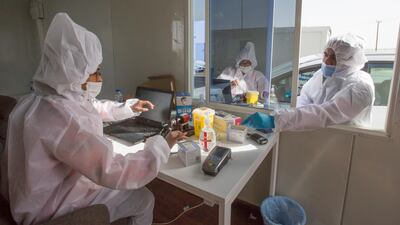
Medical staff use a laser scanning technique called DPI to look for signs that the body has generated antibodies to fight off a virus -
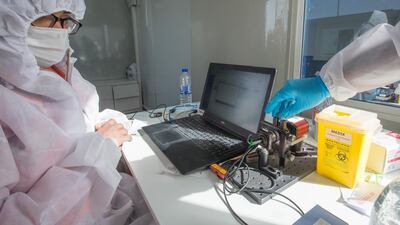
Medical staff use a laser scanning technique called DPI to look for signs that the body has generated antibodies to fight off a virus -

A medic takes a drop of blood from a commuter -
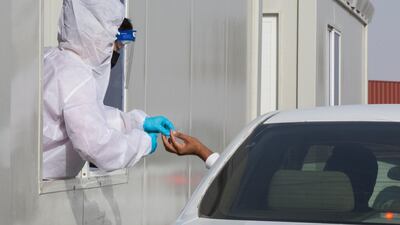
Eighteen stations can handle 36 vehicles at any one time. The process takes several minutes to show a result -

Although the DPI test does not specifically look for Covid-19, it quickly identifies whether someone may be ill -
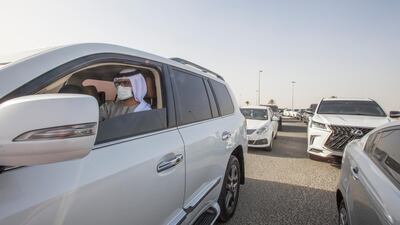
Drivers line up to be tested on Al Faya Road just off the E11 highway between Dubai and Abu Dhabi -
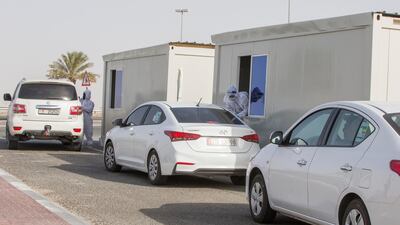
The company that runs the service for the government said it should save drivers time and money -
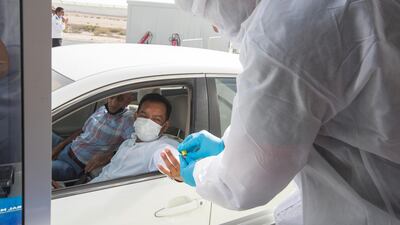
Drivers line up to be tested on Al Faya Road just off the E11 highway between Dubai and Abu Dhabi


One way to cut the risk of mis-diagnosis is to restrict testing to people who already have symptoms consistent with Covid-19: a persistence cough, fever and loss of a sense of smell – as these alone are quite strong evidence of infection.
But many people carrying the virus do not have symptoms. Understandable concern about identifying these “asymptomatic” carriers led some countries to use the fast, cheap tests across the board. Even now, the impact of this on the reliability of key data about the prevalence of the virus remains unclear.
The issue of testing flared again with the emergence of the new, more infectious form of Covid-19 virus. Some governments want to test for it using the "gold standard" PCR test. Yet this too is now under suspicion, its high sensitivity raising the risk of giving positive results with people who have long since recovered from Covid-19 and no longer pose a threat.
Many experts have stressed that the way forward lies in frequent testing plus effective contact tracing. The ability of governments to set up and maintain such testing systems will play a key role in their success against the virus over the coming year.
Lockdowns: too high a price to pay?
In the absence of wonder-cure or vaccines, lockdowns were the obvious – if drastic - first line of defence against Covid-19. And in some countries, notably China and South Korea, they appear to have worked.
Yet many other countries have found that lockdowns can prove worse than useless. While case numbers plunged once imposed, the end of lockdowns led to second waves with death rates dwarfing those of the initial outbreaks.
Scientists are already warning of impending third waves of infection. The surges reflect another vicious aspect of the pandemic: how it forces governments to make invidious choices.

Even before the second waves emerged researchers cautioned that the rapid decline in cases following lockdowns could sucker governments into lifting them too early as concern switches to saving the economy. The still-rampant virus then comes roaring back as it regains access to new victims.
Trapped between the rock of Covid-19 and the hard place of economic collapse, governments have tried avoiding nationwide lockdowns with strategies such as regional “tiers” with varying levels of restrictions. But their complexity, varying socio-demographic impact and variable success will likely see them eclipsed by the Great White Hope for defeating the virus: vaccines.
Here come the vaccines
Around the world, thousands of scientists have dropped long-standing projects to join huge research programmes to fight the virus. It quickly emerged that even such basic issues as how respiratory viruses are spread and the effectiveness of masks had never been properly studied. Bitter disputes broke out between experts wielding small, badly-executed and misinterpreted studies.
While simple but potentially valuable measures such as antiseptic gargling were dismissed out of hand, huge sums were spent investigating "cutting-edge" therapies which then failed to live up to their billing.
The WHO Solidarity trial, involving Covid-19 patients in 30 countries, found that none of the sophisticated anti-viral drugs tried against the virus had any clear impact. Ironically, the only drug found to bring major benefit is dexamethasone, an old, cheap drug for calming the immune system.
Fortunately for the scientific community, these embarrassments have been eclipsed by their triumph in developing a whole suite of vaccines that have proved effective in clinical trials against Covid-19.
The first few – including two based on entirely novel ideas – have already been approved, and are now being rolled out. Unlike the restricted access offered by most countries, the UAE is making proven vaccines from Sinopharm and Pfizer-BioNTech available to most adults in the Emirates, free of charge.
But there are concerns that vaccination cannot live up to the hopes pinned on it. While headlines trumpet the 90-plus per cent “effectiveness” of some vaccines in preventing Covid-19, how effective they are in stopping vaccinated people acting as inadvertent carriers remains unknown.
And even the perfect vaccine won’t stop the pandemic unless enough people are vaccinated fast enough.
Over the coming months, billions of doses will have to be made and shipped around the world. But the biggest challenge may be overcoming the reluctance of people to be vaccinated. Surveys suggest that in some countries barely 50 per cent of people may accept vaccination – far too low to halt the pandemic.
We enter the new year with many critical questions still unanswered. But it is clear that 2021 will be the year when responsibility for ending the pandemic shifts decisively into the hands of each one of us.
Robert Matthews is visiting professor of science at Aston University, Birmingham, UK

