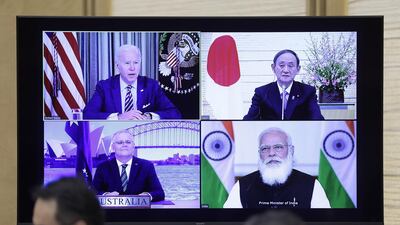
US President Joe Biden, Japanese Prime Minister Yoshihide Suga, Australian Prime Minister Scott Morrison and Indian Prime Minister Narendra Modi during their virtual meeting last week. Bloomberg
Should swiftly vaccinating as many people as possible be an endeavour that brings us all together, around the world? Or is it in reality yet another arena for political one-upmanship and great power contestation?
China's President Xi Jinping was quite clear when he addressed the World Health Assembly in May last year. The vaccines China developed, he announced, would be a "global public good". Shortly before, one of the country's top virologists, Major General Chen Wei, said their efforts would be a "contribution to humankind".
Plenty have reason to be grateful for the results so far. According to officials, by the end of February China had provided free vaccines to 69 countries and was selling doses to 28 more. Serbia – with a population of seven million – had received one and a half million Sinopharm vaccines by the middle of that month, with more promised. The UAE, which tested Sinopharm and found it 86 per cent effective, started rolling out free inoculations to the public in December.
Closer to home, last year Chinese companies committed to supplying Indonesia with 250 million doses through 2021. Beijing took a clear early lead in manufacturing and distribution, with the added plus that all its vaccines can be stored in refrigerators, unlike those produced by Pfizer, which must be kept at between -80°C to -60°C.
With some notable exceptions, such as the UK, western countries were by contrast slow off the mark in placing orders for vaccines, quarrelled about who should get what once vaccines were available, and were accused of hoarding a surplus of doses sufficient to inoculate every adult in the whole of Africa. Under former president Donald Trump, the US stood alone and prevented international access to American-produced doses.
Some countries had reservations about the Chinese vaccines, but as Yanzhong Huang of the US Council on Foreign Relations wrote in a recent essay, America’s abdication of pandemic orchestration meant that “Beijing filled a leadership void that Washington left open".
Now there appears to be a politicalpushback. Although the International Olympic Committee has accepted China's offer to supply all participants in this summer's Tokyo games with vaccines, the Olympic Minister, Tamayo Marukawa, has said that Japanese athletes would not accept them. A polite explanation for this could be that Japan has very low rates of confidence in vaccines in general – under 30 per cent believe they are safe and effective, one survey found.
Sinopharm vaccine efficacy rate was revised to 79 per cent, following trials in multiple countries. AP Photo
But Japan is also one of the four members of the "Quad" group, along with the US, India and Australia, which had its first ever heads of government meeting last week, at which they announced they would supply up to a billion vaccine doses across "the Indo-Pacific region" by the end of 2022.
These will be made in India and guided by a Quad Vaccine Experts Working Group that, as the countries' four leaders put it in an op-ed in The Washington Post, "brings together the sharpest scientific leaders from Australia, India, Japan and the United States to meet the region's pressing needs".
They listed potential partners in Asia and the Pacific, but there was no mention of co-operation with China; and given that the Quad's main purpose is to counter Beijing – without that ever being expressed quite so explicitly – the vaccine plan is naturally being seen as part of an effort to compete with and contain China. A benign take would be that the more doses produced, the better, but I do not think that making vaccination distribution a geopolitical contest is to be welcomed.
A prayer ceremony for the victims of the 2004 tsunami at Marina Beach in Chennai in 2019. The Quad has its roots in its four member countries coming together to respond to the disaster that killed over 200,000 people. Reuters
Quad was reborn in 2017 – but, as they don't say, it was reborn as something different
It didn’t have to be like this. The Quad, as its current leaders concede, has its roots in the four member countries coming together to respond to the 2004 tsunami that killed over 200,000 people and caused a humanitarian crisis in many Indian Ocean littoral states. After a long pause, it was “reborn in 2017” – but, as they don’t say, it was “reborn” as something quite different. It has since focused almost exclusively on security issues, and aims for a “free, open, resilient and inclusive… Indo-Pacific” in which “all countries are able to make their own political choices, free from coercion”.
“In recent years, that vision has increasingly been tested,” they say. The question “by whom?” needs no answer.
Many see the Quad being the core of an alliance of western-orientated democracies as problematic in itself. As a recent Carnegie Endowment for International Peace commentary points out: “If other countries in Asia view the Quad as little more than a talk shop to discuss the looming risks posed by China’s rise while occasionally holding joint military exercises, it is unlikely that other countries will see its utility or view it as a model for their own choices and conduct.”
Boxes of the AstraZeneca vaccine, manufactured by the Serum Institute of India and provided through the global Covax initiative, arrive in Mogadishu this week. AP Photo
But there is a wider point. The Quad’s current trajectory is a manifestation of a binary approach that is dialling up, not down, tensions in Asia. Another course was set out in an enlightened paper by the Quincy Institute for Responsible Statecraft this January, which called for “an inclusive, stable order in East Asia designed to manage shared, top-priority challenges such as climate change and pandemics”, in which “some initiatives should be jointly led by the United States and China… as a signal that the two sides are committed to working together to promote peace, stability and prosperity in Asia".
If working together to ensure all countries in the region receive full vaccine coverage isn’t a prime example of just such an initiative, I don’t know what is. This isn’t just a matter of how a fading superpower can rub along with a rising one, vital though that is. It is also that, to quote UN Secretary General Antonio Guterres: “At this critical moment, vaccine equity is the biggest moral test before the global community.”
So the Quad’s target of one billion vaccines is good news – but if, and only if, they are willing to work with everyone, including China, to make the region – and by extension the world – safe. As far as is possible, seeking geopolitical advantage should have no place in this time of pandemic.
Sholto Byrnes is an East Asian affairs columnist for The National

Avatar: Fire and Ash
Director: James Cameron
Starring: Sam Worthington, Sigourney Weaver, Zoe Saldana
126: The length in metres of the legs supporting the structure
1 football pitch: The length of each permanent spoke is longer than a professional soccer pitch
16 A380 Airbuses: The equivalent weight of the wheel rim.
9,000 tonnes: The amount of steel used to construct the project.
5 tonnes: The weight of each permanent spoke that is holding the wheel rim in place
192: The amount of cable wires used to create the wheel. They measure a distance of 2,4000km in total, the equivalent of the distance between Dubai and Cairo.
How to donate
Send “thenational” to the following numbers or call the hotline on: 0502955999
2289 – Dh10
2252 – Dh 50
6025 – Dh20
6027 – Dh 100
6026 – Dh 200
Mercer, the investment consulting arm of US services company Marsh & McLennan, expects its wealth division to at least double its assets under management (AUM) in the Middle East as wealth in the region continues to grow despite economic headwinds, a company official said.
Mercer Wealth, which globally has $160 billion in AUM, plans to boost its AUM in the region to $2-$3bn in the next 2-3 years from the present $1bn, said Yasir AbuShaban, a Dubai-based principal with Mercer Wealth.
“Within the next two to three years, we are looking at reaching $2 to $3 billion as a conservative estimate and we do see an opportunity to do so,” said Mr AbuShaban.
Mercer does not directly make investments, but allocates clients’ money they have discretion to, to professional asset managers. They also provide advice to clients.
“We have buying power. We can negotiate on their (client’s) behalf with asset managers to provide them lower fees than they otherwise would have to get on their own,” he added.
Mercer Wealth’s clients include sovereign wealth funds, family offices, and insurance companies among others.
From its office in Dubai, Mercer also looks after Africa, India and Turkey, where they also see opportunity for growth.
Wealth creation in Middle East and Africa (MEA) grew 8.5 per cent to $8.1 trillion last year from $7.5tn in 2015, higher than last year’s global average of 6 per cent and the second-highest growth in a region after Asia-Pacific which grew 9.9 per cent, according to consultancy Boston Consulting Group (BCG). In the region, where wealth grew just 1.9 per cent in 2015 compared with 2014, a pickup in oil prices has helped in wealth generation.
BCG is forecasting MEA wealth will rise to $12tn by 2021, growing at an annual average of 8 per cent.
Drivers of wealth generation in the region will be split evenly between new wealth creation and growth of performance of existing assets, according to BCG.
Another general trend in the region is clients’ looking for a comprehensive approach to investing, according to Mr AbuShaban.
“Institutional investors or some of the families are seeing a slowdown in the available capital they have to invest and in that sense they are looking at optimizing the way they manage their portfolios and making sure they are not investing haphazardly and different parts of their investment are working together,” said Mr AbuShaban.
Some clients also have a higher appetite for risk, given the low interest-rate environment that does not provide enough yield for some institutional investors. These clients are keen to invest in illiquid assets, such as private equity and infrastructure.
“What we have seen is a desire for higher returns in what has been a low-return environment specifically in various fixed income or bonds,” he said.
“In this environment, we have seen a de facto increase in the risk that clients are taking in things like illiquid investments, private equity investments, infrastructure and private debt, those kind of investments were higher illiquidity results in incrementally higher returns.”
The Abu Dhabi Investment Authority, one of the largest sovereign wealth funds, said in its 2016 report that has gradually increased its exposure in direct private equity and private credit transactions, mainly in Asian markets and especially in China and India. The authority’s private equity department focused on structured equities owing to “their defensive characteristics.”
Desert Warrior
Starring: Anthony Mackie, Aiysha Hart, Ben Kingsley
White hydrogen: Naturally occurring hydrogen Chromite: Hard, metallic mineral containing iron oxide and chromium oxide Ultramafic rocks: Dark-coloured rocks rich in magnesium or iron with very low silica content Ophiolite: A section of the earth’s crust, which is oceanic in nature that has since been uplifted and exposed on land Olivine: A commonly occurring magnesium iron silicate mineral that derives its name for its olive-green yellow-green colour
2016 - Lewis Hamilton (Mercedes-GP)
2015 - Lewis Hamilton (Mercedes-GP)
2014 - Lewis Hamilton (Mercedes-GP)
2013 - Nico Rosberg (Mercedes-GP)
2012 - Mark Webber (Red Bull Racing)
2011 - Fernando Alonso (Ferrari)
2010 - Mark Webber (Red Bull Racing)
2009 - Sebastian Vettel (Red Bull Racing)
2008 - Lewis Hamilton (McLaren)
2007 - Kimi Raikkonen (Ferrari)
Dr Afridi's warning signs of digital addiction
Spending an excessive amount of time on the phone.
Neglecting personal, social, or academic responsibilities.
Losing interest in other activities or hobbies that were once enjoyed.
Having withdrawal symptoms like feeling anxious, restless, or upset when the technology is not available.
Experiencing sleep disturbances or changes in sleep patterns.
What are the guidelines?
Under 18 months: Avoid screen time altogether, except for video chatting with family.
Aged 18-24 months: If screens are introduced, it should be high-quality content watched with a caregiver to help the child understand what they are seeing.
Aged 2-5 years: Limit to one-hour per day of high-quality programming, with co-viewing whenever possible.
Aged 6-12 years: Set consistent limits on screen time to ensure it does not interfere with sleep, physical activity, or social interactions.
Teenagers: Encourage a balanced approach – screens should not replace sleep, exercise, or face-to-face socialisation.
Source: American Paediatric Association
UAE currency: the story behind the money in your pockets
Technology expert in robotics and automation: Dh20,000 to Dh40,000
Energy engineer: Dh25,000 to Dh30,000
Production engineer: Dh30,000 to Dh40,000
Data-driven supply chain management professional: Dh30,000 to Dh50,000
HR leader: Dh40,000 to Dh60,000
Engineering leader: Dh30,000 to Dh55,000
Project manager: Dh55,000 to Dh65,000
Senior reservoir engineer: Dh40,000 to Dh55,000
Senior drilling engineer: Dh38,000 to Dh46,000
Senior process engineer: Dh28,000 to Dh38,000
Senior maintenance engineer: Dh22,000 to Dh34,000
Field engineer: Dh6,500 to Dh7,500
Field supervisor: Dh9,000 to Dh12,000
Field operator: Dh5,000 to Dh7,000
What went into the film
25 visual effects (VFX) studios
2,150 VFX shots in a film with 2,500 shots
1,000 VFX artists
3,000 technicians
10 Concept artists, 25 3D designers
New sound technology, named 4D SRL
Results
2.15pm: Handicap Dh80,000 1,950m
Winner: Hello, Tadhg O’Shea (jockey), Ali Rashid Al Raihi (trainer).
2.45pm: Handicap Dh90,000 1,800m
Winner: Right Flank, Pat Dobbs, Doug Watson.
3.15pm: Handicap Dh115,000 1,000m
Winner: Leading Spirit, Richard Mullen, Satish Seemar.
3.45pm: Jebel Ali Mile Group 3 Dh575,000 1,600m
Winner: Chiefdom, Royston Ffrench, Salem bin Ghadayer.
4.15pm: Handicap Dh105,000 1,400m
Winner: Ode To Autumn, Patrick Cosgrave, Satish Seemar.
4.45pm: Shadwell Farm Conditions Dh125,000 1,200m
Winner: Last Surprise, James Doyle, Simon Crisford.
5.15pm: Handicap Dh85,000 1,200m
Winner: Daltrey, Sandro Paiva, Ali Rashid Al Raihi.
Mia Man’s tips for fermentation
- Start with a simple recipe such as yogurt or sauerkraut
- Keep your hands and kitchen tools clean. Sanitize knives, cutting boards, tongs and storage jars with boiling water before you start.
- Mold is bad: the colour pink is a sign of mold. If yogurt turns pink as it ferments, you need to discard it and start again. For kraut, if you remove the top leaves and see any sign of mold, you should discard the batch.
- Always use clean, closed, airtight lids and containers such as mason jars when fermenting yogurt and kraut. Keep the lid closed to prevent insects and contaminants from getting in.
GOLF’S RAHMBO
- 5 wins in 22 months as pro
- Three wins in past 10 starts
- 45 pro starts worldwide: 5 wins, 17 top 5s
- Ranked 551th in world on debut, now No 4 (was No 2 earlier this year)
- 5th player in last 30 years to win 3 European Tour and 2 PGA Tour titles before age 24 (Woods, Garcia, McIlroy, Spieth)
Starring: Nader Abd Alhay, Majd Eid, Ramzi Maqdisi
Directors: Tarzan and Arab Nasser
Rating: 4.5/5
French business
France has organised a delegation of leading businesses to travel to Syria. The group was led by French shipping giant CMA CGM, which struck a 30-year contract in May with the Syrian government to develop and run Latakia port. Also present were water and waste management company Suez, defence multinational Thales, and Ellipse Group, which is currently looking into rehabilitating Syrian hospitals.
Game Changer
Director: Shankar
Stars: Ram Charan, Kiara Advani, Anjali, S J Suryah, Jayaram
Rating: 2/5
Fight card
Preliminaries:
Nouredine Samir (UAE) v Sheroz Kholmirzav (UZB); Lucas Porst (SWE) v Ellis Barboza (GBR); Mouhmad Amine Alharar (MAR) v Mohammed Mardi (UAE); Ibrahim Bilal (UAE) v Spyro Besiri (GRE); Aslamjan Ortikov (UZB) v Joshua Ridgwell (GBR)
Main card:
Carlos Prates (BRA) v Dmitry Valent (BLR); Bobirjon Tagiev (UZB) v Valentin Thibaut (FRA); Arthur Meyer (FRA) v Hicham Moujtahid (BEL); Ines Es Salehy (BEL) v Myriame Djedidi (FRA); Craig Coakley (IRE) v Deniz Demirkapu (TUR); Artem Avanesov (ARM) v Badreddine Attif (MAR); Abdulvosid Buranov (RUS) v Akram Hamidi (FRA)
Title card:
Intercontinental Lightweight: Ilyass Habibali (UAE) v Angel Marquez (ESP)
Intercontinental Middleweight: Amine El Moatassime (UAE) v Francesco Iadanza (ITA)
Asian Featherweight: Zakaria El Jamari (UAE) v Phillip Delarmino (PHI)
A recent survey of 10,000 Filipino expatriates in the UAE found that 82 per cent have plans to invest, primarily in property. This is significantly higher than the 2014 poll showing only two out of 10 Filipinos planned to invest.
Fifty-five percent said they plan to invest in property, according to the poll conducted by the New Perspective Media Group, organiser of the Philippine Property and Investment Exhibition. Acquiring a franchised business or starting up a small business was preferred by 25 per cent and 15 per cent said they will invest in mutual funds. The rest said they are keen to invest in insurance (3 per cent) and gold (2 per cent).
Of the 5,500 respondents who preferred property as their primary investment, 54 per cent said they plan to make the purchase within the next year. Manila was the top location, preferred by 53 per cent.
Fraudsters send an unsolicited email that appears to be from a financial institution or online retailer. The hoax email requests that you provide sensitive information, often by clicking on to a link leading to a fake website.
2) Smishing
The SMS equivalent of phishing. Fraudsters falsify the telephone number through “text spoofing,” so that it appears to be a genuine text from the bank.
3) Vishing
The telephone equivalent of phishing and smishing. Fraudsters may pose as bank staff, police or government officials. They may persuade the consumer to transfer money or divulge personal information.
4) SIM swap
Fraudsters duplicate the SIM of your mobile number without your knowledge or authorisation, allowing them to conduct financial transactions with your bank.
5) Identity theft
Someone illegally obtains your confidential information, through various ways, such as theft of your wallet, bank and utility bill statements, computer intrusion and social networks.
6) Prize scams
Fraudsters claiming to be authorised representatives from well-known organisations (such as Etisalat, du, Dubai Shopping Festival, Expo2020, Lulu Hypermarket etc) contact victims to tell them they have won a cash prize and request them to share confidential banking details to transfer the prize money.
