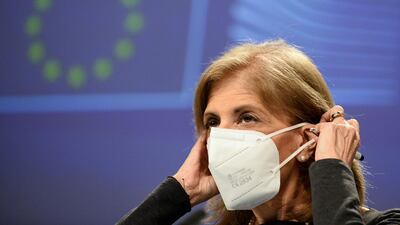
Stella Kyriakides, the European Commissioner in charge of Health, during an online news conference at the EU headquarters in Brussels on Friday. The EU and AstraZeneca agreed on Friday to make public a heavily redacted version of their Covid-19 vaccine agreement, which lies at the heart of a dispute over how many shots the pharmaceutical company should be supplying the EU's 27 nations. AP Photo
Stella Kyriakides, the European Commissioner in charge of Health, during an online news conference at the EU headquarters in Brussels on Friday. The EU and AstraZeneca agreed on Friday to make public
Echoes from the Napoleonic Wars can be heard in EU's vaccine export row
For all the ideals that underpin a peace project like the European Union, the traits of the continent's violent past are closer to the surface than we think
For months, the principle of universal access to coronavirus vaccines has been a globally shared goal. Yet on Friday, the European Union adopted powers to ban the export of vaccines from member states.
The decision immediately triggered fears that the global supply chains for vaccine production could suffer a "black swan" disruption from what was portrayed as a limited regulatory move. Not just finished product but inputs and sensitive equipment were also blockaded.
Since the launch of vaccines to fight Covid-19, the pressures for access have been too great for the European leadership to handle. Temptation to adopt the me-first approach and junk universality became all too real.
At a viral vaccine summit last year, all the European leaders pledged themselves to the highest standards. Commitments were made to global bodies with initiatives such as Gavi and Covax. UN Secretary General Antonio Guterres's catch-cry – "with this pandemic, none of us are safe until all of us are safe” – was applauded.
Mr Guterres' native continent has descended into a frenzy of feigns and panics reminiscent of behaviour under a very different world order. In fact, Europe is now jockeying in a kind of reversion to an ugly mean. The saga resembles feverish phases and swirling loyalties that powered the Napoleonic Wars, a series of major conflicts pitting the French Empire against European powers formed into various coalitions.
Last year, the vaccines were in research when the EU bound all its members into a pact to procure them for the whole bloc. As months elapsed, officials in Brussels were in charge of negotiating purchases for Germany as well as Portugal and Luxembourg. It now seems strange to recall that the UK government came under fire for opting out of the scheme and deciding to go it alone.
Two main problems emerged with the European approach. It decided to use a supermarket chain-purchasing strategy. It held out for lower costs and assumed that its bargaining power would get it preferential delivery terms. It allocated just €2.7 million ($3.2m) for the first-order schedule. It also decided to reserve relatively few doses from German manufacturers BioNTech and spilt capacity for a French-made vaccine.
The rollout of the first vaccines almost immediately exposed the fragility of the rule.
An unseemly contractual dispute with AstraZeneca quickly turned into a political row. The EU's treatment of the Swedish-British pharmaceutical giant allowed the UK to leap far ahead of Europe in mass vaccination. Almost eight million, more than 14 per cent of the population, have received at least the first dose. While Europe has now approved the AstraZeneca/Oxford treatment, it is infuriated by delays in the delivery schedule. AstraZeneca, a thoroughly European corporation, has been accused of working for the other side.
The 1812 Battle of Borodino. The battle was a part of the Napoleonic Wars, a series of major conflicts pitting the French Empire against European powers formed into various coalitions. Getty Images
In an editorial, Der Spiegel magazine declared that vaccines are "the most important" global resource. The more scarce they are, the harder the struggle is because the value lies far ahead of data, gold or weapons, it said. That has led to the torrid developments of last week during which the EU forfeited plenty of international political capital by taking powers to ban the export of the vaccine.
It even briefly invoked a last-resort clause in the just-minted Brexit deal to suspend the Northern Ireland protocol blowing up a row with London over just who controls trade between Britain and Ireland. It subsequently reversed its decision.
Just beyond these disputes, the pharmaceutical companies are acting like large standing militias in the Napoleonic era. The French firm, Sanofi, which has not yet brought its vaccine to development phase, has agreed to manufacture the one by Pfizer/BioNTech to ensure more doses come online. The Switzerland-based drug maker, Novartis, has also signed up to make the Pfizer/BioNTech vaccine. The country has been exempted from the EU ban on exports. Meanwhile, another French vaccine firm – Valneva – has thrown its lot in with perfidious Albion and opened a manufacturing plant in Scotland.
In the heat of the battle, all sides share the same goal and want it for themselves.
The Iron Rolling Mill painting is found in the collection of the Staatliche Museen, Berlin – one of the many images depicting the Industrial Revolution. Getty Images
In the heat of the battle, all sides share the same goal and want it for themselves
As the historian Christopher Herold noted, the war against Napoleon was won by Russia, Austria and Prussia. However, to the final victor went the spoils: “England won the last battle and she won the peace.” The Napoleonic conflict was a nearly two-decade power struggle that ebbed and flowed across Europe. It is no exaggeration to say that its battlelines set the frontiers for the Industrial Revolution and thus shaped the modern world.
To view that chapter in Europe's history in terms of the rise and defeat of Napoleon is not really instructive to what the consequences were. There were at least seven major coalitions formed to fight the battles. And Europeans are understandably sensitive about the continent’s reputation for staging internecine wars. The names of the conflicts tell their own stories: Hundred Years' War, Thirty Years' War, Napoleon Wars, First World War and Second World War.
The desire to create a peace project unrivalled in human history after the Second World War was genuine and an unalloyed achievement for all the generations since. But for all the ideals that underpin the European Union, the traits of history are closer to the surface than we think.
Damien McElroy is the London bureau chief at The National

The Pope's itinerary
Sunday, February 3, 2019 - Rome to Abu Dhabi
1pm: departure by plane from Rome / Fiumicino to Abu Dhabi
10pm: arrival at Abu Dhabi Presidential Airport
Monday, February 4
12pm: welcome ceremony at the main entrance of the Presidential Palace
12.20pm: visit Abu Dhabi Crown Prince at Presidential Palace
5pm: private meeting with Muslim Council of Elders at Sheikh Zayed Grand Mosque
6.10pm: Inter-religious in the Founder's Memorial
Tuesday, February 5 - Abu Dhabi to Rome
9.15am: private visit to undisclosed cathedral
10.30am: public mass at Zayed Sports City – with a homily by Pope Francis
12.40pm: farewell at Abu Dhabi Presidential Airport
1pm: departure by plane to Rome
5pm: arrival at the Rome / Ciampino International Airport
Where to stay: Courtyard by Marriott Titusville Kennedy Space Centre has unparalleled views of the Indian River. Alligators can be spotted from hotel room balconies, as can several rocket launch sites. The hotel also boasts cool space-themed decor.
When to go: Florida is best experienced during the winter months, from November to May, before the humidity kicks in.
How to get there: Emirates currently flies from Dubai to Orlando five times a week.
Who's who in Yemen conflict
Houthis: Iran-backed rebels who occupy Sanaa and run unrecognised government
Yemeni government: Exiled government in Aden led by eight-member Presidential Leadership Council
Southern Transitional Council: Faction in Yemeni government that seeks autonomy for the south
Habrish 'rebels': Tribal-backed forces feuding with STC over control of oil in government territory
France has organised a delegation of leading businesses to travel to Syria. The group was led by French shipping giant CMA CGM, which struck a 30-year contract in May with the Syrian government to develop and run Latakia port. Also present were water and waste management company Suez, defence multinational Thales, and Ellipse Group, which is currently looking into rehabilitating Syrian hospitals.
UAE currency: the story behind the money in your pockets
Focus on gratitude: And do so deeply, he says. “Think of one to three things a day that you’re grateful for. It needs to be specific, too, don’t just say ‘air.’ Really think about it. If you’re grateful for, say, what your parents have done for you, that will motivate you to do more for the world.”
Know how to fight: Shetty married his wife, Radhi, three years ago (he met her in a meditation class before he went off and became a monk). He says they’ve had to learn to respect each other’s “fighting styles” – he’s a talk it-out-immediately person, while she needs space to think. “When you’re having an argument, remember, it’s not you against each other. It’s both of you against the problem. When you win, they lose. If you’re on a team you have to win together.”
The company offers payments/bribes to win key contracts in the Middle East
May 2017
The UK SFO officially opens investigation into Petrofac’s use of agents, corruption, and potential bribery to secure contracts
September 2021
Petrofac pleads guilty to seven counts of failing to prevent bribery under the UK Bribery Act
October 2021
Court fines Petrofac £77 million for bribery. Former executive receives a two-year suspended sentence
December 2024
Petrofac enters into comprehensive restructuring to strengthen the financial position of the group
May 2025
The High Court of England and Wales approves the company’s restructuring plan
July 2025
The Court of Appeal issues a judgment challenging parts of the restructuring plan
August 2025
Petrofac issues a business update to execute the restructuring and confirms it will appeal the Court of Appeal decision
October 2025
Petrofac loses a major TenneT offshore wind contract worth €13 billion. Holding company files for administration in the UK. Petrofac delisted from the London Stock Exchange
Co-founders of the company: Vilhelm Hedberg and Ravi Bhusari
Launch year: In 2016 ekar launched and signed an agreement with Etihad Airways in Abu Dhabi. In January 2017 ekar launched in Dubai in a partnership with the RTA.
Number of employees: Over 50
Financing stage: Series B currently being finalised
Investors: Series A - Audacia Capital
Sector of operation: Transport
ICC Awards for 2021
MEN
Cricketer of the Year – Shaheen Afridi (Pakistan)
T20 Cricketer of the Year – Mohammad Rizwan (Pakistan)
ODI Cricketer of the Year – Babar Azam (Pakistan)
Test Cricketer of the Year – Joe Root (England)
WOMEN
Cricketer of the Year – Smriti Mandhana (India)
ODI Cricketer of the Year – Lizelle Lee (South Africa)
T20 Cricketer of the Year – Tammy Beaumont (England)
