• Mounted police patrol Bondi Beach in Sydney. More than five million people in the Australian city and surrounding areas entered a 14-day lockdown on Saturday, June 26. EPA
    Mounted police patrol Bondi Beach in Sydney. More than five million people in the Australian city and surrounding areas entered a 14-day lockdown on Saturday, June 26. EPA
  • Dog owners speak along a deserted street in Ankara. Dog walking is permitted during lockdowns in Turkey. AP
    Dog owners speak along a deserted street in Ankara. Dog walking is permitted during lockdowns in Turkey. AP
  • Officials check the vaccination certificates of people entering The Avenues Mall, the largest shopping centre in Kuwait. AFP
    Officials check the vaccination certificates of people entering The Avenues Mall, the largest shopping centre in Kuwait. AFP
  • Artists perform Shakespeare's 'The Tempest' at Thorington Theatre in the Woods, near Southwold, Britain, after coronavirus restrictions were relaxed. Reuters
    Artists perform Shakespeare's 'The Tempest' at Thorington Theatre in the Woods, near Southwold, Britain, after coronavirus restrictions were relaxed. Reuters
  • A woman receives the Sinovac shot as Thailand's resort island of Phuket vaccinates its population, before the July 1 deadline to end strict quarantine for overseas visitors. Reuters
    A woman receives the Sinovac shot as Thailand's resort island of Phuket vaccinates its population, before the July 1 deadline to end strict quarantine for overseas visitors. Reuters
  • Vera Kuznetsova receives a vaccine dose at home in the village of Loznoye in Volgograd, Russia. Reuters
    Vera Kuznetsova receives a vaccine dose at home in the village of Loznoye in Volgograd, Russia. Reuters
  • Demonstrators calling for nightclubs to reopen gather during the Save Our Scene protest in London. Reuters
    Demonstrators calling for nightclubs to reopen gather during the Save Our Scene protest in London. Reuters

Delta Plus: what is it and how does it differ from the Delta coronavirus variant?


Georgia Tolley
  • English
  • Arabic

Read also: Highly contagious Delta variant accounts for one in three UAE cases

Health officials announced on Sunday that one in three Covid-19 infections in the UAE stemmed from the highly contagious Delta variant.

Delta is the name given to the variant first detected last October in India.

It prompted a devastating surge in case numbers in the country and is also responsible for more than 90 per cent of new infections in the UK, according to Public Health England.

A potentially more transmissible mutation of Delta was recently discovered in India, identified as Delta Plus.

The World Health Organisation says the mutation could prove to be more deadly as time goes on.

But what is the new strain and how does it differ from Delta, already described a variant of concern by the WHO.

What is the Delta variant?

The WHO has given names to coronavirus variations in an effort to remove any stigma associated with the countries where they were first detected.

Greek letters have been assigned to the strains in the order they were designated variants of concern, starting at Alpha for the strain first detected in the UK last year.

The Delta variant was first recorded in India and is 60 per cent more infectious than the Alpha strain, according to the British authorities.

Doctors have said it affects patients differently to the original coronavirus.

Common symptoms include fever, headaches and a runny nose. At first, it appears more like a head cold, with a sore throat and sneezing.

Delta does not seem to affect patients' sense of smell.

If you have any symptoms, the authorities recommend regular testing for Covid-19, to prevent the disease spreading among the community.

Roy Cooper / The National

What is the Delta Plus variant?

Delta Plus is a mutated version of Delta, which is also known as B.1.617.2.

It has been named 'Plus' locally, but its official name is Delta-AY.1.

The Delta strain is characterised by the K417N mutation in the spike protein of the Sars-CoV-2 virus that causes the Covid-19 disease.

This mutation is also present in the Beta variant, first found in South Africa.

There are concerns the variant could be 50 per cent more transmissible than other strains, but epidemiologists have said more sequencing needs to be done.

“There is speculation regarding higher transmissibility and infectivity of the Delta Plus variant, but there is no definitive data to support this,” said Binay Panda, a professor of biotechnology at Jawaharlal Nehru University in New Delhi.

Delta mutation 'becoming more deadly'

Dr Soumya Swaminathan, the WHO's chief scientist, admitted there were concerns about the new strain.

"The reason it's been called Plus is because it has another mutation, which is also seen in the Beta and Gamma variants, which could potentially also impact the antibody killing off the virus," she said.

"So there's a bit of concern that this strain may be becoming even more deadly, because it's now going to become resistant to drugs and vaccines.

"The good thing is that there are still very few cases that have been described globally, so we can track what is happening.

"We need more studies to see whether this Delta variant with this additional mutation has any other properties. We are tracking that and are collecting that information."

Where is Delta Plus spreading?

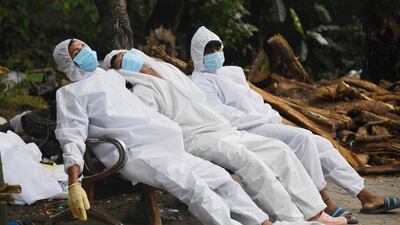
  • Exhausted ambulance crew members on Covid-19 duties collapse on a bench at a crematorium grounds in Guwahati, north-east India. AFP
    Exhausted ambulance crew members on Covid-19 duties collapse on a bench at a crematorium grounds in Guwahati, north-east India. AFP
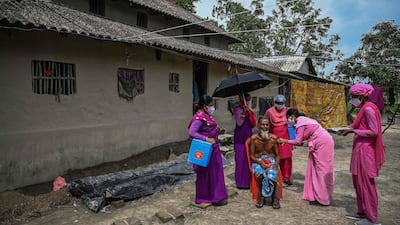
  • Health workers inoculate an elderly man against Covid-19 coronavirus in his village, in the Sundarbans area, 100 kilometres south of Kolkata, in eastern India. AFP
    Health workers inoculate an elderly man against Covid-19 coronavirus in his village, in the Sundarbans area, 100 kilometres south of Kolkata, in eastern India. AFP
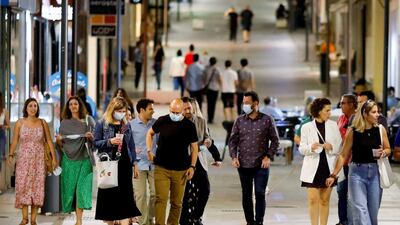
  • Pedestrians with and without masks walk along La Bola, in Ronda, Andalusia, in southern Spain, after the government eased Covid-19 restrictions. Reuters
    Pedestrians with and without masks walk along La Bola, in Ronda, Andalusia, in southern Spain, after the government eased Covid-19 restrictions. Reuters
  • A nurse pushes Covid-19 patient in a wheelchair at Honorio Delgado Hospital in Arequipa, Peru. Due to surge of Delta variant cases, the city is under lockdown. AP Photo
    A nurse pushes Covid-19 patient in a wheelchair at Honorio Delgado Hospital in Arequipa, Peru. Due to surge of Delta variant cases, the city is under lockdown. AP Photo
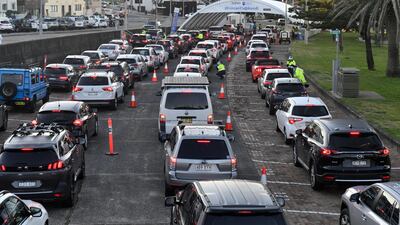
  • Cars queue at a drive-through Covid-19 testing centre at Bondi Beach in Sydney, Australia. Sydney and surrounding areas have gone into lockdown for two weeks following a surge of Delta variant cases. EPA
    Cars queue at a drive-through Covid-19 testing centre at Bondi Beach in Sydney, Australia. Sydney and surrounding areas have gone into lockdown for two weeks following a surge of Delta variant cases. EPA
  • People queue to register for the AstraZeneca Covid-19 coronavirus vaccine in Denpasar, on Indonesia's resort island of Bali. AFP
    People queue to register for the AstraZeneca Covid-19 coronavirus vaccine in Denpasar, on Indonesia's resort island of Bali. AFP
  • A man sits in the observation area after receiving a Covid-19 vaccine at a mobile bus clinic in Los Angeles, California. The US will miss President Joe Biden's goal of delivering at least one coronavirus vaccine dose to 70 percent of adults by the 4th of July holiday. Getty Images
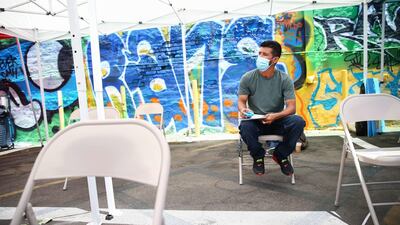
    A man sits in the observation area after receiving a Covid-19 vaccine at a mobile bus clinic in Los Angeles, California. The US will miss President Joe Biden's goal of delivering at least one coronavirus vaccine dose to 70 percent of adults by the 4th of July holiday. Getty Images

The earliest case of Delta Plus was in India from a sample taken on April 5.

The Indian authorities said there have now been 50 cases and three deaths across three states, including Maharashtra, Tamil Nadu and Madhya Pradesh. The cases were found by sequencing 45,000 samples.

As a consequence, India's richest state, Maharashtra, has tightened lockdown restrictions.

The Indian Health Ministry said Delta Plus showed increased transmissibility and advised states to increase testing.

The spread was mostly very localised, said Balram Bhargava, director general of the Indian Council of Medical Research.

However, at least 12 other countries have reported cases of Delta Plus, including the US, UK, Japan, Russia and China, he said.

Portugal's Health Minister Marta Temido, said they had detected 24 cases on June 23.

Britain said its first five cases were sequenced on April 26 and they were contacts of individuals who had travelled from, or transited through, Nepal and Turkey.

Why is Delta Plus a cause for concern?

Studies are taking place to test the effectiveness of India's vaccines against the Delta Plus variant. AFP / Punit PARANJPE

As with all variants, the concern is that they could be more transmissible or more deadly.

Immunologists also worry about vaccines' effectiveness against new variants.

Shahid Jameel, a senior Indian virologist, said K417N was known to reduce the effectiveness of a cocktail of therapeutic monoclonal antibodies, medicines like the newly available Sotrovimab, which help the body fight Covid-19 infections.

Studies are taking place to test the effectiveness of India's vaccines against the Delta Plus variant, including AstraZeneca’s Covishield and Bharat Biotech International's Covaxin.

"We should have the results in about 7 to 10 days' time whether the vaccine is working against the Delta Plus," Mr Bhargava said.

The WHO said it was tracking the variant.

"For the moment, this variant does not seem to be common, currently accounting for only a small fraction of the Delta sequences. Delta and other circulating variants of concern remain a higher public health risk as they have demonstrated increases in transmission," it said.


Pox that threatens the Middle East's native species

Camelpox

Caused by a virus related to the one that causes human smallpox, camelpox typically causes fever, swelling of lymph nodes and skin lesions in camels aged over three, but the animal usually recovers after a month or so. Younger animals may develop a more acute form that causes internal lesions and diarrhoea, and is often fatal, especially when secondary infections result. It is found across the Middle East as well as in parts of Asia, Africa, Russia and India.

Falconpox

Falconpox can cause a variety of types of lesions, which can affect, for example, the eyelids, feet and the areas above and below the beak. It is a problem among captive falcons and is one of many types of avian pox or avipox diseases that together affect dozens of bird species across the world. Among the other forms are pigeonpox, turkeypox, starlingpox and canarypox. Avipox viruses are spread by mosquitoes and direct bird-to-bird contact.

Houbarapox

Houbarapox is, like falconpox, one of the many forms of avipox diseases. It exists in various forms, with a type that causes skin lesions being least likely to result in death. Other forms cause more severe lesions, including internal lesions, and are more likely to kill the bird, often because secondary infections develop. This summer the CVRL reported an outbreak of pox in houbaras after rains in spring led to an increase in mosquito numbers.

F1 drivers' standings

1. Lewis Hamilton, Mercedes 281

2. Sebastian Vettel, Ferrari 247

3. Valtteri Bottas, Mercedes 222

4. Daniel Ricciardo, Red Bull 177

5. Kimi Raikkonen, Ferrari 138

6. Max Verstappen, Red Bull 93

7. Sergio Perez, Force India 86

8. Esteban Ocon, Force India 56

Yahya Al Ghassani's bio

Date of birth: April 18, 1998

Playing position: Winger

Clubs: 2015-2017 – Al Ahli Dubai; March-June 2018 – Paris FC; August – Al Wahda

Dengue%20fever%20symptoms
%3Cul%3E%0A%3Cli%3EHigh%20fever%3C%2Fli%3E%0A%3Cli%3EIntense%20pain%20behind%20your%20eyes%3C%2Fli%3E%0A%3Cli%3ESevere%20headache%3C%2Fli%3E%0A%3Cli%3EMuscle%20and%20joint%20pains%3C%2Fli%3E%0A%3Cli%3ENausea%3C%2Fli%3E%0A%3Cli%3EVomiting%3C%2Fli%3E%0A%3Cli%3ESwollen%20glands%3C%2Fli%3E%0A%3Cli%3ERash%3C%2Fli%3E%0A%3C%2Ful%3E%0A%3Cp%3EIf%20symptoms%20occur%2C%20they%20usually%20last%20for%20two-seven%20days%3C%2Fp%3E%0A
MATCH INFO

Uefa Champions League quarter-final, second leg (first-leg score):

Manchester City (0) v Tottenham Hotspur (1), Wednesday, 11pm UAE

Match is on BeIN Sports

German intelligence warnings
  • 2002: "Hezbollah supporters feared becoming a target of security services because of the effects of [9/11] ... discussions on Hezbollah policy moved from mosques into smaller circles in private homes." Supporters in Germany: 800
  • 2013: "Financial and logistical support from Germany for Hezbollah in Lebanon supports the armed struggle against Israel ... Hezbollah supporters in Germany hold back from actions that would gain publicity." Supporters in Germany: 950
  • 2023: "It must be reckoned with that Hezbollah will continue to plan terrorist actions outside the Middle East against Israel or Israeli interests." Supporters in Germany: 1,250 

Source: Federal Office for the Protection of the Constitution

War 2

Director: Ayan Mukerji

Stars: Hrithik Roshan, NTR, Kiara Advani, Ashutosh Rana

Rating: 2/5

Mercer, the investment consulting arm of US services company Marsh & McLennan, expects its wealth division to at least double its assets under management (AUM) in the Middle East as wealth in the region continues to grow despite economic headwinds, a company official said.

Mercer Wealth, which globally has $160 billion in AUM, plans to boost its AUM in the region to $2-$3bn in the next 2-3 years from the present $1bn, said Yasir AbuShaban, a Dubai-based principal with Mercer Wealth.

Within the next two to three years, we are looking at reaching $2 to $3 billion as a conservative estimate and we do see an opportunity to do so,” said Mr AbuShaban.

Mercer does not directly make investments, but allocates clients’ money they have discretion to, to professional asset managers. They also provide advice to clients.

“We have buying power. We can negotiate on their (client’s) behalf with asset managers to provide them lower fees than they otherwise would have to get on their own,” he added.

Mercer Wealth’s clients include sovereign wealth funds, family offices, and insurance companies among others.

From its office in Dubai, Mercer also looks after Africa, India and Turkey, where they also see opportunity for growth.

Wealth creation in Middle East and Africa (MEA) grew 8.5 per cent to $8.1 trillion last year from $7.5tn in 2015, higher than last year’s global average of 6 per cent and the second-highest growth in a region after Asia-Pacific which grew 9.9 per cent, according to consultancy Boston Consulting Group (BCG). In the region, where wealth grew just 1.9 per cent in 2015 compared with 2014, a pickup in oil prices has helped in wealth generation.

BCG is forecasting MEA wealth will rise to $12tn by 2021, growing at an annual average of 8 per cent.

Drivers of wealth generation in the region will be split evenly between new wealth creation and growth of performance of existing assets, according to BCG.

Another general trend in the region is clients’ looking for a comprehensive approach to investing, according to Mr AbuShaban.

“Institutional investors or some of the families are seeing a slowdown in the available capital they have to invest and in that sense they are looking at optimizing the way they manage their portfolios and making sure they are not investing haphazardly and different parts of their investment are working together,” said Mr AbuShaban.

Some clients also have a higher appetite for risk, given the low interest-rate environment that does not provide enough yield for some institutional investors. These clients are keen to invest in illiquid assets, such as private equity and infrastructure.

“What we have seen is a desire for higher returns in what has been a low-return environment specifically in various fixed income or bonds,” he said.

“In this environment, we have seen a de facto increase in the risk that clients are taking in things like illiquid investments, private equity investments, infrastructure and private debt, those kind of investments were higher illiquidity results in incrementally higher returns.”

The Abu Dhabi Investment Authority, one of the largest sovereign wealth funds, said in its 2016 report that has gradually increased its exposure in direct private equity and private credit transactions, mainly in Asian markets and especially in China and India. The authority’s private equity department focused on structured equities owing to “their defensive characteristics.”