
Leading scientists have joined forces in Abu Dhabi to tackle pressing healthcare problems presented by the Covid-19 outbreak.
Citizen Science is a collective of 20 UAE scientists, researchers and engineers invited to come up with innovative solutions to ease medical pressures exerted by the pandemic.
Led by the Technology Innovation Institute, a research centre in Abu Dhabi, experts will focus on improving access to personal protective equipment, ventilators and rapid testing kits.
“This disease does not discriminate, know boundaries or care about humanity,” said Dr Mohamed Al Teneiji, the Emirati chief research officer.
“We cannot fight it with rhetoric or resolve, we must act.
“Simply, innovating new ways of producing and supplying our frontliners and patients with more efficient medical equipment could be the difference between life and death for many thousands of people.
“Citizen Science has banded together to bring new solutions to the operating table.”
The group has already successfully assembled its first ventilator prototype, which is now undergoing internal tests before being sent for external verification.
Engineers at the TII are using the latest technologies to produce artificial intelligence-powered chest X-ray machines and 3D-printed medical equipment parts.
Other innovations include exploring new ways to sterilise personal protective equipment used in clinics and large public spaces and how to maximise the use of ventilators to treat three patients at a time.
The centre has appealed to all UAE-based businesses, manufacturers, distributors, engineers and the wider scientific community to contribute to the initiative’s mass production ambitions.
Researchers said the donation of equipment, resources, raw materials, knowledge transfer and vital parts can be the difference that turns the tide against an invisible enemy.
Forward-thinking efforts to address medical needs during the pandemic have already been taken across the Emirates.
-

Police officers check vehicles on the empty Ataturk Airport road on the road during 48-hour restrictions imposed to stem the spread of coronavirus in Ankara, Turkey. AFP -
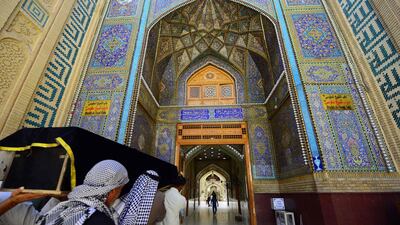
Shiite Muslim men carry a coffin to the Imam Ali Ibn Abi Talib mosque in Iraq's central shrine city of Najaf during a funeral procession, one of the very rare ceremonies still allowed in the city during the coronavirus pandemic. AFP -
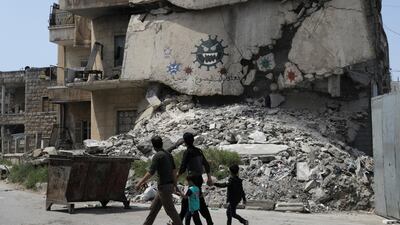
People walk past a damaged building depicting drawings alluding to the coronavirus and encouraging people to stay at home, in the rebel-held Idlib city, Syria. Reuters -

A member of the Kurdish internal security forces stands in the middle of an empty road in the city of Qamishli in Syria's northeastern Hasakeh province a day after local authorities of the Kurdish-dominated northern part of war-torn Syria recorded its first death due to the coronavirus outbreak. AFP -
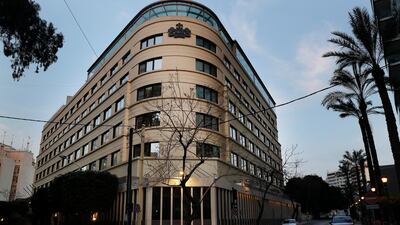
A car drives past Le Bristol hotel in Beirut, Lebanon. One of the country's landmark hotels that has survived the country's bloody 15-year civil war is closing its doors due to a combination of an economic crisis and the global health threat of coronavirus. AP Photo -
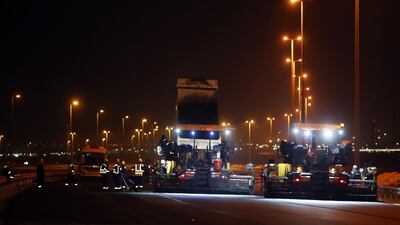
Workers from the Kuwait Ministry of Public Works paves a road near the capital as the Ministry takes the opportunity to repair and repave roads during the curfew hours. AFP -

The empty Galata bridge in Istanbul, as Turkish government announced further restrictions to prevent the spread of coronavirus. AFP -
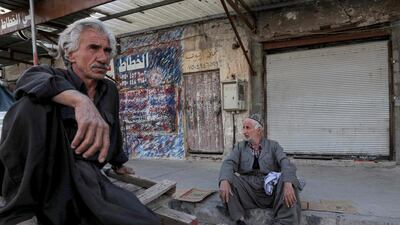
Men sit outside a closed shop along a street in Erbil, the capital of the northern Iraqi Kurdish autonomous region. AFP -
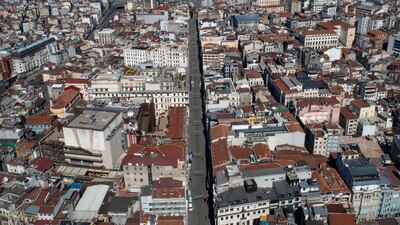
The empty Istiklal street in Istanbul, Turkey. EPA -
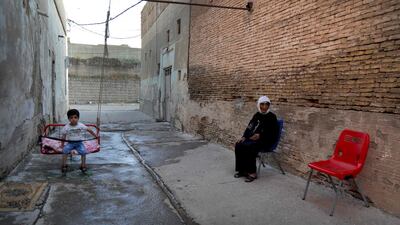
An Iraqi Kurdish woman and her relative outside their home in Erbil, the capital of the northern Iraqi Kurdish autonomous region. AFP -
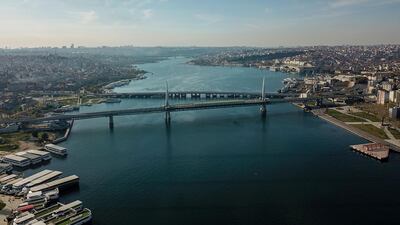
The empty shore side of the Golden Horn, with the Metro bridge in the foreground and Unkapani bridge in the background, in Istanbul. AFP -

A Palestinian groom, Rafeh Qassim, wears a mask as he sits in a car with his bride on their wedding day, in Ramallah in the Israeli-occupied West Bank. Reuters -

A member of the security forces checks his new haircut, provided by a volunteer hairdresser, in the northern Iraqi city of Mosul. AFP -
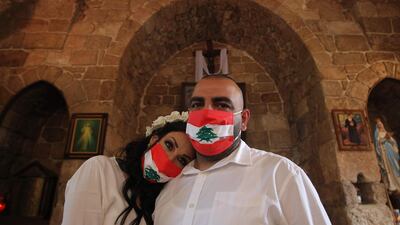
Lebanese bride and groom Joanna and Marc wearing protective masks designed as a national flag, pose for pictures during their wedding cermony attended only by close relatives amid the COVID-19 pandemic, at the Saint Georges church in the Hadath region, east of the capital Beirut. AFP -
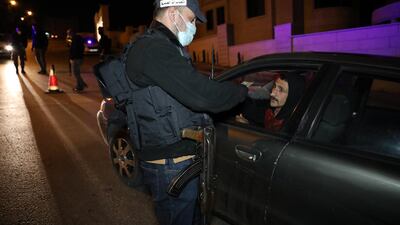
Palestinian security forces in the West Bank city of Hebron. EPA -

Police officers check vehicles on the empty Kizilay Square in Ankara. AFP -
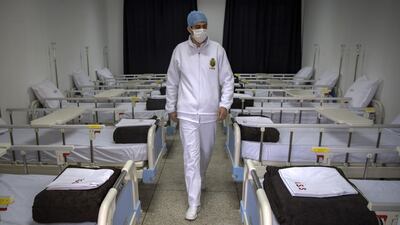
A member of the medical staff at Moroccos's military field hospital in Nouaceur, South of Casablanca, inspects the beds as they prepare to receive patients of the coronavirus pandemic. AFP -

A member of the medical staff at Moroccos's military field hospital in Nouaceur, South of Casablanca, checks a monitor as staff prepared to receive patients of the coronavirus pandemic. AFP -
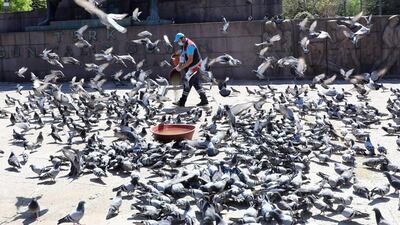
An employee of the Ankara Municipality staff feed pigeons in a park in Ankara. AFP -

A man wearing a compulsory face mask observes his neighborhood from a hill during a health state of emergency and home confinement orders in Rabat, Morocco. AP Photo -
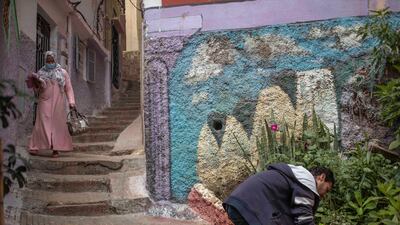
A man paints outside his home while a woman wearing a face mask walks past during a health state of emergency and home confinement order in Rabat, Morocco. AP Photo


While Masdar City-based AES Venture continues to develop its Mondialab Pro blood test device to give health authorities real-time updates on recent diagnoses of coronavirus, other firms are addressing the shortfall in protective equipment.
Factories in Sharjah and Dubai have been used by Immensa Technology Labs as 3D printing production lines for thousands of low-cost face shields to be used in hospitals and by the food industry.
Meanwhile, health authorities in Abu Dhabi have developed a mobile phone app to identify anyone who may have been in contact with somebody who has tested positive for the virus.
TraceCovid uses Bluetooth to pick up phone signals from anyone with the app who has tested positive to ensure the correct quarantine protocols are met to limit the spread of Covid-19.
Citizen Science has listed the critical equipment in demand to aid management of the pandemic across the country.
It includes 3D printers, laser cutters, valves, fans and ultraviolet light sensors.
Insiders said once the UAE need has been fulfilled, any surplus can be exported globally to areas most in need of supplies.
“At this unprecedented time, we are here to act and provide collectively for those who are giving everything for us,” Dr Al Teneiji said.
“We must all be able to look back at this phase of human history and say without doubt that we did everything we could.”

